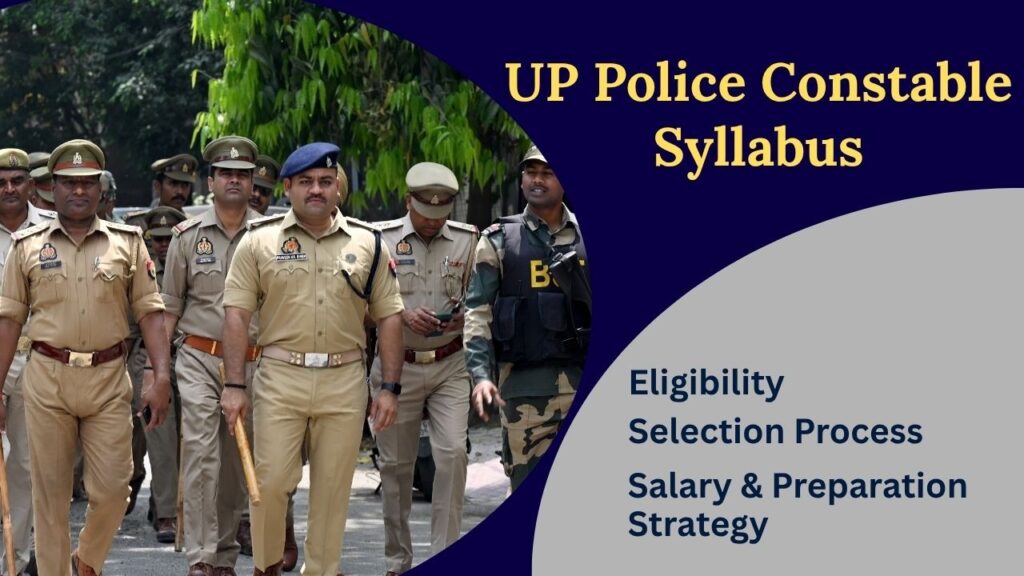
UP Police Constable Syllabus, Salary & Preparation Strategy 

UP Police Constable Syllabus

Getting a government job in India isn’t a cakewalk, and UP Police Constable exam is no exception to it. Every year, thousands of applicants vie for handful vacancies, which is making it one of the popular and toughest exams in the state. With a right approach toward UP Police Constable syllabus, and with persistent preparation, this target is of course achievable. 

If you want to put on the khaki with pride or if you want a stable career with good salary and benefits, this exam could be your ticket. But these benefits asked you to work harder and get it. This breakdown—eligibility, selection process, syllabus, salary, and a practical preparation plan of UP Police Constable will help you plan to crack this exam.

Eligibility Requirement For UP Police Constable

You need to check eligibility requirements before buying books for studying UP Police Constable syllabus and doing push ups. UPPRPB is recruiting candidates for this post under strict guidelines. So you must follow before applying: 

Educational Qualification 

No fancy degrees are required for a UP Police Constable. Candidates must acquire 12th standard (Intermediate) marksheet from any recognized board in India. 

Age Limit 

Male Candidates (General) 18 to 25 years 
Female Candidates (General) 18 to 28 years 

Reserved category candidates can get age relaxation but you must check the latest recruitment official notification to know age relaxation. 

Physical Standards (PST) 

CategoryUR/OBC/SCST
Height for Males168 cm160 cm
Chest for Males79–84 cm77–82 cm
Height for Females152 cm147 cm
Weight for FemalesMinimum 40 kgMinimum 40 kg

UPPRPB Selection Process For UP Police Constable

It’s not just one written exam here, you must pass all the stages to reach that position. It requires commitment and hard work for securing an honourable government job for the nation.

Stage 1: The Written Examination

It’s a written offline OMR-based exam. Candidates have to get above the cut off marks by answering all the MCQs accurately then you move on to the physical rounds. Questions come from the four main subjects (GK, Hindi, Mathematics, Reasoning).

Stage 2: Verify Docs And Physical Standard Test (PST)

Once you qualify stage 1 with preparation and hard work, you need to provide documents– 10th/12th mark sheets, caste certificates, domicile papers for verification. And your body measurements like height, weight and chest (men) will be taken to pass you on to the next stage of selection.

Stage 3: Physical Efficiency Test (PET)

PET is a mandatory exam for candidates without getting marks. This final round can throw you out of the list if you fail. 

  • Running for a 4.8 km run in 25 minutes is a mandatory test for male candidates. 
  • If you are a woman then you must be able to run 2.4 km in 14 minutes.

Stage 4: Detailed Medical Examination (DME)

Physical and mental health matters for this job, it has regulations if you have weak eyesight, color blindness, hearing, flat feet, knock knees. 

UP Police Constable Syllabus Breakdown

The written test contains 150 questions which is of 300 marks (2 marks per question). But be careful, there’s negative marking!  

The written exam is divided into four main subjects which you can qualify with right preparation on the syllabus.

I. General Knowledge (38 Questions)

Knowing about the world revolves around you, especially Uttar Pradesh is necessary. GK tests you based on the questions based on national and international current affairs, History/Civics, Geography, Science and Finance of India.

II. General Hindi (37 Questions)

If you attended a Hindi-medium school, this is your section to score. Even if you didn’t, you can get good marks by doing some basic grammar practice. Focus on Hindi Grammar (Vyakaran) , Unseen Passage, Famous writers & their work, Synonyms, Antonyms, Idioms and Phrases (Muhavare). 

III. Numerical and Mental Ability (38 Questions)

Question comes from basic mathematics of 9th and 10th, if you are good at maths then practice daily on Number systems, Percentages, Profit & Loss, Ratio and Proportion, Simple & Compound Interest, Time, Work & Distance, Mensuration and Data Interpretation (Tables and Graphs). 

IV. Mental Aptitude, IQ & Reasoning Ability (37 Questions)

This part examines your mind and thinking ability, and also tells you how you could potentially think in police work situations. Coding-decoding, Series, Blood Relation, Direction Sense, Syllogism, Venn Diagram, Non-Verbal (Pattern and Figure). There will also be situation based questions to test your attitude towards public interest, laws and order, communal harmony and police force. 

How to Prepare For A Police Constable

Avoid beginning to study with difficult mock tests. Instead, strengthen your foundation with standard books like Lucent GK, R.S. Aggarwal (Math & Reasoning) and a good hindi grammar book.

Keep practicing last year’s question papers. They give you a clear idea about the exam level and the types of questions that are asked. UPPRPB also has a penchant for posing questions similar (even a same question sometimes) to what they had already asked. 

Once you have completed about 60-70% of the syllabus, begin attempting full-length mock tests. Use a timer when you practice so you can work on your speed and accuracy. Check your mistakes to correct them each day. 

Don’t neglect physical fitness. Most candidates qualify the written exam but they are unable to clear the 4.8 km run. Something as simple as a 30-minute jog each day will smoke out your stale lungs and build your stamina. 

So, for the present events keep it simple. Just subscribe to a good monthly magazine (eg. the Economist) or a decent Youtube channel and don’t bother with the dailies. 

Salary and Perks After Getting a Job

UP Police pays its constables quite a good salary with additional perks that makes it worth the struggle to secure a position.

CategoryAmount
Pay ScaleRs. 5,200 – 20,200
Grade PayRs. 2,000
Basic Pay MatrixRs. 21,700

Under the 7th Pay Commission, the salary is distributed but other allowances also given to the constable which sum up to Rs. 27,000 to Rs. 32,000 per month.

  • Dearness Allowance (DA)
  • House Rent Allowance (HRA)
  • Travel Allowance (TA) & City Compensatory Allowance.
  • Ration Money & Uniform Allowance

Career Growth & Promotions 

A government job is not just a job, it is a career for a lifetime. Joining as a Constable does not imply that you will retire with that rank. The UP Police is providing a transparent path for promotions along the years of services, departmental exams and your performance record. 

  1. Police Constable (Your starting point)
  2. Senior Constable
  3. Head Constable
  4. Assistant Sub-Inspector (ASI)
  5. Sub-Inspector (SI)
  6. Inspector

If you have the ambition, you can appear for departmental exams for Sub-Inspector which will speed up your promotion rather than waiting wholly on seniority. An honest and sincere police officer can easily get retired as Inspector and in some rare cases even as DSP (Deputy Superintendent of Police) from the post of Constable with the blessing of the Almighty. 

Read More:-  Banking Job vs SSC Job: Details On The Top Government Jobs 

Conclusion

Passing the UP Police Constable exam is a challenge for mind and body. It needs a balanced approach, practicing math and checking daily news then getting up to run on the track. 

Focus on UP Police Constable Syllabus and your health to secure your position. The large number of applicants is not to be discouraging. You just need to prepare yourself for one seat.

The salary and additional perks are good with lifetime growth opportunities in the department, so there’s a golden door, you just need to jump long.


Leave a Comment

Your email address will not be published. Required fields are marked *

HR Professional Courses: Get Complete Guide on Career Path, Salary & Growth

HR Professional Courses

If you’re curious about what it takes to be a Human Resources (HR) professional, you’re in the right place. Over the past 10 years, the HR Professional Courses has undergone significant transformation, shifting away from an administrative role to gaining importance and recognition as a strategic business partner in organizational culture, employee satisfaction and business performance. This all-in-one resource will take you through the Need to Knows of building a fulfilling HR career in India, whether you are a fresher exploring career options or a career changer seeking a meaningful direction. 

What Does an HR Professional Actually Do?

Before we get into courses and salaries, let’s demystify the day-to-day life of a HR professional. Despite the stereotype that human resources is just paperwork and policies, HR employees today wear many hats. You will participate in strategic talent acquisition to seek and recruit candidates aligned with company values and who will drive growth. You’ll design and deliver programs to upskill the employees, mentor junior staff, and help them grow their career within the company. 

On the compliance and policy side, you will be monitoring the company’s compliance with labour laws, conducting employee relations with tact, mediating disputes equitably and managing the full spectrum of employee life from hiring to offboarding. Compensation and benefits policies are your domain too: You develop the strategies, coordinate the performance reviews, and you can even assist with organizational development by working with your leaders on future staffing and succession planning. In today’s world of data and analytics, many HR professionals are also utilizing analytics to monitor indicators such as employee engagement, retention rates and hiring effectiveness to drive additional business improvements. 

The joy of human resources is that each day is different, with issues ranging from handling a difficult employee complaint to developing a creative new-hire program or spearheading an organization-wide change effort. 

Educational Roadmap To Become HR Professional

HR career paths

The great thing about HR career paths is that there is no single “correct” path. To your education and current level of career aspirations, you can add several points of entry: 

After 12th Grade

If you have completed the high school you can go for the Diploma in Human Resource Management. These 1-3 year courses are available at a cost of Rs 50,000 to Rs 2,00,000 according to the classification of institution as a government or a private one. Alternatively, you can do 3 years of Bachelor’s degree (BBA, BA, BS) in HR or something related. Government College fee is goes from ₹1-8.5 lakhs and for private college fee is from ₹3-16.25 lakhs.The eligibility criterion is generally 50-60% in 12th class. 

For Graduates

If you already hold a bachelor’s degree (in any stream as per your undergraduate major), you can go forward for professional certificates or a post graduate diploma. A professional certificate of 6-12 months costs between ₹20,000 and ₹1,00,000, while a post graduate diploma for 1-2 years is valued at ₹50,000-₹1,20,000. These courses are great if you want to make a move into HR for then a full 2 year MBA. 

MBA / PGDM Route

If you are looking for an overall business education with focus on HR, a 2 year MBA or PGDM in Human Resources fees vary from ₹ 2-27 lakhs based on the tier of the college and the location. These programs on the repel need entrance exams as CAT, SNAP, MAT, or XAT. Top tier institutions such as IIM, XLRI have higher fee yet provide excellent placement package and networking. 

Professional Certifications

Professional certification is also valuable in addition to formal education. The popular certification include CHRG (Certified Human Resource Generalist) which has fees of ₹50,000-₹2, 00,000.

The CHRM (Certificate in Human Resource Management) is priced at ₹90,000-₹8,00,000 and the CHRP (Certified Human Resource Professional) costs ₹80,000-₹4, 00,000.Two globally-oriented credentials that also have value on an international basis are the SHRM-CP (Society for Human Resource Management Certified Professional) and the aPHR (Associate Professional in Human Resources) both of which are recognized by employers in many countries around the world.   

Eligibility Requirements You Need to Know

  • For Diploma Courses: You need to pass 12th grade exam with minimum 45% in aggregate.
  • ​For Bachelor’s Degrees: Obtain 50-60% in 12 grade; some colleges require entrance exams.
  • ​For M.B.A. Directly after 10+2: Achieved a minimum of 60% in your 12th grade exams; passed entrance exams such as CAT, MAT, SNAP, or XAT.
  • ​HR-Related Certifications: Many certifications such as SHRM-CP have prerequisites of at least 3 years of HR work experience in an HR function, whereas entry-level aPHR caters to HR novices or individuals beginning their journey in HR. 

Starting Salary For HR

Entry level HR professionals in India get a good pay as per market standard. An HR fresher gets a salary in the range of ₹15,000-₹30,000 per month, which comes around ₹3-5 LPA per annum. However, this might differ drastically depending on a few things such as: 

  • By Role: HR recruiters and coordinators normally begin with salaries of ₹18,000–₹26,000 per month and HR analysts with good technical skills can make ₹25,000–₹35,000 per month from the very start.
  • By Education: Tier-1 MBA (HR) pass-outs have high salary prospects of ₹30,000–₹40,000 per month and BBA or BA grad can make ₹18,000–₹25,000 per month.
  • By Industry: It is not always that an HR company gives you a chance but you can get IT, finance and e-commerce industries offer for an HR with starting pay of ₹28, 000 to ₹35, 000. 
  • By Location: Metrocities like Bengaluru and Delhi offer great pay to HR Professionals.  

Career Growth

Indian HR salaries have increased 24% from 2019, this is higher compared to IT sector’s 6.5% CAGR. This signals the rising level of strategic importance that HR has in organizations. 

Indian HR salaries

Career Progression Timeline

Start as an HR Assistant or Coordinator (0-2 years), then advance to HR Generalist or Specialist (2-10 years) in areas such as L&D Manager or Recruiter, then go to HR Manager or HR Business Partner (5-10 years) and subsequently to executive positions which include Director, Head of HR, or CHRO (10+ years).   

Salary Growth by Experience

A fresher can typically expect a starting salary of ₹3–5 LPA. As you gain more experience, this can be anywhere from ₹11-15 LPA at HR Manager level, ₹20-25 LPA in senior specialist roles and anywhere between ₹40-150+ LPA for CHRO of a large company. The steepest rise in salary is generally seen between 10 to 13 years of experience- whereby the median CTC varies around ₹38 LPA.   

Emerging High-Growth Specializations

For maximum growth, strategic HR roles are the way to go. HR Analytics Managers earn ₹40-60 LPA, Salary & Benefits Managers earn ₹28-42 LPA, and Diversity & Inclusion Managers earn close to ₹20 LPA. These positions are growing at 15-22% per year because they have a direct effect on business results. 

Conclusion

The Job growth of approximately 7% over the next ten years will add about 17,400 new jobs and is expected for the HR occupation. Instead of being automated out of existence like some admin jobs, strategic HR roles are increasingly precious. You get to work with people, solve truly complex organizational issues, shape company culture, and have a tangible impact on whether employees are happy at work.

​”The investment, be it ₹50,000 for a diploma or ₹20 lakhs for an MBA, gets returned fast in the form of a competitive pay package and strong career growth. More than who you’re working for, it is the work, financial and personal fulfilment you are creating.

First, decide on the HR professional Courses that best matches your current qualifications and your career timeline, learn core HR skills to get started, and don’t overlook the impact certifications can have in helping you stand out. 

Leave a Comment

Your email address will not be published. Required fields are marked *

Bihar ITI CAT Admission Form 2026: Apply Online, Dates, Eligibility, Fees

Bihar ITI CAT 

If you are reading this, you are probably a student who has passed out his schooling or a parent who wants to get some tips to take admission of his child in best ITI in Bihar. Its very normal to be stress about admission procedures, and you are not at all the only one having that feeling. This is the high time to apply for Bihar ITI CAT Admission Form 2026. Hundreds of students, every year, lost out on good opportunities due to getting confused with the process or missing on key deadlines.

This is the perfect guide for you to get answers to all your questions related to Bihar ITI CAT Admission Form 2026. So, after reading this information, you will be able to learn how to apply in an easy manner without any hurdles. 

What is Bihar ITI CAT?

Before we get into the forms and deadlines, let’s clear up exactly what we’re talking about. ITI – Industrial Training Institute: ITI is a training center formed under industrial training act which is best option after 10th. These are not random classes; they are designed to get you a job as soon as you finish. 

CAT here means Common Admission Test. Unlike in certain states, where the admissions are given on the marks of board exams, a proper entrance exam was conducted by Bihar to make the seats in the best colleges available to deserving candidates. Consider it a level playing field, where preparation counts more than who you know. 

The whole process is being handled by Bihar Combined Entrance Competitive Examination Board (BCECEB). Yes, That is the same board which takes various other professional course admission in the state. They are the ones who will issue the form, take the exam, and then assign you to an ITI based on your rank and what you have indicated as your preferences. 

When Should You Check the Notification?

Most people are wrong at this point because they have waited too long. Based on the trends of the past years, the Bihar ITI CAT 2026 notification is expected to be released in the month of February/ March of that year. Around three to four weeks will elapse during the registration process.

Get your paperwork in order, know the qualifications requirements, and maybe even brush up on your basic arithmetic and general info. The early bird gets a special ITI and a trade in the worm! 

Who Can Actually Apply?

You must know the requirements for the admission before filling out the Bihar ITI CAT Admission Form 2026. Students who passed 10th with a good score from a recognized board can take the admission. Good trades and government ITI’s except for a 10th certificate, some trades may take in class 8th pass students.

As a general rule, you should be at least 14 years old in the year of admission. There is usually an upper age limit of approximately 40 years, which makes the courses relatively accessible for older students hoping to reskill themselves – a really thoughtful touch, if you ask me. 

In the admission, domicile is important. Preference will be given to residents of the state in Bihar ITI admissions. If you are a resident of Bihar you have to show your domicile certifícate. If you are from outside, see if there are any all-India quota seats since, strictly speaking, your options may be limited by the Bihar natives. 

The Actual Form-Filling Process: Step by Step

Step 1: Registration

BCECEB is an official website which will provide you with the application portal, so visit the site to register by clicking on the ITI CAT 2026 link. 

Step 2: Fill in Your Details

Enter your personal, educational and contact details meticulously. A minor spelling error may lead to inconvenience at a later stage of verification of documents, so review well before you proceed. 

Step 3: Upload Documents

After that, you need to upload the evidence of your application. Sign, Photo, Marksheet, and certificates (caste and domicile) are needed.

Step 4: Application Fee

Pay the requisite amount (₹500 or ₹1000) for this application through UPI, Credit Card, Debit Card or Net Banking. 

Step 5: Final Submission and Print

Check everything for the last time. Apply. At least two copies of your confirmation page should be printed. One copy for your records, another for good luck (and a third because you’ll want it later). 

After the Form: What Comes Next?

Filling the form is just the starting of the whole procedure. The admit card is issued a few weeks before the exam — download it immediately and verify all the details. The exam generally comprises objective questions from your general awareness, basic maths and possibly some aptitude relating to your trade.

Then the results come out and there’s a counseling process at which you choose your preferred ITIs and trades according to your rank. So this is very very important – check out the ITIs beforehand. Some have good infrastructure, some have good placement records, and in some trades more jobs are available than the others. Just don’t pick because you’re exhausted by the process. 

Common Mistakes to Avoid

I’ve seen smart people make this mistake over really dumb things. So, stop waiting for the last minute and apply as soon as possible. 

Don’t forge documents — Bihar’s verification process is strict and getting caught means you will be banned from writing any more exams. Don’t trust the random videos on Youtube or WhatsApp forwards —always verify the information. 

Read More:- UPTET Online Form 2026: Eligibility, Timeline and Other Details

Bihar ITI CAT Admission Form 2026 is a Golden Opportunity

ITI training can really transform where your life goes. In a state like Bihar where the government jobs are minimum and private sector companies demand relocation to metros, an ITI certificate gives you portable skills. There are jobs in Bihar and you can also move to other states or even to foreign lands, the demand for skilled tradesmen is universal.

The Bihar ITI CAT 2026 Application Form is not just another form that you have to fill out to get to your next step. It’s your portal to hands-on training for real jobs. Take it seriously, but don’t be afraid of the process. 

Conclusion

If you’re thinking about whether to go to a college or an ITI, then both are good options. You don’t have to be a doctor or an engineer to make it. Apply early and carefully to take a chance for making a better life ahead of you. Everything is here that is needed to know but still all students must check the latest updates and notification of the procedure about the Bihar ITI CAT Admission Form 2026 for admission.

Leave a Comment

Your email address will not be published. Required fields are marked *

Railway RRB ALP Admit Card 2026: Download Now From Direct Link

Railway RRB ALP Admit Card 2026

The Railway RRB ALP Admit Card 2026 for the CBT 1 is live on the official website for the candidates who have applied for the post can now download the admit card from below and appear for the exam to get a dream job in the Indian Railways. Upon its schedule from 13 February 2026, the admit card is the official ticket telling off that you are going to the exam hall. 

If you have been studying for this exam for months, it’s time to calm down, stay focused, and get organized. Download your hall ticket well in advance and check all the particulars in it thoroughly and also make arrangements to link your transport to the examination centre. 

Now, with a total of 9,970 ALP vacancies to be filled and lakhs of candidates competing for them, every little step now matters — and it all begins with your hall ticket. 

Quick Exam Schedule Guide

StageDetailsTimeline/Status
CBT 1 ExamHeld RRB-wise for 9,970 total vacancies16—-18/February/2026 
CBT 1 Admit CardsReleased online via regional RRB sitesOut since Feb 9, 2026
CBT 1 ResultsMerit lists prepared with normalization for multi-shiftsExpected 2-3 weeks post-exams
CBT 2 ShortlistingAround 150,000 total candidates shortlistedBased on CBT 1 merit
CBT 2 City SlipAdvance info on exam city3-4 days before CBT 2 (pattern-based)
CBT 2 Admit CardDownload from regional sites3-4 days before test date
CBT 2 TentativePer RRB Calendar 2026March—April/2026

Railway RRB ALP Admit Card 2026 Release Update

The Railway RRB ALP Admit Card 2026 has been released on 09th February 2026 on all the regional websites of Railway RRB. This is in regard to the Computer Based Test (CBT 1) to be held on 13, 16, 17 and 18 February. There are no hard copies to be sent—it’s all online, so don’t wait till the last moment. Thousands of aspirants registered for a total of 9,970 vacancies, so this was a golden chance in Indian Railways. 

Read More 👉 BSc Radiology and Imaging Technology: Course, Eligibility, Fees & Career

Step-by-Step Download Guide

The process of downloading is simple, just make sure you follow the steps properly to avoid bugs:

  1. Go to your regional RRB site (like rrbcdg.gov.in for Chandigarh, rrbapply.gov.in for Hyderabad) or the consolidated link at rrb.digialm.com.
  2. Click on the ”RRB ALP CBT 1 exam admit card 2026″ link.
  3. Fill in the Registration Number/User ID and Password/Date of Birth.
  4. Hit “Submit” or “Login,” and your hall ticket will pop up.
  5. Check the details, download the PDF and take 2-3 printouts. Save your backups!

Pro tip : If you panic, forget your password, just click on “Forgot Password” right there. Test Your Login Early to Avoid Getting Clogged Up on Exam Eve. Test your login early to dodge any server rush issues on exam eve. 

What’s Inside Your Admit Card

DetailWhy It Matters
Candidate’s NameConfirms identity
Roll/Registration No.For entry and verification
Photo & SignatureMust match your ID
Exam Date & ShiftNote reporting time (usually 1-2 hrs early)
Centre AddressPlan your travel now
Duration & InstructionsCBT 1 is 60 mins, 75 questions
CEN No. (01/2025)Links to your application

Documents to Carry in Exam 

Remember to carry these following document as it is get you enter the examination hall:

  1. Bring a hard copy of your admit card and a recent passport size photograph. 
  2. a valid original photo ID for verification.
  3. Black or blue ballpoint pen.

Please note:

  • Accessories, bags, and eatables are strictly prohibited in the examination centre.
  • The gate will be shut prior to 8-9 AM, even if you have a late shift.
  • Further stages after CBT 1 are: CBT 2, CBAT, document verification (DV), and medical examination. 

Exam Pattern

PartSubjectsQuestionsMarksDurationNotes
AMathematics, Logic & Reasoning, General Science 10010090 minsQualifying cut-offs: 40% must secure by UR/EWS category candidates/ above 30% for OBC/SC/ 25% for ST 
BRelevant Trade (qualifying only)757560 minsMust pass Part B to proceed
Useful Links
Download Admit CardClick Here
LoginClick Here
Official WebsiteClick Here

Leave a Comment

Your email address will not be published. Required fields are marked *

DSSSB MTS Recruitment 2026: Apply Online for Multi-Tasking Staff Posts

DSSSB MTS Recruitment 2026

DSSSB MTS Recruitment 2026: The Delhi Subordinate Services Selection Board (DSSSB) has released the Notification for the Recruitment of Multi Tasking Staff (MTS) vacancies for the Year 2026. There are 714 posts in all. The application form submission will start from 17th December, 2025 and will end on 15th January, 2026. Eligible and interested candidates may apply online from the official DSSSB website. Candidates can check the detailed notification for eligibility criteria, application fee, age limit, salary, selection procedure, etc. 

Follow the link to download the detailed notification and to apply. Hope you apply if you qualify. Information regarding eligibility criteria, application fee, age limit, salary and selection process is provided in the notification. Make sure you have gone through the official notification before you apply. 

Details of DSSSB MTS Recruitment at a Glance

OrganizationDelhi Subordinate Services Selection Board
PostMulti Tasking Staff
Vacancy 714 
Min Age to apply18 years
Max Age to apply27 years
Salary Lie Between ₹18,000 to ₹56,900/- Per Month
Official WebsiteClick Here

Dates To Remember For Application Process

EventDate
Notification Date11/December/2025
Application Start17/December/2025 
Last Date Apply Online15/January/2026 
Last Date Fee Payment15/January/2026 
Correction DateAs Per Schedule 
Admit CardUpdate Soon 
Exam DateUpdate Soon 

Read More:- SSC Exam Calendar 2026–27: Complete SSC Exam Schedule

Follow These Steps To Apply 

DSSSB MTS Notification 2026 has been published on 30 September 2025 for 5159 vacancies. of MTS has been released on 17/December/2025. 

To Apply Online for Multi Tasking Staff, Follow These Steps:

1. Observe the DSSSB MTS Notification 2026 PDF for complete details.

2. Go to the Official site at dsssb.delhi.gov.in or click below to Apply Online.

3. Fill in the DSSSB MTS Online Application Form 2026 with the necessary details.

4. Upload the required files to prove your claimed information.

5. Submit the requisite fee via the mode of payment mentioned.

6. Print a copy of your application form after you have submitted it.

If you’d like, you can also check out reasoning ability practice tests’, exam preparation courses’, and time management techniques’ for more help. 

Useful Links
Apply NowClick Here
Download NotificationClick Here
Official WebsiteClick Here

Leave a Comment

Your email address will not be published. Required fields are marked *

BSc Dialysis Technology: Course Details, Eligibility, Salary & Career Scope

BSc Dialysis Technology

BSc Dialysis Technology course is recognized a professional course under the regimen of which the students are prepared and polished to serve in the field of renal care and dialysis. The course duration is 3 to 4 years and is a mix of theoretical concepts as well as practical training. Subjects studied include anatomy, physiology, renal pathology, dialysis techniques, biochemistry and pharmacology. Also, patient care management is stressed so that graduates will be able to function at a high level in clinical environments, such as hospitals and dialysis centers. 

Eligibility and Admission

Requirements for the Admission in BSc Dialysis Technology courses are the possession of higher secondary education with a science background. Some colleges may also demand entrance tests and/or interviews as a part of the application process. Here is the full breakdown of Eligibility for Bsc Dialysis Technology:

Educational Background:

Candidates are generally expected to have passed their 10+2 or an equivalent higher secondary education examination with science stream (with the subjects of Physics, Chemistry, and Biology (PCB)) from a recognized board.45% to 60% in aggregate in these subjects is required by most institutions coming with variations as per applicant category i.e. general,sc/st or obc. 

Entrance Exams:

BSc Dialysis Technology programs entrance examination may differ from one college to another, however, many colleges conduct B.Sc in dialysis technician examination for admission, to check the candidate’s knowledge and comprehension of basic scientific concepts related to the field of dialysis-tech. So, they accept admissions through their merit scores. 

The mentioned premier institutions including JIPMER, SGPGI and Jamia Hamdard have started admitting students on the basis of entrance exams like NEET, CUET, KCET (Karnataka Common Entrance Test), KEAM (Kerala Engineering Architecture Medical)

But most of the colleges accept students on their 10+2 scores with subjects including physics, chemistry and biology or mathematics.

Admission Process

Check the colleges that offer BSc Dialysis Technology courses then visit their official website to enroll yourself. 

  • The admission portal opens for a short period of time, mostly in April and March. Students need to apply with supportive documents which includes marksheets and certificates of qualifications. Please fill the application carefully while applying for admission.
  • If there is any entrance exam required during the admission then the notification will be released for the examination, you must check carefully.
  • Some programs may also require an interview after the entrance exam to determine if the candidate is truly interested and if he or she would be a good fit for the field of dialysis technology. 
  • Institutions generally prepare a merit list considering aggregate performance in the written-test, interview (if applicable) and the qualifying examination which is used for offering the admission to the applicants. 

BSc Dialysis Technology Syllabus Details

The educational content of the BSc Dialysis Technology syllabus is designed to be comprehensive for developing required skills in students to carry out dialysis procedures and patient care. The course duration is 3 years which may extend to 4 years including internships and practice-based activities. Important topics are:

  1. You’re going to learn the human body’s systems, mainly the renal system, so you know how dialysis works on your body.
  2. Renal Pathology: How the kidneys work, what goes wrong in the different kinds of kidney illnesses.
  3. Understanding Different Dialysis Modalities: Obtain specialized knowledge about various dialysis modalities, including hemodialysis and peritoneal dialysis, such as machine operation, procedures, and patient care during treatment.
  4. Biochemistry Metabolic alterations in patients with kidney diseases and the contribution of dialysis to these biochemical alterations.
  5. Pharmacology Medications used in renal care: Drug interactions and patient safety during dialysis.

The objective of the syllabus is to make the student well versed with the theoretical and practical aspects of the dialysis technology profession. 

Practical Training

Besides the core subjects the curriculum also includes practical modules, which enable the students to become familiar with the real work situation. This training is frequently conducted in the following settings:

  • Clinical Rotations: Students complete clinical rotations in hospitals or in specialized dialysis centers, offering hands-on experience with the dialysis processes and patient care procedures.
  • Simulation Labs: Numerous programs include simulation training to train students in a simulated environment prior to working with real patients. 

Elective Modules

In some universities, optional courses are available where students can develop their knowledge in particular fields, as:  

  • Nutritional Support in Renal Disease: This study unit focuses on the dietary management of renal patients, including those receiving dialysis.
  • Advanced Renal Nursing (Beginners) Suitable for residents who wish to further their nursing knowledge in renal care.
  • Investigations in Dialysis Technology: This section considers new developments and breakthroughs in the renal procedure. 

Assessment Methods

The syllabus often involves different methods of assessment including the following:

Written examinations: To test knowledge of theoretical subject areas.

Practical tests: At clinical rotations or labs, you will undergo testing.

Projects: To promote research and investigation on particular subjects in the field of dialysis technology. 

Skills Acquired in BSc Dialysis Technology

Dialysis Technicians are an important part of the healthcare team, especially in caring for patients with kidney disease that must undergo dialysis. What they need to learn are technical skills as well as interpersonal skills. 

Dialysis technicians require a suitable combination of technical skills and people skills. Technically, they have to operate dialysis machines, watch patient vital signs, handle vascular access and interpret lab results to deliver safe and efficient care. 

They must also be empathetic and possess the ability and skills to communicate with patients, attend to emergencies and work with medical teams. They serve an educational role, as well, teaching patients about treatment, lifestyle and managing illness, so patients can become active participants in their care. 

Career Opportunities & Future Scope

Dialysis technicians are a subset of technologists, who work with the machines located at a dialysis center, the dialysis machine. Indraprastha Apollo Hospitals (New Delhi), Fortis Memorial Research Institute (Gurgaon) and Max Hospital (Several locations) are among the best employers, offering vacancies for patient care technicians and clinical managers.

Hospitals: Dialysis Technicians may work in a hospital setting, providing care to patients who require dialysis. These specialized technicians are essential to deliver safe and effective treatment. 

Travel Placement: Something a few travel dialysis tech are able to do, is to work on a travel basis at various locations. Companies like Nephro Plus help these travel positions, typically with great pay and benefits.

Home Dialysis: Or in some cases, technicians work in the home care arena. Companies like DCDC Kidney Care aiding patients that dialyze in their own homes. They assist with instructions and follow-up care, monitoring that patients operate their equipment safely. 

Some of the top global Dialysis Hospitals and Companies that offer first class patient care, not only this but they hire in a massive figure from India too. So, students can also apply outside of India. There are few top Dialysis centers including AMN Healthcare, Aya Healthcare, Cross Country Healthcare etc.

Career Advancement

Specialization: Dialysis technicians may further specialize, and become a certified dialysis technician (CDT). This certification could improve employment opportunities and generally results in higher salaries and more advanced positions.

Additional Education: Further education, such as an associate’s degree in nursing or supplemental certifications in nephrology, may qualify you for more advanced positions as registered nurse roles.

Management Opportunities: Senior technicians or lead in-centre technicians frequently go on to management, they may manage teams, manage patient care provision, and day-to-day logistics of dialysis clinics – center operations management. 

Read More 👉 RRB ALP Admit Card 2026 Released: Download CBT-1 Hall Ticket Now

Dialysis Technician Salary Expectations

Dialysis technician salaries may be different according to various factors like the location, the experience, and the nature of the organization they work in.

Dialysis Technicians in India make about ₹2,00,000 to ₹4,00,000 a year. Our the ceiling is 5,00,000 which is not unrealistic for a technician with 8+ years of experience.

It is normal for people living in or around the cities of Delhi, Chennai etc to have a higher demand for health care. A skilled technician can make between ₹4,00,000 and ₹6,00,000 annually in these regions.

Also, earning specialized training – such as hemodialysis or peritoneal dialysis certification, salaries can also go up. They may earn the opportunity to further increase their income. 

In the US, the average dialysis technician salary is $25 per hour which is about $51,316 per year. For example, in California, the wage per hour for a dialysis technician is about $26.47

Conclusion

BSc Dialysis Technology is tailor made for Students who are aspiring to be a Backbone of Renal Healthcare Sector. This combination of theoretical and practical knowledge enables the graduate to confidently perform advanced procedures such as dialysis, patient care and clinical work. 

Due to the increasing number of patients suffering from kidney disorders in India as well as all over the world, the opportunity for trained Dialysis Technicians is also increasing. From hospitals and dialysis units to home-care agencies and world health services, job prospects are varied—and growing. 

For students seeking a secure, respected and impactful healthcare career with immense potential for growth, BSc Dialysis Technology is a winning choice that will not just help them reach their professional goals, but also provide them the satisfaction of being able to make a real difference to the lives of patients. 

Leave a Comment

Your email address will not be published. Required fields are marked *

Scroll to Top