The RRB Station Master Exam 2026–27 is an important opportunity for candidates preparing for Railway Recruitment Board (RRB) examinations. Candidates should understand the latest RRB Station Master syllabus, exam pattern, selection process, and question format before starting their preparation.
To help candidates prepare effectively, we have provided an RRB Station Master Mock Test 2026–27 featuring 100 multiple-choice questions based on the prescribed syllabus. This practice paper covers Basic Science and Mathematics, Data Analysis and Interpretation, Logical Capability, and Mental Reasoning.
Candidates can attempt the questions, check the answer key, and evaluate their preparation through the practice test.
RRB Station Master Exam Pattern 2026–27
Before attempting the RRB Station Master online mock test, candidates should understand the examination structure.
Subject
Questions
Marks
Basic Science, Mathematical and Analytical Capability
60
60
Logical Capability
20
20
Mental Reasoning
20
20
Total
100
100
Total Questions: 100
Total Marks: 100
Exam Duration: 120 Minutes
Question Type: Multiple Choice Questions (MCQs)
Negative Marking: 1/3 mark for each incorrect answer
Note: Refer to the applicable official RRB notification for the final examination rules.
How to Prepare for RRB Station Master Exam 2026–27?
Candidates should follow a structured preparation strategy to improve their performance.
Understand the complete RRB Station Master syllabus.
Study Basic Science and Mathematics regularly.
Practice Data Analysis and Interpretation questions.
Improve Logical Capability and Mental Reasoning.
Attempt RRB Station Master online mock tests.
Review incorrect answers and understand their solutions.
Practice with a timer to improve speed and accuracy.
Frequently Asked Questions (FAQs)
1. How many questions are asked in the RRB Station Master CBT?
The examination pattern provides 100 objective-type questions carrying 100 marks.
2. What is the duration of the RRB Station Master examination?
The CBT duration is 120 minutes.
3. Is there negative marking in the RRB Station Master exam?
Yes, 1/3 mark is deducted for every incorrect answer.
4. Where can I practice RRB Station Master mock tests?
Candidates can practice the 100-question mock test provided in this article.
5. What subjects should I prepare for the RRB Station Master exam?
Candidates should prepare Basic Science, Mathematics, Data Analysis and Interpretation, Logical Capability, and Mental Reasoning according to the applicable syllabus.
Conclusion
Preparing for the RRB Station Master Exam 2026–27 requires consistent practice, a clear understanding of the syllabus, and proper time management. This RRB Station Master Mock Test provides candidates with an opportunity to practice important questions, evaluate their performance, and identify areas that require improvement.
Candidates are advised to regularly attempt practice tests and follow official RRB notifications for the latest examination updates.
Good news for job seekers in India! The Railway Recruitment Board (RRB) has released RRB Group D Recruitment 2026 notification with approximately 22000 Level-1 posts. This drive, for CEN 09/2025 will fill posts of Track Maintainer, Assistant (Workshop), Pointsman and the like and is suited for 10th-pass youngsters aspiring for handsome coach packets jobs in railways.
Key Dates at a Glance
Short Notification
19/Jan/2026
Online Registration Start
31/Jan/2026
Application Deadline
02/March/2026
Detailed Notification
Update Soon
Application Fee For RRB Group D Recruitment
General/OBC/EWS : Rs. 500 per person
Female/SC/ST/PWD : Rs. 250/-
Eligibility Essentials For RRB Group D Recruitment 2026
Candidates who have 10th pass (or ITI from NCVT/SCVT for certain posts) are qualified to apply for this job. Age must be above 18 and below 33 years (relaxation for SC/ST/OBC). No degree required, so it’s open to millions. Physical health and rudimentary abilities are important also.
Criterion
Requirement
Education
10th Pass / ITI
Age Limit
18-33 years
Nationality
Indian Citizen
Age relaxation is provided for reserved category
Selection Process Breakdown
The procedure of selection is conducted in phases: at the beginning, a Computer-Based Test (CBT) includes the subjects Mathematics, General Awareness, Science, and Reasoning (100 questions within 90 minutes).
Then, there is a Physical Efficiency Test (PET), consisting of running and lifting, among other things. This is followed up by Document Verification and Medical Examination.
Aspirants are shortlisted in accordance with merit, so begin your preparations for the PET right away.
Salary and Perks
Get the job and enjoy Level-1 pay: Basic 18,000 + DA, HRA, TA – take-home 22,000-25,000 a month. Throw in job security, pensions, free travel and prospects for advancement.
Follow These Steps To Apply
Go to Official Website via direct Link given in the below section
Under the ‘Notices’, click on the Railway Recruitment 2026 and find registration form
Once the link will be active to the application portal, you can fill up your details and submit.
While submitting it requires you to pay the amount and print out the offline copy of the application.
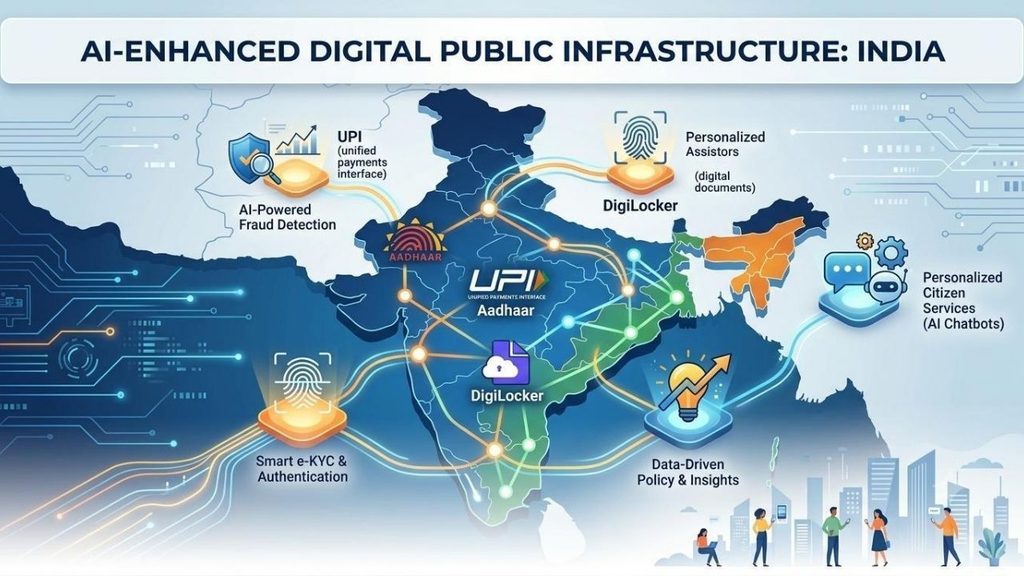
The shift from traditional systems to Digital India raises concerns about public privacy and security, as greater reliance on digital systems can create new opportunities for fraud and scams. Aadhaar is one pillar of what the government now calls India’s Digital Public Infrastructure and how AI could change that DPI for making it faster and more reliable is the biggest evolution.
Every month, close to 20 million people across India get turned away by a fingerprint scanner or a face-authentication camera that’s supposed to hand them a subsidised ration bag, a pension, or a bank withdrawal. That failure rate — a little over 6% of roughly 312 million Aadhaar-based authentications attempted monthly has stayed almost unchanged for a decade, according to UIDAI’s own parliamentary disclosures.
It’s a strange fact to sit with, because DPI includes the stack of identity, payments, and data-sharing rails — Aadhaar, UPI, DigiLocker, Account Aggregator, ONDC — that more than a billion Indians touch, often without realising it. AI is now being wired into nearly every one of those rails. Some of it is already live and working.
What Is India’s Digital Public Infrastructure
Aadhaar is the identity layer — a biometric ID held by nearly every adult in the country. UPI is the payments layer, the real-time system that lets any bank app talk to any other. DigiLocker and Account Aggregator are the document and data-sharing layers, letting people share verified paperwork or consented financial records instead of photocopies.
ONDC is the newest piece, an attempt to do for e-commerce what UPI did for payments: an open network any app can plug into, rather than one company owning the marketplace.
Each of these was built as plumbing — deliberately boring, interoperable infrastructure. AI is the first layer being added on top that isn’t boring at all, and it’s arriving fastest in fraud detection, credit, language, and now shopping.
Fraud Detection at a Scale No Human Team Can Watch
UPI now clears more than 750 million transactions a day, a number NPCI expects to keep climbing toward a billion. At that volume, catching fraud after the money has moved is close to useless — NPCI’s fraud-detection platform processes roughly 2 terabytes of transaction data daily and needs to score risk within about 20 milliseconds, fast enough to block a payment before it settles.
Its MuleHunter AI tool has already flagged more than 4.7 lakh mule accounts — the disposable, borrowed accounts fraud rings use to bounce stolen money through four to six hops before cashing out.
NPCI is now piloting what it calls a “federated model” with three or four banks: instead of pooling everyone’s raw transaction data in one place, banks and NPCI compare AI-generated risk scores on a customer, getting the benefit of shared pattern-matching without centralising anyone’s actual financial history.
NPCI’s leadership has said openly that the next leg of UPI’s growth depends on AI doing three jobs at once — catching fraud, extending credit based on payment history, and onboarding the next half-billion users through voice and regional-language interfaces instead of English-only screens.
Half of India Still Can’t Access Bank Credit
For decades, an MSME owner without three years of clean, bankable paperwork was mostly invisible to formal lenders — not un-creditworthy, just un-scoreable.
The Account Aggregator framework, built on the RBI’s 2016 Master Direction and NITI Aayog’s Data Empowerment and Protection Architecture, changed the plumbing: with a customer’s explicit consent, a lender can now pull real bank statements, GST filings, and insurance records through a single encrypted pipe instead of chasing PDFs.
As of the framework’s fourth anniversary in 2025, 112 financial institutions had gone live on both sides of that pipe, with hundreds more connected as data providers or users. AI models sit on top of that data flow, and lenders report the payoff is real: industry estimates put improvements in default-prediction accuracy at 15 to 25%, and processing times that used to run one to three weeks are increasingly settled same-day.
This isn’t unregulated black-box lending, though — RBI’s digital lending rules require a lender to explain, in terms a risk officer or auditor can actually interrogate, why a model approved or rejected an application, which puts a real ceiling on how opaque these systems are allowed to get.
No More Language Barrier: Treating Language Like Infrastructure
India has more than one language and an AI layer that drops the barrier between languages is Bhashini. In India, MeitY’s National Language Translation Mission became fully AI-powered translation engines and it now sits underneath every government services app from January 2026. Portals like DigiLocker, UMANG, e-Shram running into 22 Indian languages.
A Bhashini-powered voice assistant called Kumbh Sahaiyak used a Llama-based model to field pilgrim questions in 11 languages in real time — arguably the clearest proof yet that a DPI project can meet people in their own language at genuine crowd scale, not just in a pilot deck. If India’s Digital Public Infrastructure’s whole promise was ever about reaching people who can’t fill out an English form, Bhashini is the piece actually doing that, one API call at a time.
The Part AI Might Not Fix: Aadhaar’s Exclusion Problem
The government’s current bet is that AI-driven face authentication — rather than fingerprint or iris scanning, which struggle with a manual labourer’s worn fingerprints or an elderly person’s cataracts — will close that 6.5% failure gap.
It’s already been tested at real scale with UIDAI ran a face-authentication proof of concept at NEET-UG 2025 exam centres with the NTA and NIC, and by 2026 similar AI-camera verification, backed by liveness checks and a fingerprint or manual fallback, was standard at UPSC exam halls. Officials describe the results as promising.
Researchers who’ve actually gone door to door are less convinced: a survey across 32 villages in Jharkhand by economist Jean Drèze and co-authors found exclusion errors running as high as 20% in areas where biometric authentication was required for every ration purchase — and critics note that swapping fingerprints for face scans doesn’t remove the underlying design flaw, which is that a single biometric check, controlled by a ration dealer or bank teller rather than the beneficiary, decides whether someone eats that month.
There’s a second, quieter concern sitting alongside is the more AI systems sit on top of Aadhaar-linked data — UPI payments, SIM registrations, app logins — the easier it becomes to assemble a detailed behavioural profile of someone, usually described publicly as fraud prevention rather than surveillance. Both things can be true at once.
AI-based face authentication may genuinely cut into the 20-million-a-month failure count, and the same infrastructure may quietly expand what the state and private platforms can see about a person’s life. That tension, not a clean technical fix, is the actual story here.
Agents That Could Soon Shop and Transact for You
The newest layer is barely a layer yet. ONDC, India’s government-backed alternative to Amazon and Flipkart, runs on the open-source Beckn protocol, which had onboarded more than 900 network participants across grocery, food delivery, mobility, and financial services by 2026.
FIDE, the nonprofit behind Beckn, has already demonstrated BecknGPT — an experimental agent that lets a ChatGPT-style assistant browse and complete an ONDC purchase on a shopper’s behalf and mainstream apps including Swiggy, BigBasket, and Flipkart have started exposing their catalogues directly to AI shopping assistants.
It’s genuinely early, more demo than daily habit right now. But the direction matters: if UPI proved India could build a public payments rail that private apps compete on top of, ONDC plus AI agents is the government’s bet that the same model can work for commerce itself, without any single platform owning discovery.
Whatever India’s Digital Public Infrastructure domestic wrinkles, India has turned it into one of its more effective diplomatic exports.
During its 2023 G20 presidency, India pushed Digital Public Infrastructure as a global development model, the framework receiving endorsement from 20 member nations. By 2026, the cooperation agreements between India and other 23—24 countries have been signed for helping them build their own version of Aadhaar, UPI, or DigiLocker by sharing open-source blueprints rather than selling a finished product.
UPI itself is already live in eight-plus countries, from the UAE and Singapore to France and Mauritius, and Kenya is reportedly building a national digital-identity stack directly modelled on India’s approach.
Analysts who track this call it the “Aadhaar Paradox”: India is exporting a model with real, unresolved problems at home — the exclusion numbers above, heavy market concentration in UPI apps, ongoing data-protection debates — alongside genuine, population-scale successes that few other countries have managed.
Both halves of that sentence are true, and any AI layer India bolts onto its own DPI will likely travel abroad along with everything else.
What Determines Changing India’s Digital Public Infrastructure With AI Goes Well
A few concrete things to watch over the next year, rather than general optimism about AI transforming governance.
First, whether NPCI’s 30% market-share cap for individual UPI apps — currently set to take effect December 31, 2026 — actually holds this time, since two apps still control more than 80% of transaction volume and AI-driven credit and voice features could widen that gap further or finally give smaller players something to compete on.
Second, whether UIDAI’s AI-based face authentication measurably moves the 6.5% Aadhaar failure rate in its next couple of annual disclosures, or whether as analyzer expect — it just changes which biometric ends up failing people.
None of these are settled yet. Both will tell you, faster than any government press release, whether AI made India’s Digital Public Infrastructure more inclusive, or just faster at doing the same thing to the same people.
AI could make India’s Digital Public Infrastructure faster, more accessible, and better at handling problems that humans simply cannot manage at this scale. From spotting fraud across UPI transactions to helping lenders understand small businesses and breaking language barriers, the benefits are already becoming visible.
But the bigger question isn’t whether AI can make India’s Digital Public Infrastructure more efficient. It’s whether it can make it more inclusive without creating new problems along the way. Aadhaar’s authentication failures, concerns around data profiling, and the risk of AI-powered systems becoming harder to challenge show why speed alone isn’t enough.
India has already built the digital rails. The next phase is about deciding how intelligently, transparently, and fairly AI runs on top of them. The success of that shift will depend not just on better models, but on whether the people using these systems actually have fewer barriers when they need them most.
Candidates with a Psychology degree or a B.Ed. have a golden chance to secure a stable and well-paying job right now. ITBP Head Constable (Education & Stress Counsellor) post application form is active until 27 October 2026. Apply early to hold your seat because the Indo-Tibetan Border Police Force announced only 16 available positions.
Everything about ITBP Head Constable from schedule to how to fill the form is given below. Read and check the official notification before applying for this post.
Overview of ITBP Head Constable Recruitment 2026
Detail
Information
Post
Head Constable (Education & Stress Counsellor), Group C, Non-Gazetted
Don’t confuse this with the other ITBP Head Constable drive from the same month, for Motor Mechanic. That one is male-only and has 21 posts. Women can apply here, and that’s the main reason this notification is worth a closer look.
Who Can Apply for ITBP Head Constable (Education & Stress Counsellor)?
You need a bachelor’s degree with Psychology as a subject, or a bachelor’s degree plus a B.Ed. or Bachelor of Teaching. One is enough. A history graduate with a B.Ed. is eligible. A BA Psychology graduate can also apply without a teaching qualification. Final-year students don’t, because the degree must be completed by the closing date.
The age band is 20 to 25 years as on 27 October 2026. That is narrower than the usual 18 to 25 for ITBP constable posts. The relaxations up to 28 for OBC (non-creamy layer) and 30 for SC/ST candidates, with extra relaxation for ex-servicemen. Confirm your relaxation period in the official notification PDF.
The application fee is reported as ₹100 for male General, OBC and EWS applicants, with women, SC/ST candidates and ex-servicemen exempt.
ITBP Head Constable Vacancy 2026
Fourteen seats are for men and two for women. Beyond that, the category-wise split is unclear. The two women’s seats make that category the tightest on a per-seat basis. The pool of applicants is also smaller than for a general constable drive, since the role needs a specific degree. Smaller doesn’t mean easy, though. Sixteen seats is sixteen seats.
ITBP Head Constable Selection Process: Physical Tests Come First
The order is Physical Efficiency Test (PET), Physical Standard Test (PST), written examination, document verification, then a Detailed Medical Examination, with a Review Medical Examination available on appeal. Putting the physical stages before the written paper is the opposite of what many exam-takers expect. A candidate who scores well on psychology and fails the run is out.
PET Standards
Category
Race
Long Jump
High Jump
Male
1.6 km in 7 minutes 30 seconds
11 feet
3.5 feet
Female
800 metres in 4 minutes 45 seconds
9 feet
3 feet
Written Examination
This is a Computer-Based Mode exam with 100 objective questions and each mark carries one mark. There is no negative marking and you are given only two hours to complete it. The paper is prepared in bilingual language so it won’t be difficult to understand the question.
Qualifying this exam is important to go to the next stage of the selection process. ITBP prepares merit lists according to written examination scores.
Documents and Medical Test
At document verification, candidates must produce original certificates, including educational qualification proof—such as a recognised degree with Psychology, or a degree along with B.Ed./B.T.—along with matriculation, category and domicile documents where applicable.
The final stage is the DME, conducted under CAPF medical guidelines. Candidates found medically unfit may be considered for the RME, where applicable.
None of the later dates are out yet. PET/PST, the written exam, document verification and the medical will be announced separately on the ITBP portal. The exam pattern, number of questions and negative marking aren’t public either.
ITBP Head Constable Salary
The selected candidates get a job and their starting salary at ITBP Head Constable is ₹25,500 and a ceiling of ₹81,100. It is disbursed under Pay Level 4 on the 7th CPC matrix. The allowances including Dearness, house, posting-based allowance are also added in the salary.
Postings can include border and high-altitude locations, which carry extra allowances. A newly appointed candidate at the starting basic pay of ₹25,500 will generally receive a monthly gross salary above the basic pay after allowances, while net pay depends on deductions
How to Apply for ITBP Head Constable Education & Stress Counsellor 2026
Open the official website of ITBP and register yourself first with the correct Email and Mobile number. Then login to fill the Head Constable (Education & Stress Counsellor) application form.
Fill the exact details asking in each box of application form, upload your documents along with your photo, sign, and pay the fee to process the application.
Before submitting, review every detail carefully, because edits aren’t allowed afterwards. Download the confirmation page.
Keep ready your 10th certificate (for date of birth), your degree marksheets, your Psychology proof or B.Ed. certificate, and your category certificate if you’re claiming reservation.
If you’re relying on an “equivalent” to a B.Ed., expect to produce an equivalence certificate at document verification.
One prep tip: start your running now, before you open any psychology notes. The PET comes first and failing it ends your application regardless of your marks.
Apply if you meet either degree route and fall within the age band. The competition is thinner than for a mass constable drive, and Level 4 pay is secure central government pay. Skip it if your degree has neither Psychology nor a B.Ed., because document verification is where those applications end.
If you’re a woman with a qualifying degree, apply early. Two seats won’t wait for the last week. Submit at least three days before 27 October so a portal crash doesn’t decide your future.
Chennai offers great options for the BCA Data Science program which opens various opportunities in the IT field for students. But pursuing it from the right college matters, these best BCA Data Science colleges in Chennai will help you get a placement in tech companies. If you also have an interest in Data Science programs then this guide will help you choose the right college for you.
Some students might find it difficult to get an admission in BTech due to expensive fees but BCA offers various specializations including Data Science which help you build a stable and growing career.
What is Data Science?
Data Science is an interdisciplinary field that is growing faster in the world due to its combining methods to collect raw data and turn it into useful information. Data is a powerful resource for businesses or organizations to make better decisions. Data Science involves scientific methods, algorithms, and tools to extract useful insights and structure it in a manner that can be operated easily for decision making.
Real-life examples that relates to this field:
Recommendation from an online shopping app like Amazon. Detection for a fraud transactions from a Bank Movies recommendation from Netflix “shows you may like.”
Why These Colleges are Best For BCA Data Science
These types of fields, especially related to technology, need a core curriculum and practical assessment to understand the working of functionalities. These colleges are best because of their strong curriculum which covers every advanced tool and technologies which are used currently in the industries, experienced faculty provide you with the right roadmap to your destination, and industry exposure for real-world working knowledge.
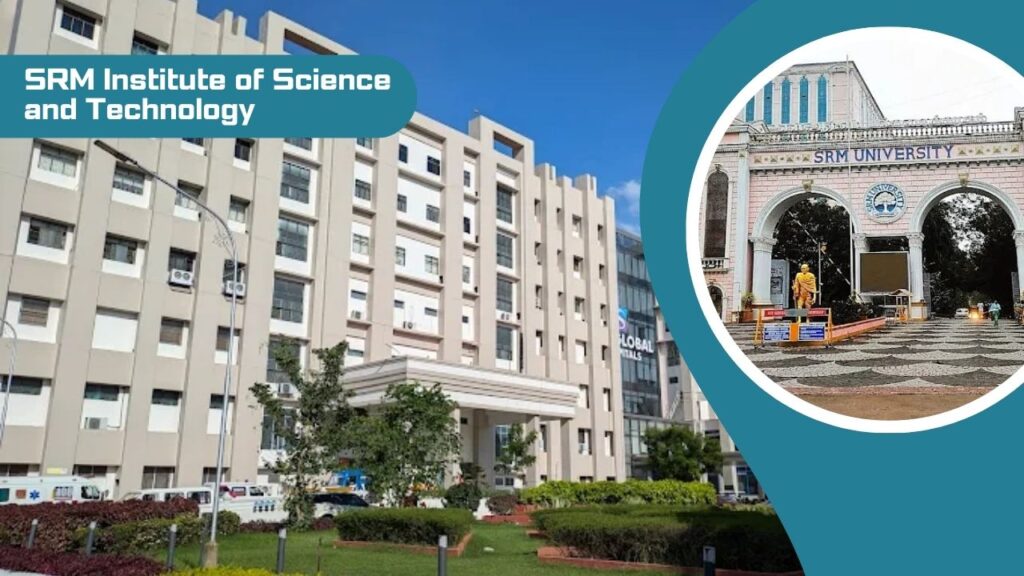
SRM Institute of Science and Technology
SRM Institute of Science and Technology offers a 3 year BCA program in Data Science for students who have completed their 10+2 from a recognized board. Candidates with valid diploma certificates in engineering are also eligible for this course. This is a deemed university located in Kattankulathur, Tamil Nadu.
Image credit: SRM Institute of Science and Technology
Fees
₹4.5-4.6 Lakhs entirely
Duration
3 years
Eligibility
10+2 with Physics, Mathematics and Chemistry
Placement Rate
80-89%
Average Package
Around ₹4.4 Lakhs
Highest Package
Around ₹6.6 Lakhs
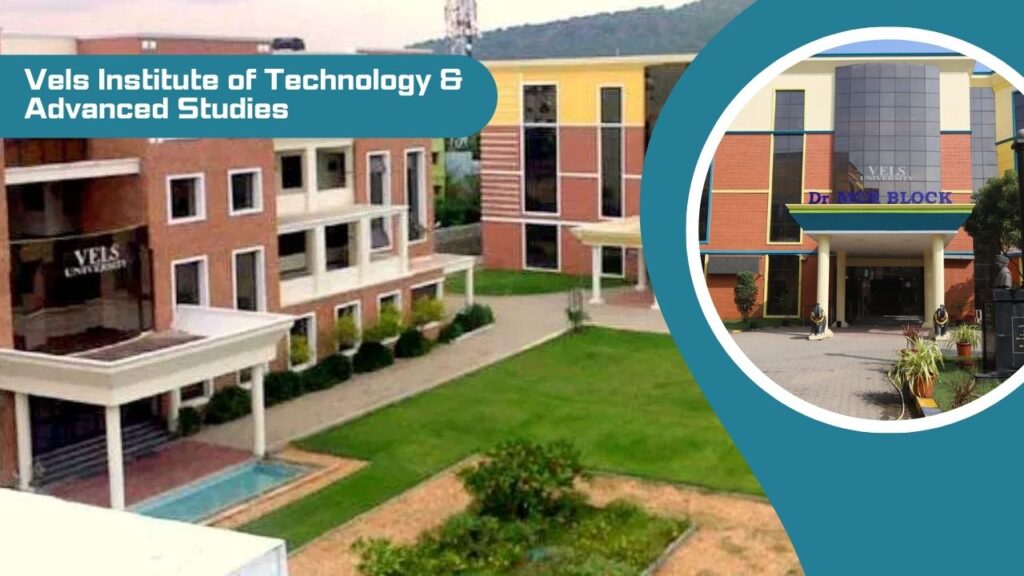
Vels Institute of Technology & Advanced Studies
Vels Institute of Science, Technology & Advanced Studies in Pallavaram, Chennai is known as the best college for BCA Data Science. It offers well-equipped labs, smart classrooms and research centres with a strong faculty for over 12,600 students every year.
Image credit: Vels Institute of Science, Technology & Advanced Studies
Fees
₹3.51 Lakhs
Duration
3 years
Eligibility
10+2 with Mathematics/Computer Science as core subject
Placement Rate
70-80%
Average Package
Around ₹3.2-3.8 Lakhs
Dr. MGR Educational and Research Institute
Dr. MGR Educational and Research Institute is a private deemed university which offers Data Science specialization at affordable fees. Students can easily get admission if they have completed their 12th with 50% marks. It provides digital/e-library facilities and modern labs for quality education.
Image credit: Dr. MGR Educational and Research Institute
Fees
₹1,10,000 annually
Duration
3 years
Eligibility
10+2 with Mathematics/Computer Science as core subject
Placement Rate
70-75%
Average Package
Around ₹6.95 Lakhs
Hindustan Institute of Technology and Science
Hindustan University is offering multiple academic blocks, research centres, and smart labs to provide better education. International collaboration is allowing students to get opportunities to go abroad. Chennai’s most prominent private university with a high placement rate. They provide updated curriculum to keep up with the newer technologies, making students industry-ready.
Image credit: Hindustan University
Fees
₹3.2-3.8 Lakhs entirely
Duration
3 years
Eligibility
10+2 with Mathematics/Computer Science as core subject
Placement Rate
70-85%
Average Package
₹3.5-4.2 Lakhs
Sathyabama University
Sathyabama Engineering College is a multi-disciplinary private university providing Data science specialization to thousands of students. It has a strong alumni network which proves their STEM-intensive education develops student’s minds to become innovative.
Image credit: Sathyabama Engineering College
Fees
₹3.0-4.5 Lakhs entirely
Duration
3 years
Eligibility
10+2 with Mathematics/Computer Science as core subject
Placement Rate
70-85%
Average Package
₹3.0-3.8 Lakhs
Admission Process Requirements
Eligibility
Students can take admission only after completing their 12th with a good percentage from a recognized board.
At least one of the subjects like Mathematics, Statistics, Computer Science, must be included in the 12th marksheet.
Some colleges accept business mathematics or diploma in engineering.
Admission procedure
Selection of a candidates is based on the merits
Some universities may conduct entrance exams like SRMJEE for SRM university.
The salary of the candidate depends on the company and job post. International companies offer high packages and domestic companies are offering average salary packages, data scientists get higher packages after a few years of experience. Top tech companies including Infosys, TCS, Wipro, TATA, HCL are hiring BCA students with an average level of salary package.
Conclusion
These best BCA Data Science colleges in Chennai are a great option for science students to make a line in the IT industries. Admission to BCA is easy and affordable but with the right college you can get better opportunities. These colleges not only offer quality education but also provide live projects, internships, and research opportunities.
Almost 2 lakh nervous students are going to throng into exam centres across the country, their heartbeats racing for one of the most competitive entrance exams in India. The CAT 2025 Exam Analysis was held on November 30, 2025 in three slots. It was more difficult than last year and some parts were a lot harder. Let’s understand what exactly made these sections tick and why DILR turned out to be the section that had aspirants sweating bullets.
VARC: The Surprisingly Approachable Section
Starting with the section which allowed students a fighting chance—Verbal Ability and Reading Comprehension came in at 24 questions to be answered in 40 minutes. Here’s what made VARC the relative breeze compared to the others. The section continued the following pattern: 4 RC passages (reading comprehension question) with 16 questions, and 8 Verbal Ability questions based on parajumbles, para-summaries, and odd sentences out.
What took many students by surprise was that although VARC had a few tough passages, it was more-or-less the same as last year’s CAT. One highlight was a tract on the ill effects of dams that proved to be amperable, while tracts on AI ethics and The Forest Act 1982 presented mild difficulties with knotty questions and extended options.
No Rule-Breaking Surprises in the distribution of topics (or in the format). For those students planning to go for a decent percentile, somewhere close to 18-20 correct attempts out of 24 can easily take you till 85 percentile.
DILR: The Monster Everyone Feared
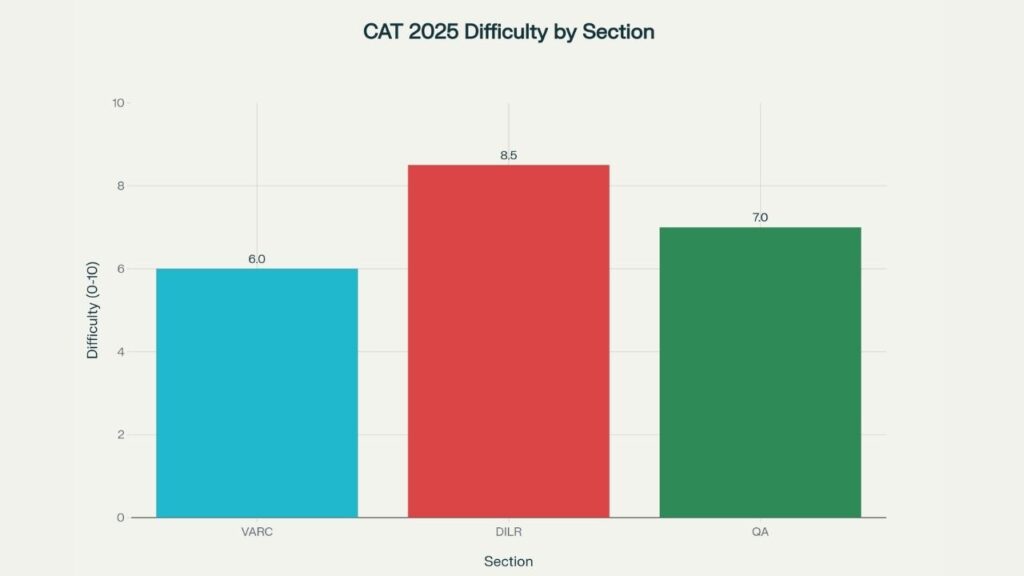
Now, let’s talk about the elephant in the room — DILR or as many started calling it, “the nightmare section.” With 22 questions distributed in five sets, this section turned out to be the toughest part of CAT 2025. DILR was reportedly “much harder” than the previous year, according to candidates across all three sessions.
There were about 11 Data Interpretation and 11 Logical Reasoning questions, and about 11–12 questions were to be Type In The Answer (TITA). But here’s the real kicker: DI sets were moderately solvable, LR sets were much more demanding in terms of analytical thinking and puzzle solving skills. One set on a pollution index using weighted averages left many candidates baffled, while simpler sets such as the Spider + Bar graph gave some relief.
The psychological effect was true. Students observed that in this section, smart question choice became an absolute must. 8–10 good questions with high accuracy was the realistic target to get 90 percentile, as against that year it might have been the need of similar accuracy in 10–12 questions. This was the part that really tested not only what you know, but how you prioritize when you’re under fire.
QA: Deceptively Moderate but Tricky
Quant may be described by experts as “medium-difficult having a flavor of difficulty and toughness. With 22 questions from the areas of Arithmetic (8), Algebra (5), Geometry (3), Modern Math (4), and Numbers (2), the pattern was pretty much the same. But this is where CAT 2025 surprised many aspirants—each question appeared doable, but a large number of them required multi-step thinking and fast computations while under heavy time pressure.
Geometry questions, though easier, could be answered quickly, but the other portions were more calculation-intensive and tested not only your speed but your accuracy. To score well, answering 12-15 questions correctly appeared to be the magic number, with somewhere around 13-14 potentially pushing you towards the 90 percentile.
Here’s the hard truth about CAT 2025: the paper was overall a shade more challenging than CAT 2024. DILR took center stage as the villain in the storyline of this year, while VARC surprisingly ended up as the hero. QA swung to the challenging side, particularly in the afternoon and evening slots.
Section
Total Questions
Difficulty Level
Comparison to 2024
Good Attempts
Target Percentile
VARC
24
Moderate
Similar
18-20
85%
DILR
22
High
Tougher
8-10
90%
QA
22
Moderate-High
Slightly Tougher
12-15
90%
So What Does That Mean for You and Your Prep?
Quality trumps quantity Every bit as much as in volume matters in this area. Increased difficulty on all three positions also means as you go through the percentiles, the score ranges will be more condensed. You can’t let yourself be sloppy. Smart question selection Knowing when to skip and managing your time ruthlessly become your superpower.
CAT 2025 Section-Wise Difficulty Level Comparison
To those who are readying themselves for CAT 2026 or are giving it another shot, this is what I want you to take away — practice consistently, analyze your errors and know your weak links in each section, that is what will give you an edge. It’s not just testing what you know anymore, it’s testing how you think under pressure.
Conclusion
CAT 2025 was a testament to how this exam is not only about knowledge of concepts but also about stamina, being flexible and taking razor-sharp decisions under pressure. VARC was somewhat relaxing, DILR was the real game changer which stretched even the best candidates to the brink. QA struck a difficult calculation-heavy balance, rewarding calm precision.
For future aspirants, the biggest take away is simple — “Accuracy is the key, build strong basics and selective solving is the art”. As long as you keep your cool, read patterns fast and fight your battles wisely in the exam, you will always be having that extra edge – Whatever way CAT chooses to dance!