Government Jobs After Graduation in India: Complete Guide for 2026

Government Jobs After Graduation in India Complete Guide for 2026 Most of the students join the corporate sector but private jobs won’t provide security, high-salary, and additional perks which the government sector offers to the employees. But position matters in government jobs too if you have a higher position in the department, your salary will be more and other perks. There are many government jobs after graduation in India in the different departments. But you must understand which department suits you best. Let’s look into the details of each government job after graduation. Don’t rush, just focus on what you want to achieve in life. Why Government Jobs Still Matter People who spent years working in a public sector bank or Ministry of finance described that money attracts you but the major reason is you never have to worry about if you’ll have a job next year or not. If you watch it closely, you are going to understand — A government job in India isn't just a paycheck. It comes with job security that private companies rarely match. It comes with a pension through the National Pension System, so the years after retirement aren't a financial scramble. Government jobs offer fixed working hours, but there are exceptions. Defence and UPSC is tougher and no fixed hours. Most jobs are not that tough so you can give time to your family. In India, society gives more respect to government employees than private employees. There is one more thing, if you belong to SC, ST, OBC, and EWS categories, government recruitment includes reservation benefits that make the competition a little more balanced than it is in the open private market. None of this means government jobs are easy to get. But it explains why so many students keep this door open, even while exploring others. Government Jobs After Graduation in India There is no one big exam for a government job, it gives you job security and high salaries that makes it tough to compete with lakhs of students and being selected. In Finance and Accounting Department IBPS conducts the PO and Clerk exams for most public sector banks, while State Bank of India runs its own separate recruitment for similar roles. If you want something closer to economic policy, RBI hires for Grade B officer and Assistant positions, and NABARD focuses specifically on rural and agricultural banking. Job Title Minimum Qualifications Example Employers Recruiting Bodies Accountant Junior Accountant Bachelor’s degree in Commerce (B.Com) or equivalent; some posts accept diploma in accounting State departments, municipal corporations, central ministries, cultural institutions Assistant Accounts Officer Assistant Executive (F&A) B.Com M.Com MBA(Finance) CA Inter PSUs, autonomous bodies, government companies Junior Accounts Officer Junior Accountant (Ministry) B.Com, proficiency in Tally Govt accounting rules Department of Economic Affairs, ministries, central govt offices Treasury Officer Cashier (Treasury) B.Com; sometimes specific treasury certificates State treasuries, municipal treasuries Internal Revenue Agent Revenue Inspector Graduation; specialized departmental exams Tax departments, revenue directorates Central Government Jobs The Staff Selection Commission runs several exams worth knowing. SSC CGL is the big one, opening doors to positions like Income Tax Inspector and Assistant Audit Officer. SSC CHSL leads to roles like Data Entry Operator or Lower Division Clerk. If you studied engineering, SSC JE is built specifically for you. And if you can take dictation quickly, there's SSC Stenographer. Job Exam Minimum Qualification Common Extra Requirement SSC CGL Graduation degree Post-wise age and skill test requirements SSC CHSL 12th pass OR Graduation Typingskill test for some posts SSC MTS 10th pass OR Graduation Age relaxation as per category SSC JE Diploma or B.E.B.Tech in relevant field Technical qualification in engineering branch SSC CPO Graduation in any stream Fitness and medically fit Railways, Largest Employer in the Country RRB NTPC opens up roles like Station Master and Traffic Assistant for general graduates. RRB ALP is for those drawn to operating trains as Assistant Loco Pilots. RPF handles railway security and law enforcement. And RRB JE, again, is the engineering route. Railway Job Post Main Work Basic Eligibility Usual Recruitment Route Station Master Controls train movement and station operations Graduation in any stream RRB NTPC Graduate-level exam Goods Train Manager Manages goods train operations and coordination Graduation in any stream RRB NTPC Graduate-level exam Senior Clerk cum Typist Handles records, typing, office work, and data entry Graduation with typing skill where required RRB NTPC Graduate-level exam Junior Accounts Assistant cum Typist Accounts work, billing, clerical finance tasks Graduation, usually commerce preferred RRB NTPC Graduate-level exam Commercial cum Ticket Clerk Ticketing, passenger support, commercial counters Graduation in any stream RRB NTPC Graduate-level exam Trains Clerk Train records, movement entries, office coordination Graduation in any stream RRB NTPC Graduate-level exam Traffic Apprentice Supports railway operations and traffic control work Graduation in any stream RRB recruitment NTPC-related notifications Section Controller Monitors train operations and sectional control Graduation; often a high-responsibility post RRB notification senior railway recruitment Junior Engineer (JE) Technical supervision in civil, electrical, mechanical, signal, etc. Diploma or B.Tech, depending on post RRB JE exam UPSC Civil Services, Bigger Ambitions & Highest Authority Job the exam that produces IAS and IPS officers. It's open to graduates from any stream, but it's also the toughest exam in this entire list, with three stages testing not just knowledge but stamina and patience. Each state also runs its own version through its Public Service Commission. UP has UPPSC, Bihar has BPSC, Madhya Pradesh has MPPSC, and so on, each recruiting for state-level administrative roles. UPSC Service Post Group Main Work Basic Eligibility Indian Administrative Service (IAS) All India Service District administration, policy implementation, public welfare, law and order coordination Graduation in any stream Indian Police Service (IPS) All India Service Internal security, policing, crime control, public order Graduation in any stream Indian Foreign Service (IFS) Group A Diplomacy, foreign relations, embassies, international representation Graduation in any stream Indian Revenue Service (IRS - Income Tax) Group A Tax assessment, collection, investigation, enforcement Graduation in any stream Indian Revenue Service (IRS - Customs & Indirect Taxes) Group A Customs duties, GST-related enforcement, indirect tax administration Graduation in any stream Indian Audit and Accounts Service (IA&AS) Group A Government audit, accounts, financial compliance Graduation in any Indian Civil Accounts Service (ICAS) Group A Central government accounting and financial reporting Graduation in any stream Indian Defense Accounts Service (IDAS) Group A Defence finance, budgeting, accounts management Graduation in any stream Indian Railway Protection Force Service (if allotted through UPSC-related services) Group AB depending on cadre Security and protection of railway property and passengers Graduation in any stream Central Civil Services Group A Group A Administration in central ministries and departments Graduation in any stream Central Civil Services Group B Group B Assistant-level administrative and policy work Graduation in any stream Defense Jobs If discipline and service appeal to you more than office work, the defence sector offers CDS for officer entry into the Army, Navy, and Air Force, and AFCAT specifically for the Air Force. Defence Job Entry Main Role Basic Eligibility Selection Route Indian Army Officer Lead troops, field operations, administration Graduation in any stream CDS SSC (Non-Technical) other officer entries Indian Navy Officer Naval operations, technical or executive duties Graduation; engineering degree for technical entries CDS SSC Executive technical entries Air Force Officer Flying, ground duty, administration, support roles Graduation in any stream for many entries AFCAT CDS NCC special entry Short Service Commission Officer Temporary officer role in Army, Navy, or Air Force Graduation; post-specific rules apply SSC entry routes CDS Officer Entry Commissioned officer in Army, Navy, or Air Force Graduation in any stream CDS written exam, SSB, medical AFCAT Officer Entry Air Force officer in flying, technical, or ground duty branches Graduation in any stream; technical branches need relevant degree AFCAT, interview, medical NCC Special Entry Officer entry for NCC cadets Graduation + NCC certificate requirements Direct officer selection, no written AFCATCDS in some cases Territorial Army Officer Soldier Route Support and reserve-duty role Graduation for officer routes; other posts vary Territorial Army recruitment CRPF BSF CISF ITBP Officer-level or specialist posts Internal security, border protection, force administration Graduation, depending on post UPSCSSCdepartmental recruitment DRDO Scientist Technical Staff Defence R&D, systems, research, testing Graduation in engineeringscience for technical roles DRDO recruitment GATE-based selection for some posts Defence Production HAL PSU Jobs Engineering, planning, operations, management Graduation; technical degree for many roles Direct recruitment deputation Teaching Jobs Teaching has its own path too. CTET or your state's TET exam qualifies you to teach in schools, while UGC NET is for those who want to lecture at the college level. KVS and Navodaya Vidyalaya recruitment also fall in this teaching bucket. Important Tip You didn't need to pick just one. Many students prepare for two or three of these at the same time, since the subjects often overlap. Teaching Job Level Basic Eligibility Main Exam Route Primary Teacher (PRT) Class 1–5 Graduation in some cases, usually with D.El.Ed B.El.Ed; CTET Paper 1 for central jobs CTET TET + recruitment exam Trained Graduate Teacher (TGT) Class 6–10 Graduation in relevant subject + B.Ed; CTET Paper 2 for central schools CTET TET + recruitment exam Guest Teacher School institute Graduation, sometimes B.Ed preferred Local government recruitment walk-in contract basis Special Educator School level Graduation + special education qualification Recruitment through education department DSSSB state boards Who Can Actually Apply The good news is that most of these exams simply ask for a graduation degree, in any subject. You don't need a specific stream unless the job itself is technical, like engineering posts in SSC JE or RRB JE, which obviously expect an engineering background. Most exams accept candidates roughly between 18 and 32, though SC, ST, and OBC candidates usually get age relaxation, and the exact numbers shift slightly from year to year. You also need to be an Indian citizen for nearly all of these roles, and for defence or paramilitary jobs like CDS or RPF, there are physical fitness standards on top of everything else. Never assume for the exam updates. Dates are extended sometimes and shifts every year. Every government organization publishes its own official notification that declares eligibility and process. Rules shift slightly year to year, so do not rely on people’s words or what happened last year. How the Application Actually Works Once you decide which field you are going to join, you have to figure out the process itself, which felt confusing the first time but became simple once he broke it down. It starts with tracking official notifications. Websites like ssc.nic.in, ibps.in, rrbcdg.gov.in, and upsc.gov.in post recruitment notifications which include detailed instruction and a timeline to open the portal where you can apply. It happens every year, so checking them regularly matters. Once a notification drops, the first step is registering online, usually with just a mobile number and email. Then comes the actual application form, where personal details, educational background, category, and post preferences need to be filled in carefully. Remember that correction windows are short, so a careless mistake here can follow you for the whole process. After that, documents like your photograph, signature, and category certificates need to be scanned and uploaded. Then there's the application fee, though SC, ST, PWD, and female candidates often get a waiver or discount here. Once everything is submitted, the admit card becomes available a few weeks before the exam date, and then it's just down to showing up and going through whatever stages that particular exam has, whether that's a single test or a longer chain of prelims, mains, and interview. How To Prepare For Government Exams Once you know that these exams exist doesn’t mean you are fully prepared for it. You need to read the syllabus properly instead of skimming it. Every exam leans on a mix of Current Affairs, Simple Mathematics, Logic and Reasoning, and English or Hindi, but the weight given to each section changes depending on the exam. After you study the topics of a specific exam, check previous year papers, not to memorize answers, but to understand the pattern, the difficulty level, and how questions are usually framed and paired with regular mock tests. This technique will teach you how to manage time under pressure, since most of these exams are brutally time-bound. Make Current affairs a daily habit too, especially since banking and SSC exams lean heavily on it. If your exam has more weightage on Current Affairs then prepare well for it day-by-day. What made the real difference, though, was a basic timetable. Not a rigid one, just something that kept you showing up every day instead of cramming in bursts. And you had to decide between coaching and self-study. Most students who cracked their exams recommend choosing both. As some subjects are hard that need guidance and some are easy, you can prepare it by yourself. There's no universal right answer here. It depends on how you learn best. Common Mistakes Students Should Avoid For decades, students have been doing wrong while preparing for the government exams which can be put away and made aware future generations to stop going wrong. Some students put all their effort into one single exam and ignore everything else, which is risky given how competitive these exams are. Others miss notification deadlines simply because they weren't checking regularly. A lot of students skip mock tests entirely, only to be blindsided by time pressure on the actual exam day. And many treat current affairs as optional, which costs them marks in exams where it's actually a major scoring section. Conclusion There are massive numbers of vacancies every year in government jobs after graduation in India. If you also finish your college this year or previous year, you can apply for any of the jobs which fits into your profile. Government Jobs After Graduation

Most of the students join the corporate sector but private jobs won’t provide security, high-salary, and additional perks which the government sector offers to the employees. But position matters in government jobs too if you have a higher position in the department, your salary will be more and other perks. There are many government jobs after graduation in India in the different departments. 

But you must understand which department suits you best. Let’s look into the details of each government job after graduation. Don’t rush, just focus on what you want to achieve in life.

Why Government Jobs Still Matter

People who spent years working in a public sector bank or Ministry of finance described that money attracts you but the major reason is you never have to worry about if you’ll have a job next year or not. 

If you watch it closely, you are going to understand — A government job in India isn’t just a paycheck. It comes with job security that private companies rarely match. It comes with a pension through the National Pension System, so the years after retirement aren’t a financial scramble. Government jobs offer fixed working hours, but there are exceptions. Defence and UPSC is tougher and no fixed hours. Most jobs are not that tough so you can give time to your family. In India, society gives more respect to government employees than private employees. 

There is one more thing, if you belong to SC, ST, OBC, and EWS categories, government recruitment includes reservation benefits that make the competition a little more balanced than it is in the open private market. 

None of this means government jobs are easy to get. But it explains why so many students keep this door open, even while exploring others. 

Government Jobs After Graduation in India

There is no one big exam for a government job, it gives you job security and high salaries that makes it tough to compete with lakhs of students and being selected.

Read More 👉 HSSC CET Group D Recruitment 2026: Get All the Details to Apply 

In Finance and Accounting Department 

IBPS conducts the PO and Clerk exams for most public sector banks, while State Bank of India runs its own separate recruitment for similar roles. 

If you want something closer to economic policy, RBI hires for Grade B officer and Assistant positions, and NABARD focuses specifically on rural and agricultural banking. 

Job TitleMinimum QualificationsExample Employers / Recruiting Bodies
Accountant / Junior AccountantBachelor’s degree in Commerce (B.Com) or equivalent; some posts accept diploma in accountingState departments, municipal corporations, central ministries, cultural institutions 
Assistant Accounts Officer / Assistant Executive (F&A)B.Com / M.Com / MBA(Finance) / CA InterPSUs, autonomous bodies, government companies 
Junior Accounts Officer / Junior Accountant (Ministry)B.Com, proficiency in Tally / Govt accounting rulesDepartment of Economic Affairs, ministries, central govt offices 
Treasury Officer / Cashier (Treasury)B.Com; sometimes specific treasury certificatesState treasuries, municipal treasuries 
Internal Revenue Agent / Revenue InspectorGraduation; specialized departmental examsTax departments, revenue directorates 

Central Government Jobs

The Staff Selection Commission runs several exams worth knowing. SSC CGL is the big one, opening doors to positions like Income Tax Inspector and Assistant Audit Officer. SSC CHSL leads to roles like Data Entry Operator or Lower Division Clerk. 

If you studied engineering, SSC JE is built specifically for you. And if you can take dictation quickly, there’s SSC Stenographer. 

Job / ExamMinimum QualificationCommon Extra Requirement
SSC CGLGraduation degreePost-wise age and skill test requirements 
SSC CHSL12th pass OR Graduation Typing/skill test for some posts 
SSC MTS10th pass OR Graduation Age relaxation as per category 
SSC JEDiploma or B.E./B.Tech in relevant fieldTechnical qualification in engineering branch 
SSC CPO Graduation in any stream Fitness and medically fit 

Railways, Largest Employer in the Country 

RRB NTPC opens up roles like Station Master and Traffic Assistant for general graduates. RRB ALP is for those drawn to operating trains as Assistant Loco Pilots. 

RPF handles railway security and law enforcement. And RRB JE, again, is the engineering route. 

Railway Job PostMain WorkBasic EligibilityUsual Recruitment Route
Station MasterControls train movement and station operationsGraduation in any streamRRB NTPC Graduate-level exam 
Goods Train ManagerManages goods train operations and coordinationGraduation in any streamRRB NTPC Graduate-level exam 
Senior Clerk cum TypistHandles records, typing, office work, and data entryGraduation with typing skill where requiredRRB NTPC Graduate-level exam 
Junior Accounts Assistant cum TypistAccounts work, billing, clerical finance tasksGraduation, usually commerce preferredRRB NTPC Graduate-level exam 
Commercial cum Ticket ClerkTicketing, passenger support, commercial countersGraduation in any streamRRB NTPC Graduate-level exam 
Trains ClerkTrain records, movement entries, office coordinationGraduation in any streamRRB NTPC Graduate-level exam 
Traffic ApprenticeSupports railway operations and traffic control workGraduation in any streamRRB recruitment / NTPC-related notifications 
Section ControllerMonitors train operations and sectional controlGraduation; often a high-responsibility postRRB notification / senior railway recruitment 
Junior Engineer (JE)Technical supervision in civil, electrical, mechanical, signal, etc.Diploma or B.Tech, depending on postRRB JE exam 

UPSC Civil Services, Bigger Ambitions & Highest Authority Job

the exam that produces IAS and IPS officers. It’s open to graduates from any stream, but it’s also the toughest exam in this entire list, with three stages testing not just knowledge but stamina and patience. 

Each state also runs its own version through its Public Service Commission. UP has UPPSC, Bihar has BPSC, Madhya Pradesh has MPPSC, and so on, each recruiting for state-level administrative roles. 

UPSC Service / PostGroupMain WorkBasic Eligibility
Indian Administrative Service (IAS)All India ServiceDistrict administration, policy implementation, public welfare, law and order coordinationGraduation in any stream 
Indian Police Service (IPS)All India ServiceInternal security, policing, crime control, public orderGraduation in any stream 
Indian Foreign Service (IFS)Group ADiplomacy, foreign relations, embassies, international representationGraduation in any stream 
Indian Revenue Service (IRS – Income Tax)Group ATax assessment, collection, investigation, enforcementGraduation in any stream 
Indian Revenue Service (IRS – Customs & Indirect Taxes)Group ACustoms duties, GST-related enforcement, indirect tax administrationGraduation in any stream 
Indian Audit and Accounts Service (IA&AS)Group AGovernment audit, accounts, financial complianceGraduation in any 
Indian Civil Accounts Service (ICAS)Group ACentral government accounting and financial reportingGraduation in any stream
Indian Defense Accounts Service (IDAS)Group ADefence finance, budgeting, accounts managementGraduation in any stream 
Indian Railway Protection Force Service (if allotted through UPSC-related services)Group A/B depending on cadreSecurity and protection of railway property and passengersGraduation in any stream 
Central Civil Services Group AGroup AAdministration in central ministries and departmentsGraduation in any stream 
Central Civil Services Group BGroup BAssistant-level administrative and policy workGraduation in any stream 

Defense Jobs

If discipline and service appeal to you more than office work, the defence sector offers CDS for officer entry into the Army, Navy, and Air Force, and AFCAT specifically for the Air Force.

Defence Job / EntryMain RoleBasic EligibilitySelection Route
Indian Army OfficerLead troops, field operations, administrationGraduation in any streamCDS / SSC (Non-Technical) / other officer entries 
Indian Navy OfficerNaval operations, technical or executive dutiesGraduation; engineering degree for technical entriesCDS / SSC Executive / technical entries 
Air Force OfficerFlying, ground duty, administration, support rolesGraduation in any stream for many entriesAFCAT / CDS / NCC special entry 
Short Service Commission OfficerTemporary officer role in Army, Navy, or Air ForceGraduation; post-specific rules applySSC entry routes 
CDS Officer EntryCommissioned officer in Army, Navy, or Air ForceGraduation in any streamCDS written exam, SSB, medical 
AFCAT Officer EntryAir Force officer in flying, technical, or ground duty branchesGraduation in any stream; technical branches need relevant degreeAFCAT, interview, medical 
NCC Special EntryOfficer entry for NCC cadetsGraduation + NCC certificate requirementsDirect officer selection, no written AFCAT/CDS in some cases 
Territorial Army Officer / Soldier RouteSupport and reserve-duty roleGraduation for officer routes; other posts varyTerritorial Army recruitment 
CRPF / BSF / CISF / ITBP Officer-level or specialist postsInternal security, border protection, force administrationGraduation, depending on postUPSC/SSC/departmental recruitment 
DRDO Scientist / Technical StaffDefence R&D, systems, research, testingGraduation in engineering/science for technical rolesDRDO recruitment / GATE-based selection for some posts 
Defence Production / HAL / PSU JobsEngineering, planning, operations, managementGraduation; technical degree for many rolesDirect recruitment / deputation 

Read More 👉 Allahabad High Court RO / ARO / CA Recruitment 2026 For 543 Seats

Teaching Jobs

Teaching has its own path too. CTET or your state’s TET exam qualifies you to teach in schools, while UGC NET is for those who want to lecture at the college level. KVS and Navodaya Vidyalaya recruitment also fall in this teaching bucket.

Important Tip: You didn’t need to pick just one. Many students prepare for two or three of these at the same time, since the subjects often overlap. 

Teaching JobLevelBasic EligibilityMain Exam / Route
Primary Teacher (PRT)Class 1–5Graduation in some cases, usually with D.El.Ed / B.El.Ed; CTET Paper 1 for central jobsCTET / TET + recruitment exam 
Trained Graduate Teacher (TGT)Class 6–10Graduation in relevant subject + B.Ed; CTET Paper 2 for central schoolsCTET / TET + recruitment exam 
Guest TeacherSchool / instituteGraduation, sometimes B.Ed preferredLocal government recruitment / walk-in / contract basis 
Special Educator School level Graduation + special education qualification Recruitment through education department / DSSSB / state boards 

Who Can Actually Apply

The good news is that most of these exams simply ask for a graduation degree, in any subject. You don’t need a specific stream unless the job itself is technical, like engineering posts in SSC JE or RRB JE, which obviously expect an engineering background. 

Most exams accept candidates roughly between 18 and 32, though SC, ST, and OBC candidates usually get age relaxation, and the exact numbers shift slightly from year to year. 

You also need to be an Indian citizen for nearly all of these roles, and for defence or paramilitary jobs like CDS or RPF, there are physical fitness standards on top of everything else. 

Never assume for the exam updates. Dates are extended sometimes and shifts every year. Every government organization publishes its own official notification that declares eligibility and process. Rules shift slightly year to year, so do not rely on people’s words or what happened last year. 

Read More 👉 How To Prepare For Railway RRB ALP Exam And Secure High-Paying Government Job

How the Application Actually Works

Once you decide which field you are going to join, you have to figure out the process itself, which felt confusing the first time but became simple once he broke it down. 

It starts with tracking official notifications. Websites like ssc.nic.in, ibps.in, rrbcdg.gov.in, and upsc.gov.in post recruitment notifications which include detailed instruction and a timeline to open the portal where you can apply. It happens every year, so checking them regularly matters.

Once a notification drops, the first step is registering online, usually with just a mobile number and email. Then comes the actual application form, where personal details, educational background, category, and post preferences need to be filled in carefully. 

Remember that correction windows are short, so a careless mistake here can follow you for the whole process. After that, documents like your photograph, signature, and category certificates need to be scanned and uploaded. 

Then there’s the application fee, though SC, ST, PWD, and female candidates often get a waiver or discount here. Once everything is submitted, the admit card becomes available a few weeks before the exam date, and then it’s just down to showing up and going through whatever stages that particular exam has, whether that’s a single test or a longer chain of prelims, mains, and interview. 

How To Prepare For Government Exams?

Once you know that these exams exist doesn’t mean you are fully prepared for it. You need to read the syllabus properly instead of skimming it. 

Every exam leans on a mix of Current Affairs, Simple Mathematics, Logic and Reasoning, and English or Hindi, but the weight given to each section changes depending on the exam. 

After you study the topics of a specific exam, check previous year papers, not to memorize answers, but to understand the pattern, the difficulty level, and how questions are usually framed and paired with regular mock tests.

This technique will teach you how to manage time under pressure, since most of these exams are brutally time-bound. Make Current affairs a daily habit too, especially since banking and SSC exams lean heavily on it. If your exam has more weightage on Current Affairs then prepare well for it day-by-day.

What made the real difference, though, was a basic timetable. Not a rigid one, just something that kept you showing up every day instead of cramming in bursts. And you had to decide between coaching and self-study. Most students who cracked their exams recommend choosing both. As some subjects are hard that need guidance and some are easy, you can prepare it by yourself. There’s no universal right answer here. It depends on how you learn best.

Read More 👉 UP GNM Entrance Test UPGET: Eligibility, Syllabus, and Selection Process

Common Mistakes Students Should Avoid

For decades, students have been doing wrong while preparing for the government exams which can be put away and made aware future generations to stop going wrong.

  • Some students put all their effort into one single exam and ignore everything else, which is risky given how competitive these exams are. 
  • Others miss notification deadlines simply because they weren’t checking regularly. 
  • A lot of students skip mock tests entirely, only to be blindsided by time pressure on the actual exam day. 
  • And many treat current affairs as optional, which costs them marks in exams where it’s actually a major scoring section. 

Conclusion

There are massive numbers of vacancies every year in government jobs after graduation in India. If you also finish your college this year or previous year, you can apply for any of the jobs which fits into your profile. 

Check the official notifications daily to find the dates for application, admit card, and exam date. Some exams take multiple phases to get selected but some require a simple exam. Students who can stay consistent, give hours to study, and set their goals can achieve it by going through a tough process of selection.

Leave a Comment

Your email address will not be published. Required fields are marked *

BCA vs BTech – Which Course Offers Better Career Opportunities in 2025?

BCA vs BTech 

Among the first questions that a prospective student aiming for a career in the field of technology wants to know is which option is better BCA vs BTech. While they are not the same in terms of learning format, technical detail, and career trajectory, both degrees lead to great jobs in software and IT. BTech vs BCA where BTech is more focused on engineering principles, hardware systems, and complex programming whereas BCA focuses more on applications development, software and other IT tools. 

In 2025, the tech industry is evolving faster than ever, with cybersecurity, data science, and artificial intelligence leading the charge. Because of this, it is important to know how these two courses complement each other with respect to your goals. The following comparison will help you to ascertain whether BCA or BTech is the best route for kickstarting your dream career, be it for rushing straight into the IT field with hands-on application or pursuing core engineering roles with advanced specialization. 

BCA & BTech Course Learning Approach

ParameterBCABTech
Duration3 years4 years
FocusSoftware application & IT toolsEngineering in both software & hardware development, operating systems
CurriculumCoding, website/application development, DBMS, practical projectsAlgorithms & data structures, maths, hardware, Coding
DepthApplication & programmingIn depth technical & engineering involve programming
FlexibilityRegular or Often available onlineMainly available offline (online BTech degree doesn’t have any value)
Feeaffordable for many students (approx 3 lakh – 4 lakh)Higher (approx. 8 lakh – 10 lakh)
EligibilityQualified 12th with from any stream but some colleges required mathsQualified 12th in science with math as a mandatory subject
Admission ProcessMerit-based entrance (some colleges need entrance test)Entrance test (JEE Main, CET, other) score is required for the admission

BCA is a practical course and is best suited for those who want to make a quick entry into the world of software. BTech gives you deep technical and engineering knowledge for specialised roles, and a wider technology career. 

Industry Demand After the Course

Both degrees are highly demanded in 2025 because they hold knowledge of advanced technology. Candidates who want to enter the tech field can prefer to have any one of the degrees as per their future goals but they lead to different types of roles and levels of specialization.

BCA Career Options

  • Software (Web/App) Developer, 
  • Network Administrator
  • Database Administrator
  • IT Support
  • Cybersecurity Analyst
  • Digital Marketer

Candidates can upskill while pursuing the degree with other valuable certificates like Google, AWS, IBM. IT companies, startups, web & app firms, digital agencies, government IT departments look forward first to the candidates who hold upskill certificates.

BTech Career Options

  • Software Engineer
  • Data Scientist
  • System Architect
  • Network and security engineer
  • AI/ML Engineer
  • R&D and core engineering roles

BTech students get hired through placement in top companies like TCS, Infosys, Wipro from India’s best colleges. Other tech companies also hired BTech students who have passed with good scores and clear interview sessions.

BTech allows you to go for core, technical and high end jobs and BCA is good for entry level jobs in software, IT and application fields. Specialized and senior roles generally choose BTech holders, but you can grow with time if you are an ambitious BCA graduate with some certifications or MCA degree. 

Read More :- RRB NTPC 2025 Exam – Application Dates, Eligibility & Vacancy Details

Salary Difference in BCA vs BTech

DegreeStarting SalaryHigher End
BCA₹2–8 LPAUp to ₹10 LPA
BTech₹4–9 LPAUp to ₹20 LPA

Especially from top-notch universities or in technical role, BTech students get better pay starting point and better growth in salary. The market seems to clearly favour BTech at the junior and mid level, but BCA holders can bridge the gap by way of additional study (MCA) and relevant certifications. 

Technical Depth & Industry Alignment

AspectBCABTech
Programmingmostly coding for softwareAdvanced programming, plus theory and engineering in both software & hardware
HardwareLimited to noneIn-depth (circuits, architecture, hardware)
MathModerate levelHigh level
AI/ML, Data ScienceBasic introduction in some collegesMandatory, core to the topic
Projectacademic projectsRegular labs, real-world projects, mandatory major project
InternshipOptional (applicable in some colleges)Usually mandatory for industry exposure

Eligibility and Career Growth 

Most of the students can afford BCA and it is available in a wider range, so it’s easy to access this degree. No difficult exams have to pass to get the admission. It is a better option for students who are weaker in maths and they can get quick entry in the job market as it finishes in three years.

Students who want a higher starting salary and they can afford a higher cost of the degree. But they must pass highly competitive exams to get the admission for four years course as it is valued for core technical and leadership tracks.

Both degrees allow for further studies:

BCA → MCA, MBA, MSc

BTech → Masters, MS, PhD for Research, MBA (Digital Marketing)

Which Degree Offers Better Career Opportunities?

Eventually, BTech has more broad, profound and lucrative prospects, especially for people who wish to become leaders in engineering and core technology, R&D or specialized areas.

BCA is an excellent option for the students who want to make a career in software and IT industry and earn full quick entry in the industry at affordable practical education. It is suitable for application developers, IT support, and those who intend to taking up an MCA or MBA in future owing to its three year duration, ease of enhancement in form of certifications and focus on practical knowledge. 

Conclusion

BTech, on the other hand, still offers better career options in the long run, better salary prospects and a possibility of more options of technical specialization. That said, for students who prioritized affordability, speed in entering the workforce, or niche IT/application roles. BCA remains a sensible pick. Think about your strengths and long-term goals, your time and financial investment, and your interest and ability in core engineering vs. applied software. If both degrees were done with determination and continued education along with adaptability in the fast paced tech world, they can both lead to successful careers. 

Leave a Comment

Your email address will not be published. Required fields are marked *

BTech vs BSc vs BA in 2025: Which Degree Offers the Best Future Scope?

BTech vs BSc vs BA in 2025: Which Degree Offers the Best Future Scope?

In today’s world, students must choose their field in which they have interest. Whether you choose BTech vs BSc vs BA in 2025, the future scope is consistently growing, if you follow the right direction. The right direction means if you are interested in teaching then BSc and BA is a good option but if you want to grow in the tech industry then BTech is the right option for you. Focus and the right college is also a matter to build your established career. 

Graduation is the first step in your career so take it wisely. The primary focus of BTech is Engineering & Technology. While BSc opens a path for you in science and research areas. BA is leading you towards further education to get a specialization in any specific subject. Students who are preparing for government exams can also pursue BA after 12th but many posts require other degrees. Before taking any action, you must check eligibility carefully for your future scope. 

Tips To Choose the Field for Graduation

Remember your passion, what you want to become in future? By acknowledging these questions, you can find the answer within yourself and then check the path to reach there. Once you know where to go, you will not get confused about your education. BA and BSc are easy courses, meanwhile BTech is hard, so if you want to become an engineer then you must pursue a BTech degree. 

If you want to become a Teacher, Journalist, Social Worker, HR, or Government Employee then BA is the best option for you. You can pursue other Technical courses and Specializations after BA. If you are interested in Teaching Science, Research, Nursing, or Higher Degrees, you can pursue a BSc. 

Comparison of BTech vs BSc vs BA

BTech (Bachelor of Technology), BSc (Bachelor of Science), and BA (Bachelor of Art) are highly demanding careers which offer a wider range of opportunities to the students. Their comparison is primarily focused on the career scope, course duration, course fees, eligibility and course curriculum.

Course Content of BTech vs BSc vs BA

BTech is a professional degree to deliver hands-on learning for engineering and technology. To advance technology with innovative minds is the motive of the industries. Colleges maintain their curriculum of BTech with application-based skills to get their students industry ready. It covers technical and applied aspects of specific engineering disciplines such as Mechanical, Civil, Computer Science, Chemical, Electrical, and Information Technology.

BSc is a graduation degree with more theoretical education in pure science like Physics, Chemistry, Zoology, Botany, Computer Science, IT, Statistics, Economic, Aeronautics, etc. It offers core concepts on the theories of science & technologies which get you focused on more research methodologies and theoretical understanding.

BA is involved in more Literature, History, Economics, Psychology, Sociology, Political Science, Geography, Journalism, Public Administration, and Social Work. It focuses on more theoretical concepts, creative writing and analytical skills, that is why it is perfect for those who want to become a professor in any of the subjects.

Read More:- SSC JE vs RRB JE: Which Govt Job Offers Better Salary, Growth & Stability in 2025?

Courses Duration 

  • BTech is entirely four years with one year internship. 
  • Standard BSc is a three year course which can be extended in specific programs such as Integrated program or BSc Honors.
  • BA standard degree is a total of three years course but BA honors is extended for four years. 

Eligibility for BTech, BSc, BA Courses

BTech & BSc graduation requires a 10+2 marksheet with science subjects including Physics, Chemistry, Biology & Mathematics. Admission in BSc can be done through an entrance test or direct admission. During BTech admission, you may have to clear JEE Mains/ Advanced which is hard to score well.

Students can take admission in BA after completing their 10+2 in any stream. It is not necessarily important to come from a science or commerce background. Students from arts, commerce, or science are eligible for BA.

Best Future Scope for BTech vs BSc vs BA

BTech Graduates are developing skills in engineering roles in departments of IT, Manufacturing, Chemical, Electrical, Production, Civil, Biomedical. After BTech, students can get a high salary in engineering roles from the top companies like Tata, IBM, Amazon, TCS, Infosys, Cisco, Godrej, and Siemens.

BSc Graduates are offering students a diverse range of opportunities to become job ready but for a higher scope, you should consider a master’s degree after BSc. There are some other specializations in technical courses, data science, and machine learning that can be helpful for getting a job in tech industries. You can also pursue higher education in pure science to become a lecturer or professor.

BA degree is offering many opportunities in further education for research, teaching, nursing, and creative arts & writing. Students can take a BA degree to establish a career in any specific field of subject. It offers many opportunities in the departments like HR, Media & Journalism, Social Work, Event Management, Hotel Management, Content Writer, Digital Marketing, Business Analyst, and Government Sector. Some of these require a diploma or certificate course for applying to the particular role.

How Can You Choose the Best Course?

There is a final answer for that because it all depends on your interest and budget. Let’s start from the lower budget course to the highest budget course:

Choose BA if:

  • You want to become a teacher, professor, analyst, content creator, digital marketing, sales executive, owning a business or preparing for a government job. 
  • You can’t afford the heavy expenses of the course.
  • You are working professionally and want to continue your education.
  • You want to pursue another degree (MA, BEd, LLB) or diploma and don’t want to burden yourself with a ton of syllabus.

Choose BSc if:

  • You are interested in science and want to research into this field.
  • You want to become a professor in a science subject.
  • You cannot afford BTech so you can choose BSc with a technical subject.
  • You are not prepared for the entrance tests, direct admission can happen in BSc.
  • You want further studies after graduation.

Choose BTech if:

  • You want to become an Engineer, interested in Physics, Chemistry, and mathematics.
  • You can afford to study from a recognized college.
  • You want the highest salary package after graduation.
  • You want a structured program to grab industry opportunities. 
  • Higher education like MTech for leadership roles in tech-driven industries. 

How do BTech, BSc, and BA degrees differ in career prospects

A comparison table will be good to observe the differences easily among them:

DegreeKey Career ProspectsTypical RolesSalary and Opportunities
BTechTechnology, engineering, IT, manufacturingSoftware engineer, mechanical engineer, data scientist, IT consultantHigher starting salaries, strong industry demand, direct recruitment in technical roles
BScResearch, academia, pharmaceuticals, environment, governmentResearch scientist, lab technician, data analyst, teacherModest starting salaries, very good with advanced qualifications, flexible career paths
BAHumanities, social sciences, media, civil servicesJournalist, teacher, public relations officer, civil servantGenerally requires higher studies for career growth, diverse but less technical roles

Conclusion

Whether it is a debate of BTech vs BSc vs BA, you can choose your degree according to your interest and need for your career scope. Let’s explore the differences in each degree’s details and career scope which can help you to decide the right degree for you. It’s a turning point of your life after 12th, you can’t decide just in a second. You have to list out your choices, interest, and budget then come back to this article to explore every detail for the BTech, BSc, and BA degree future scope.

Leave a Comment

Your email address will not be published. Required fields are marked *

BSc Emergency and Trauma Care: Get Trained to Serve in Emergencies

BSc Emergency and Trauma Care

In the intense hospital setting, there is a place where seconds count and the word “routine” hasn’t been uttered in years. It’s the Emergency Room (ER) after BSc Emergency and Trauma Care. Although the faces with which we most commonly associate life saving are those of the doctors and nurses, there is an equally specialised group of para-professionals working with them: Emergency and Trauma Care Technologists.

Requirement for BSc Emergency and Trauma Care

A candidate must possess 10+2 in Science (PCMB/PCMC) & it’s important to know that some colleges asked for a 45%- 55% minimum score. This course prepares students to pursue a career on an emergency basis like when an urgent requirement of a doctor arise in an emergency room, on an operating table etc.

English is normally compulsory subject in class 12th and you should be minimum of 17 years of age at the time of the admission, medical fitness certificate is also required at times. 

Duration and Course Subjects

The 3-­4-year BSc Emergency and Trauma Care course enables students with the necessary skills and knowledge to deliver care to the traumatized and the emergency patient. The content sequentially increases in complexity starting with the basic sciences and advancing to clinical interventions.

The following topics are repeatedly addressed:

Basic Sciences

  • Human Anatomy 
  • Physiology 
  • Biochemistry 
  • Pathology 
  • Microbiology

Emergency Care 

  • Emergency Medical Services 
  • Pre-hospital Trauma Life Support 
  • CPR & Airway Management 
  • Hemorrhage Control

Clinical Emergencies 

  • Medical Emergencies 
  • Trauma & Surgical Emergencies 
  • Pediatric and Special Population Emergencies 
  • Critical Care Technology

The program is focused on theoretical and clinical training, designed to equip students to manage high-stakes trauma environments with both assurance and thoroughness. 

Semester Breakdown

SemesterCore Subjects
1st/2ndAnatomy, Physiology, Biochemistry, Intro to EMS, Pharmacology
3rd/4thMedical Emergencies, Trauma Emergencies, Pathology, Biostatistics
5th/6thDisaster Management, Patient Monitoring, Advanced Life Support

Mail Skill You Must Have

While the “BSc” part of the title sounds academic, the job is deeply emotional. You will become a patient’s life-saver on the worst day of their life.

Empathy in the moment is a talent they don’t always rate you on, but it’s the most important one you’ll have. You’re not just treating a body but also confronting the panic and worry and sorrow of the people surrounding it. Those relatives, too, are often in over their heads, and those patients are frightened. You’ve got to be a genuinely kindhearted person to remain calm, tell them everything will be all right and comfort them while you are doing something like firing up a ventilator.  

Career Goal 

The demand for graduates from the BSc Emergency and Trauma Care course continues to grow within the health care industry, with opportunities for employment with both public and private providers, transport­ focused roles in emergency situations, and roles such as the immediate stabilization of patients. It is one of the best courses which open your professional way with good packages because experience in this field has many different responsibilities. 

Roles & Responsibility 

RoleResponsibility
Trauma TechnicianTake part in Trauma Cases with surgeons and ER doctors to stand as a pillar on saving lives.
Emergency Medical Technician (EMT)Quick Response to save life’s on the spot emergencies techniques. 
Flight ParamedicWorking on air ambulances or rescue helicopters for remote locations.
Critical Care AssistantManaging patients in the ICU who require constant monitoring.
Disaster Management OfficerWorking with Social Work Organisations like NGOs or governments to plan responses to natural disasters.

Top Employers

SectorExamples
HospitalsApollo, Fortis, Max Healthcare, Medanta
Ambulance ServicesGVK EMRI, Air Ambulance
Government/OtherIndian Red Cross, Fire Department Emergencies, Disaster Organizations

Jobs Salary After BSc Emergency & Trauma Care

The BSc Emergency and Trauma Care salary in India varies as per the job position, skills, experience, work location (metros like Delhi, Bangalore provide higher salary) and type of the company. For 3 to 5 years of experience, the salary can be 5 — 8 lakhs per year along with allowances for shifts or overtime. 

Salary by Role

RoleFresher Salary (₹/month)Experienced salary in LPA
Emergency Medical Technician20,000-40,0003-7
Trauma Care Technician25,000-50,0005-8
ER Coordinator30,000-55,0005-9
Disaster Specialist40,000-70,0006-10

How to Get Government Jobs After This Degree

For government job after BSc Emergency and Trauma Care, concentrate on the paramedical recruitment in state health departments, NHM, and hospitals as these are the very places that consider this as a preferred degree for EMT and trauma-related Jobs.

Preparation includes watching portals, acquiring certifications such as BLS/ACLS, and passing written tests or interviews. 

Steps to make a career in government healthcare or allied services: 

  1. Get updated: Get into the habit of visiting the official websites regularly i.e. NHM, State Health Society, ESIC, AIIMS, and 108 Ambulance Services. These sites raise alerts for complainants for job notification, recruitment-related news and other information which might help you get one step closer to your dream job.
  2. Boost your profile: Having professional certification can do wonders in polishing up your resume. Courses like BLS (Basic Life Support), ACLS (Advanced Cardiovascular Life Support) and ITLS (International Trauma Life Support) bring weightage to your profile. Along with these certifications, relevant field experience 1-2 years will make a great difference in your selection. 
  3. Apply and Prepare: Apply online for exams that generally comprise multiple choice questions (MCQs) on anatomy, emergency care, and general information. 
RecruiterRoles7th CPC Salary
NHM/State Health Societies EMT/ParamedicRs 25500—81100 at Level-4 Rs 35400—1,12,400 at Level-6 
AIIMS/Government Hospitals and ESICTrauma Technician, ER AssistantRs 25000—50,000 entry role
Armed Forces/Disaster BodiesAmbulance TechnicianVaries by level

The Future of Emergency Care

As medicine becomes more specialized, the need for full-time trauma providers is growing exponentially. We are going from “general” care to “specialized,” rapid response. With the advent of smart ambulances and telemedicine, an BSc Emergency and Trauma Care alumnus is no longer a mere “aide”, they are a high-tech clinician leading the cutting-edge of medicine.

 Read more: MPESB Group 5 Paramedical Recruitment 2026

Conclusion

A BSc Emergency and Trauma Care is not just an academic qualification; it is a key which opens the door to the human condition. It is a profession for the strong, the fast-thinking and the kind. If you’re looking for a career in which you’ll keep on learning, and where you can tell people, “You really needed me today,” this is the road for you. 

Leave a Comment

Your email address will not be published. Required fields are marked *

Nainital Bank Recruitment 2025: Clerk, PO, SO Exam Date & Details

Nainital Bank Recruitment 2025

Nainital Bank Recruitment 2025: Nainital Bank invites applications from eligible candidates for the posts of Clerk CSA, PO and SO. The application process started on 12 December 2025 and the last deadline for applying is 01/January/2026. The candidates need to be 21 years old at least and the maximum age limit is 40 years. For more information visit the official website to see the notification. 

EventDate
Online Apply Start Date12/December/2025 ​
Online Apply Last Date01/January/2026
Last Date for Fee Payment02/January/2026 ​
Exam Date18/January/2026 ​
Admit Card ReleaseBefore Exam 
CSA CLERK Form FeesRs. 1000
PO/SO Form FeesRs. 1500

The Eligibility For the Clerk CSA, PO and SO Recruitment

The age limit for different posts in Nainital Bank are: While the candidates for the posts of CSA, PO and IT officer must be aged between 21 to 32 years. The age limit for the posts of Manager IT and Manager Risk (Grade-II) is from 25 years to 35 years. Likewise, applicants for the posts of CA or Manager-Law (Grade-II) must be 25 to 40 years of age. Nainital Bank also grant the relaxation of age as per policy. 

Read More 👉 UPSC CDS 1 Recruitment 2026 Notification, Eligibility, Application Dates Guide

Total Vacancy For Nainital Bank Recruitment 2025

The agency has declared 175 jobs in different posts. These are 71 vacancies for the post of Customer Service Associate (CSA) / Clerk, 64 vacancies for Specialist Officers (SO) and 40 vacancies for Probationary Officers (PO). Eligible aspirants may apply for the posts applicable to them after reading the instructions. 

Follow These Steps To Apply Online

  • Browse the official website of Nainital Bank and go to the Recruitment tab. Click on the link for Nainital bank Recruitment.
  • Log in with your username and password and fill out the multi-page form one relevant step at a time with your personal information, education, employment, and post preferences. 
  • Kindly upload your latest passport size photograph and signature in the given format. 
  • Attach you valid documents which support your claim of education qualifications and ID proof.
  • Pay the application fee online through various payment methods, and finalize the application by click on submit. 
Online FormClick Here
Official NotificationClick Here
Official WebsiteClick Here

Leave a Comment

Your email address will not be published. Required fields are marked *

IIT BHU Fees for BTech: Tuition, Hostel & Other Charges Explained

IIT BHU fees for 4 years btech

Students must be aware of the entire IIT BHU fee structure if they are planning to pursue the B.Tech degree for 4 years, as the Institute operates on an income- and category-based system. IIT BHU is considered one of the best value for money engineering colleges in India with good placements and govt backed fee waivers and the fee is moderate as compared to many other IITs. 

The overall academic fee for four years for General/OBC/EWS students having an annual family income of more than ₹5 lakh is almost ₹10.4 lakh, while due to hefty tuition fee waivers, the students coming from lower income groups or reserved categories are charged a lot less. Students should also keep in mind that in addition to tuition realistic these fees are as well as hostel and mess charges while calculating up the actual four-year budget.  

IIT BHU B.Tech Fees Overview

IIT BHU (Varanasi) has a caste cum income-based fee structure and hence what you have to pay depends both on your caste category as well as your annual income. Academic fees include the fees for tuition, examination, registration, hostel seat rent and other institutional charges, but mess fees must be paid separately every semester.​

For a General/OBC/EWS student with income above ₹5 lakh per annum, the total academic cost for 4 years of B.Tech (not including mess and personal expenses) comes to around ₹10.41 lakh. The addition of hostel and mess makes the true 4 year cost regularly cross ₹11.5-12 lakh, based on yearly revisions and your lifestyle. 

IIT BHU B.Tech Fees Fee Structure Table

The following is the approximate fee structure of B.Tech course of IIT BHU for 4 years for various categories and income slabs (Mess charges are not included). These figures are for indicative purpose for 2025-entry students and are subject to minor changes in future circulars. 

CategoryAdmission CostSemester FeeFirst-Year Total4-Year Total 
GEN/OBC/EWS with Income less than ₹5L₹15,750​₹1,06,350₹1,21,600​₹10,00,000
GEN/OBC/EWS with Income less than ₹1-5L₹15,750₹39,683₹54,933~₹3,20,000
GEN/OBC/EWS with Income less than ₹1L₹15,750₹6,350₹21,600~₹50,000
SC/ST/PwD with no income limitations₹15,750₹6,050₹21,300~₹48,000

Fee Structure in More Detailed Way

One-Time Charges at Admission₹5,750
Refundable Deposits at Admission₹9,000
Tuition Fee₹1,00,000
Additional Charges₹16,500 per semester

Realistic Budget: Academic + Hostel + Mess

While academic fees only are quoted in brochures, parents should calculate fees with hostel and mess included so as to not suffer a financial shock later. IIT BHU Hostel fee (seat rent plus utilities) is very nominal compared to fees, but mess bills are a hefty recurring cost.​

  • Seat rent for the hostel and utilities: a few thousand rupees per semester (added to the normal semester fee).
  • Mess advance: usually ₹15,000–17,000 a semester – rates depend on the mess committee.
  • Estimated four-year mess cost: ₹1.2–1.4 lakh (based on eight regular semesters and modest inflation has been taken into account).
  • General/OBC/EWS Candidates who have their house income less than 5 lakh have a good all inclusive practical 4 year budget (academics+hostel+mess) would be around 12 lakh. 

This is the lower fee budget particularly for those who receive full or partial tuition waivers, students with lower-income can have a shot at IIT BHU. 

Read More 👉 UP Board Exam Date 2026 – Latest Time Table, Schedule & Updates

Comparison With Other Top Universities

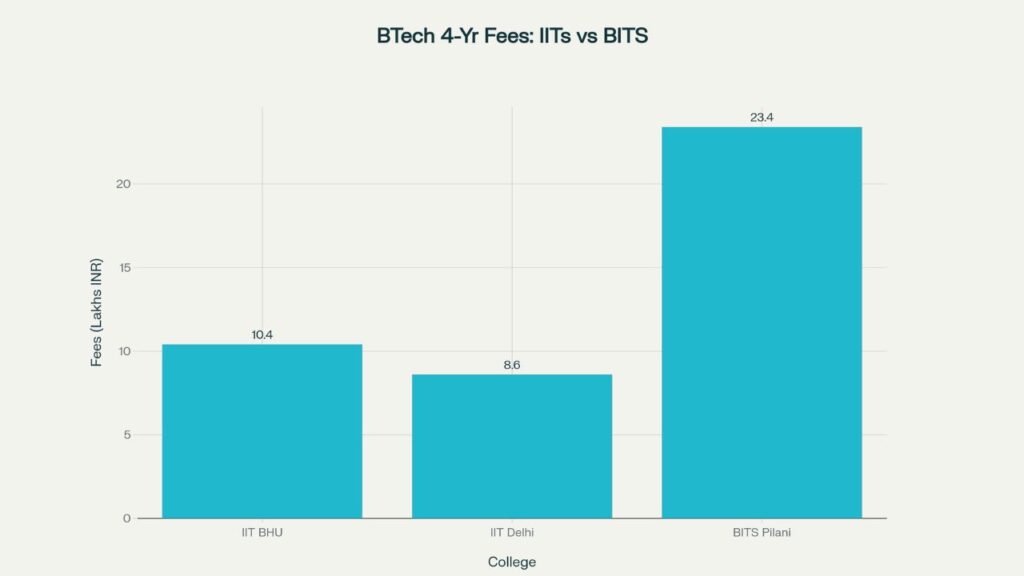
In order to get a sense of how affordable IIT BHU is, it makes sense to compare its 4-year B.Tech fee with that at other reputed institutes like IIT Delhi and BITS Pilani. The following amounts (approximates) are for General/OBC/EWS students with income above ₹5 lakh per year and do not include hostel/mess. 

InstituteApprox. 4-Year Academic Fees Verdict
IIT BHU₹ 10.4 lakhAmong the lowest 4-year IIT fees. 
IIT Delhi₹ 8.6–8.7 lakhSlightly lower than most IITs; very strong ROI. 
BITS Pilani (any campus)₹ 19–22 lakhNearly 2x IIT BHU; private, higher annual tuition.

Both IIT BHU and IIT Delhi receive government subsidies that make the cost of tuition approximately ₹8–10 lakh for 4 years.​

Since BITS Pilani is a private deemed institution the fees are much higher, the total cost for 4 years (including hostel and mess) can easily cross ₹22-24 lakh. 

Fee Comparison With IIT Delhi And BITS Pilani

4-year BTech Academic Fee Comparison (2025)

IIT BHU and IIT Delhi 4-year fees are about ₹10.4 lakh and ₹8.6 lakh respectively for the same duration. Meanwhile, tuition fees at BITS Pilani vary from ₹19 lakh to ₹22 lakh for 4 years, not inclusive of inflation and full residential expenses. 

For students who are granted income-based fee waiver or belong to SC/ST/PwD categories, IIT BHU becomes significantly better option over private colleges, as their burden of tuition fees is substantially reduced or waived off. This balance of modest fees, good placements and central government support is what makes IIT BHU one of the best ROI engineering options now available in India. 

Conclusion

The B.Tech fee at IIT BHU is kept as per the income slabs of students, Hindi Medium assistance patches are provided. With substantial waivers for economically backward sections and SC/ST/PwD students, and government subsidies making the aggregate academic fee lesser than most of the premier institutes, IIT BHU promises one of the best ROI among the top engineering colleges. 

The bottomline is that the 4-years cost of attendance remains affordable when compared to private institutes like BITS Pilani, whose fees can run to almost twice this amount, even after adding hostel and mess charges. If you are a student who wants a good mix of fees, quality education with good placements, IIT BHU is a very cost-effective and future proof bet. 

Leave a Comment

Your email address will not be published. Required fields are marked *

Scroll to Top