Data Science vs AI: Which Career Is Better?  

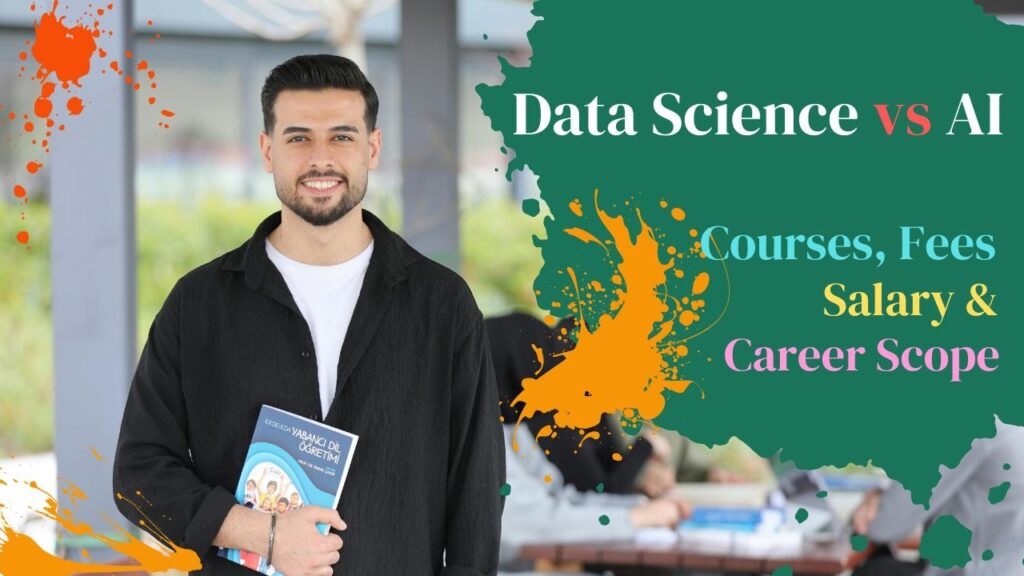
Data Science vs AI

Students in this generation really got stuck on choosing a stable career. In India, the choice is not limited between doctor or engineer anymore, there are a lot of options such as Data Science and Artificial Intelligence. Both are growing fields that offer wider opportunities. Continue reading to understand why Data Science vs AI comparison is important.

Most students couldn’t differentiate these two courses since they are somehow interconnected, every AI engineer needs data science fundamentals, and every good data scientist today is expected to know basic machine learning but work responsibilities, eligibility, and salary is different.

What Data Science Really Involves

Data Science, at its core, is about making sense of information that already exists. You’re looking at sales numbers, customer behaviour, hospital records, whatever the industry, and pulling out patterns that help a business make a decision. 

Data scientists at Paytm or JPMorgan often involve arranging raw data using manual coding and models to analyze trends, behaviour, and developing dashboards that allows managers to anticipate what might happen in the following quarter. The job depends a lot on statistics, SQL, Python and increasingly on data visualization tools to turn complex datasets into actionable insights. 

What AI Really Involves

Artificial Intelligence, on the other hand, is a trained model to automatically read data and process it without needing to be handled manually by any human. If Data Science is about interpreting the past, AI is about building machines that can act in the present or future. 

This includes machine learning models, deep learning, computer vision, natural language processing, and now heavily, generative AI and agentic systems. An AI engineer is more of a software builder than an analyst because constructing an AI model that not only reads data but also processes it with its own brain. 

Eligibility: Who Can Actually Get In

For Data Science Courses

The eligibility bar is comparatively relaxed. If you’ve cleared class 12 with Maths, Statistics, or Computer Science as a core subject, you can walk straight into a B.Tech, BSc or BCA in Data Science. 

For postgraduate programs, you need a bachelor’s degree in engineering, science, commerce, or even economics, along with basic statistics knowledge. This is why so many commerce and arts graduates in India are successfully switching into data roles through PG diplomas.

For AI Courses

AI is stricter about your technical background. Most AI degree programs, especially the IIT B.Tech in Artificial Intelligence, expect you to clear JEE Advanced, which means your foundation in Maths and Physics has to be genuinely strong from school itself. 

For M.Tech and PG-level AI programs, GATE scores are usually mandatory, and the cutoffs at institutes like IIT Patna and IIT Kharagpur are competitive. 

If you’re coming from a non-technical background, entering AI usually means starting with an online certification first and building up your programming and linear algebra skills before you can even think about a formal AI degree.

Best Courses for Data Science

If you want the government-institute route, the IIT Madras BS in Data Science and Applications is one of the most respected options right now, since it’s fully online and doesn’t require JEE, only a qualifier exam. 

IIT Roorkee & Kanpur, and IIIT Bangalore also offer certificate programs for both Data Science and AI. Other private universities like Christ University, NMIMS, and Symbiosis are recommended highly from former students and educators across India for offering BSc or MSc in Data Science.

If you are working professional and want to upgrade your career skills without spending three years to get a degree then shorter bootcamp-style programs from Scaler, DataTrained, and Great Learning are the best options for you. They provide courses that are designed specifically for getting a job within six to twelve months.

Best Courses for AI

If you have cleared JEE Advanced, B.Tech in Artificial Intelligence from IIT Hyderabad, IIT Madras, IIT Kharagpur, and IIT Gandhinagar are the right options for you to start your career journey in AI.

If you are a working professional, the IIT Roorkee Executive Program in Applied Data Science and AI, delivered through Jaro Education, has become a common pick because it doesn’t require you to quit your job. IIM and ISB executive AI programs are aimed specifically at managers who want to lead AI-driven teams rather than build models themselves, so that’s a different crowd entirely.

If you’re just testing the waters before committing money, NPTEL’s free AI and ML courses through IIT Madras are a genuinely good starting point, and they carry an official certificate for a token fee.

Read More 👉 Technical Government Jobs in India: A Complete Guide for Engineers and Diploma Holders

Fees: What You’ll Actually Pay

Data Science Courses Fees 

  • A Data Science course in India can be found at every possible cost. Free learning options are NPTEL, YouTube, and financial-aid courses on Coursera. 
  • Short online certification programs generally cost around ₹30,000, while structured postgraduate programs from training institutes typically range from ₹70,000 to ₹1.6 lakh. 
  • If you are looking for a degree such as BSc, MSc, or MBA in Data Science, the fees will be in the range of ₹1.5 lakhs to ₹4 lakhs. 
  • Certificate courses offered by IITs are generally in the range of ₹80,000 to ₹2.5 lakh, varying with the course content and duration. 

AI Courses Fees

  • AI courses are typically a little more expensive than Data Science courses since they may provide access to high-end computing resources or specialized labs, plus more industry-relevant training. 
  • Short online certification courses usually range from ₹20,000 to ₹50,000 and structured professional programmes—like the executive certification from the IIT—come at a cost of around ₹1.5 lakh and upwards. 
  • The fee for a four-year B.Tech in Artificial Intelligence at an IIT ranges from Rs 8.8 lakh to Rs 12 lakh, institute and fee structure wise. 
  • The executive AI programs of top business schools including IIMs and ISB are meant for the working professionals and usually vary from ₹3 lakh to ₹5 lakh for six to twelve months duration courses. 

So if budget is your biggest constraint right now, Data Science is genuinely the more affordable entry point, especially if you go the online-certificate-plus-portfolio route instead of a full degree.

Data Science vs AI Career Scope that Leads Better Opportunities

An entry-level data scientist in India can expect to earn from ₹3.5 LPA to ₹6 LPA in companies as data analyst, business intelligence analyst, junior data scientist. With 3 to 5 years experience and expertise in machine learning or big data tools like Spark, a candidate’s salary can go up to ₹15 LPA to ₹25 LPA.

Typically, the starting salary for AI roles is a bit higher at around ₹6 LPA to ₹10 LPA for a fresher AI or ML engineer, and experts working in NLP, computer vision, or generative AI at senior level are drawing ₹20 LPA to ₹40 LPA, sometimes more if they are working with LLM-based systems at a product company. 

Why does AI pay more at the top end? 

It’s not magic, it is because there are less people who can actually build these systems, and deploy these systems than there are people who look at a data set and analyse it. 

What Should You do After Completing the Course

Finishing the course is the easy part. If you have completed a Data Science course, your first step should be creating 3 to 4 real projects using publicly available datasets from Kaggle, preferably related to Indian industries like retail, fintech, or agriculture, as recruiters in this region love to see work that’s locally relevant. 

Learn to use SQL a little more than just the basics, learn how to tell a business story with your visualisations in Power BI or Tableau, and start applying for data analyst positions even before you feel “ready” because they all expect you to be learning on the job anyway. 

If you have recently completed an AI course, then your attention should be on deploying models rather than merely training models. You should write code on a Jupyter notebook and be able to turn it into an actual production run using tools like Docker and some minimal MLOps. 

Also publish the codes on GitHub because interviewers trust your hard work and concepts more than your certificate. And for where the industry is going, get serious about generative AI frameworks and agentic workflows, because that’s where the strongest demand for new hires is today, not in vanilla supervised learning, alone. 

Which One Should You Actually Pick

If you enjoy working with numbers that already exist, you like storytelling through data, and you want a lower-cost, faster entry into a paying job, Data Science is the safer and quicker route. If you’re strong in maths and coding, you’re patient enough to handle a steeper learning curve, and you want to be closer to building the technology rather than interpreting it, AI offers a higher ceiling, both in salary and in long-term relevance, but it demands more from you upfront, in both eligibility and course investment.

There isn’t a universally “better” choice here, there’s only the one that matches what you’re good at and what you’re willing to put in over the next two to three years. Most people building serious careers today don’t pick one and abandon the other anyway, they start in Data Science to build the foundation, and move into AI once they’ve got the fundamentals locked in.

Read More 👉 How To Prepare Current Affairs For Government Exams: A Complete Strategy

Conclusion

It’s better to understand the difference between Data Science vs AI before getting more confused. There is no single factor, but your budget, schedule, eligibility, and level of knowledge might affect your decision. 

Most importantly, your interests also matter. Getting confused in them is easy because they are somehow connected but work, courses, fees, and salary are totally different.  

Leave a Comment

Your email address will not be published. Required fields are marked *

DUVASU Mathura PVT Online Form And Full Details On Admissions, Eligibility, and Preparation

DUVASU Mathura PVT Online Form

DUVASU Mathura PVT Online Form can give you the opportunity to set your future as a veterinarian, biotechnologist, or agricultural scientist, by getting into a top university is the first important step on the path to your dream job. U.P. Pandit Deen Dayal Upadhyaya Pashu Chikitsa Vigyan Vishwavidyalaya Evam Go-Anusandhan Sansthan (DUVASU), situated at Mathura, is the best university for veterinary and allied sciences in India. 

Thousands of students contest for a place in DUVASU’s prestigious UG (Undergraduate), PG (Postgraduate), and diploma courses annually. The entrance to these courses is the Mathura PVT (Pre-Veterinary Test), which is held in a sky-high format under the UGEE (Undergraduate Entrance Examination), DEE (Diploma Entrance Examination), PGEE (Postgraduate Entrance Examination). 

Managing the process of admission may appear to be a daunting task at times. If you are going to get admission in 2026-27, in this article we are going to tell you everything to know that how you can apply for DUVASU Mathura PVT 2026 online form, how to check your eligibility, important dates and more. 

Why Choose DUVASU Mathura?

Before getting into the application process, let’s take a look at what makes DUVASU so desirable to students. It is not only just another veterinary university but a premier institute for veterinary education, animal science and research established by the Government of Uttar Pradesh. DUVASU has multiple constituent colleges, excellent infrastructure, faculty, and experiential clinical training, making it a comprehensive institute that draws aspirants from across India. 

Be it DUVASU or any other veterinary university (which is a regular university having agriculture and veterinary stream), you are guaranteed to graduate with theoretical knowledge, stringent practical work, and a degree that is well respected in the public (government veterinary officers) and private (dairy farms, biotech companies and pharmaceuticals) sectors. 

Important Dates for DUVASU Admission 2026

EventDate/Details
Online Application Starts15/February/2026
Last Date to Apply Online15/April/2026
Last Date for Fee Payment15/April/2026
Admit Card Release DateExpected in May/2026
UGEE 2026 Exam Date (UG)Update later (Usually late May/June)
DEE 2026 Exam Date (Diploma)Update later
PGEE 2026 Exam Date (PG)Update later

Courses Offered Through DUVASU Mathura PVT Online Form

The DUVASU offers many courses to cater the requirement of all these educational background and career related dreams.The main courses which you can apply for are: 

Undergraduate Degree Programmes (UGEE)Diploma Programmes (DEE)Postgraduate & Ph.D. Programmes (PGEE)
B.V.Sc. & A.H. (Bachelor of Veterinary Science and Animal Husbandry)B.Tech. (Biotechnology)B.Tech. (Dairy Technology)B.F.Sc. (Bachelor of Fisheries Science)Diploma in Veterinary Pharmacy (DVP)Diploma in Livestock Extension (DLE)M.V.Sc. and Ph.D. in Veterinary ScienceM.Sc. / M.Tech. / Ph.D. in BiotechnologyM.F.Sc. in Fisheries ScienceM.Sc. / M.Tech. in Dairy Science

Educational Qualifications and Age Limit for UG Programs

Students’ age must lie in the range of 17 to 25 years though it is relaxable by 5 years for the SC, ST and OBC candidates according to the state government rules. 

  • B.V.Sc. & A.H. / B.Tech (Biotechnology) / B.F.Sc: PCB students with 12th Marksheet.
  • B.Tech (Dairy Technology): PCM/PCB students with 12th Marksheet.
  • Marks Requirement Minimum: General, EWS and OBC students must have 60% marks and 55% for SC/ST students in their 12th marksheet. 

Educational Qualifications for Diploma Programs

To take admission in a Diploma course, candidates must have a passed certificate and marksheet of 10th and 12th with good scores in Physics, Chemistry, Biology and English.

Scores should be above 50% for General, EWS, OBC and 45% for SC/ST students.

Domicile Requirement

It should be brought to the notice that the candidate must be a resident of Uttar Pradesh for various state-quota seats, more so for the Diploma courses. Always verify with the official prospectus for course-specific domicile related instructions. 

Step-by-Step Guide to Filling the DUVASU Mathura PVT Online Form

DUVASU Application Form procedure is online only. The VARC does not entertain any hard copies of the registration form. Read the instructions below for a detailed step by step process to register as well as apply. 

Step 1: Gather Your Documents

  • A valid and active personal email ID & mobile number (The link, OTP and all other official communication will be sent to the email ID).
  • Class 10th Marksheet & Certificate (for Date of Birth Proof).
  • Class 12th Marksheet ( if passed ; candidates who are appearing can also apply, but they have to produce their marksheet at the time of counseling).
  • A recent passport-size color photograph with a white or light coloured background must be scanned.
  • A scanned copy of your signature (sign with a black or blue pen on a white sheet of paper).
  • Aadhaar Card or other valid government-issued ID.
  • Category Certificate (in case applying under SC/ST/OBC/ EWS Quotas). 

Step 2: Online Registration

  • Browse the university official portal: www.upvetuniv.edu.in or www.duvasu.com.
  • Click on Admission 2026-2027 – Apply Online under “Admission 2026-2027” menu.
  • Choose the level of Entrance exam you are going to appear for (UGEE for Bachelors, DEE for Diploma, PGEE for Masters/Ph.D.).
  • Enter your Basic details: Name, Father’s Name, Date of Birth, E-mail and Mobile No .
  • Submit the registration from You will get a unique Registration ID and Password on your mobile and Email Id. Keep this safe as you will need this to download your admit card.” 

Step 3: Complete the Application Form

  • Re-login to the portal using your new Registration ID and Password.
  • Complete the in-depth application form. This consists of the personal information, permanent and communication address, and educational qualifications.
  • Take your time here. Make sure your name is exactly as that given in your 10th certificate. A small spelling error can give you big headaches at the time of document verification. 

Step 4: Uploading Documents

Upload your scanned photograph and signature. Size and format must be in the given limit (usually less than 50-100 KB), do not upload blur or colourful pictures as it will be rejected.

Step 5: Pay the Application Fee

DUVASU Mathura PVT Application Fee is same for all candidates. Whether you belong to General, OBC, SC, ST, EWS, you have to submit Rs. 1800/- through online payment mode.

Step 6: Final Review and Submission

After submitting the payment, download and print the final confirmation page. Keep a physical copy of it safe in your admission folder — you need not send it to the university but take it to counseling. 

Understanding the Exam Pattern and Syllabus

Preparing for Mathura PVT, Hard work should be combined with a smart strategy. Knowing exam pattern is your blue print to win the game.

  • Method of Exam: The UGEE and DEE exams have, in the past, been conducted offline(i.e. Pen and Paper based) with the help of OMR sheets.
  • Question Type: Objective type (MCQs)
  • Subjects Covered: Physics, Chemistry And Biology. Instead of Biology, Math students have Mathematics.
  • Syllabus: It’s simple as you have already studied 10+2 UP board or CBSE syllabus. NCERT textbooks are more valuable to you for preparations.

What Happens After the Exam? (Counseling and Document Verification)

Once the examinations are completed, the answer keys will be made available by DUVASU and then the results will be announced through the same portal. The candidates will be ranked on the basis of marks secured in the exam and a merit list will be released.

If your name comes in the merit list then you will be called for offline counseling at DUVASU Mathura campus. This is wherein your readiness works off. You need to be present for the counseling with the original documents. 

Read More:- BPSC AEDO Syllabus, Recommended Books, Pattern, Job Profile & Skills Required

Preparation Strategy

Getting a seat in DUVASU Mathura involves a combination of timely application and good academic performance. Fill the DUVASU Mathura PVT online form at first, to avoid last day rush or server breakdown or payment gateway malfunction.

After you have filled the form, focus on preparation with all your might. Consider the NCERT books of Physics, Chemistry and Biology as your bible. Practice old question papers and do timed mock tests to enhance your speed and accuracy. 

Conclusion

Applying for the DUVASU Mathura PVT online form is an important step to enter in your interested field to study veterinarian, biotechnologist, or agricultural scientist. This is an opportunity for the interested candidates because DUVASU is an excellent university with a strong curriculum and experienced faculty. Most importantly is that it is a government university so you need to qualify the entrance exam to take an admission in this university and take a step forward towards your career.

Leave a Comment

Your email address will not be published. Required fields are marked *

AIIMS Nursing Officer Recruitment (NORCET-10) – 3600+ Vacancies, Eligibility, Exam Date & Apply Online

AIIMS Nursing Officer Recruitment

The AIIMS Nursing Officer Recruitment is the greatest Career option for the nursing candidates. The job notification dated 13-Feb-2026 contains 3,614 vacancies for Nursing Officers at different AIIMS across India and highlights the need for competent nursing professionals in the industry of healthcare. This isn’t a new government exam notification, it’s an entry point into the center of India’s most admired healthcare system, under the legendary All India Institute of Medical Sciences.

To thousands of nurses, NORCET-10 offers not just employment, but dignity, stability, advancement, and meaning in a profession tasked with the obligation of rescuing lives every day. 

Why AIIMS Nursing Officer Recruitment 2026 Truly Matters

The Indian public healthcare system is growing at a rate never seen before. Under national healthcare missions, new AIIMS campuses and tied up trauma centers are being established across the country. It’s a Nursing Officer behind every doctor, every ICU machine, every code red hospital protocol, who is the real backbone of hospital care.

In order to select these candidates in a just, transparent and merit-driven way, the Ministry of Health and Family Welfare (MoHFW) organizes a centralized national examination named NORCET (Nursing Officer Recruitment Common Eligibility Test).

The NORCET-10 (2026) will be the 10th edition of this exam, and it stands as the gold standard of nursing recruitment in India. It would anticipate 3,625–3,700 seats, a big fill new for the trauma centers and super-specialty wings. To the aspirants, particularly GNM or B.Sc. Nursing graduates, it’s an opportunity to get rid of private sector uncertainty and come under the central government umbrella. 

This one test is being held for recruitment to the posts of Nursing Officer in: 

  • Various AIIMS located in different parts of India
  • Top central government hospitals like
  • ESIC hospitals and associated medical institutions

One examination can provide you with different career options in the whole of India, That’s what it means. 

Schedule For AIIMS Nursing Officer Recruitment 2026

EventDate (2026)
Short Notification13/February 
Detailed NotificationBy 24/February​
Application Start24/February 
Application Close & Fee Payment16/March, 5:00 PM
Stage I (Prelims)11/April 
Stage I Results16/April 
Stage II (Mains)30/April 30
Final Results11/May 

Eligibility: Who Qualifies?

NORCET-10 is open to fresh graduates of B.Sc Nursing (Hons/Post Basic), experience not required and GNM certificate holders with 2 years post-qualification experience in a 50+ bed hospital. All the candidates must have a valid Nurse/Midwife registration with the INC or any State Nursing Council.

Age: 18–30 for UR/EWS (as on 16 March). Exemptions shall be applicable as under: 5 years for Ex-Servicemen 15 years(56 years) for SC/ST PwBD Category person.  

Application Fee

CategoryFee
General / OBC₹3000
SC / ST / EWS₹2400
PWBD₹0 (Free)

Massive Opportunities in 2026

With AIIMS Nursing Officer Recruitment 2026 NORCET-10, there is great scope for Nursing Officers, as a total of 3600+ posts are available across all AIIMS campuses, ESIC hospitals, and central government medical institutes. 

While this round of recruitment is not just replacing stagnation but also echoes a scale up of healthcare infrastructure – new ICU blocks, super speciality wings, trauma centres and regional AIIMS culturing. Notably, the growth is not metropolitan-centric and there are good job prospects in tier-2 and tier-3 cities as well. 

Vacancy Breakdown

CategorySeats%
UR1,46740.5
OBC1,02028.1
SC53614.8
EWS3539.7
ST2496.9

Exam Pattern: Two-Stage System

Preliminary 

Exam ParameterDetails
Total Questions100 MCQs
Total Marks100
Exam Duration90 minutes
SectionsBreakdown
General Knowledge & Aptitude20 questions
Nursing Subjects80 questions (covering nursing practices and theories)

Mains

Exam ParameterDetails
Total Questions160 MCQs
Total Marks160
Exam Duration3 hours
Focus AreasNursing principles, Image-based questions, Emergency care logic, ICU situations, Patient management decisions

Salary & Career Security

An AIIMS Nursing Officer is entitled to financial benefits under Pay Level 7 of 7th CPC. Their gross salary is ₹44,900 per month and the net salary is ranging from ₹65,000 to ₹72,000 per month. This works out a yearly package of ₹8–9 lakh. Other allowances include Dearness Allowance (DA), House Rent Allowance (HRA), Nursing Allowance, Uniform Allowance, Night Duty Allowance. 

This Job brings:

✔ Financial stability

✔ Government job security

✔ Pension benefits

✔ Medical facilities

✔ Social respect

✔ Family stability

Career Future Opportunities

Freshers

After the successful selection, candidates are appointed at the post of Junior Nursing Officer or Staff Nurse for the first time Nursing Officers commence their career. Initially, they get paid between INR 9,300 and 34,800 per month with a grade pay of INR 4,600. 

Skill Development and Specialization

The nursing officers are allowed to attend many training and workshops to upgrade their knowledge throughout their service. The specialization options allow nursing professionals to enhance their expertise and earn higher pay for taking on specialized roles and advanced positions for example in pediatrics, oncology or critical care. 

Promotions and Higher Roles

Through experience and skills growth, nursing officers can get promoted to the post of Charge Nurse, Nurse Manager or Clinical Nurse Specialist. These positions are usually more responsibility and more pay. For example, Nurse Managers can make a great deal more money, as they are leaders, managing teams of nurses and the day to day operations. 

Future Scope Of AIIMS NORCET Nursing officers who qualify through the AIIMS NORCET will be placed in a good position in a career that will only grow. With growing healthcare and a demand for trained nurses, there are plenty of opportunities to move into senior management or education roles. such as those concerned with supervising the practice of nursing or developing policies, or those that involve teaching. 

Read More:- HPSC Recruitment For PGT Post Graduate Teacher (PGT) Computer Science 2026

AIIMS Nursing Officer Application Process

The process to apply for the AIIMS Nursing Officer Recruitment 2026 is simple and involves few steps.

The online application process for the AIIMS NORCET 10 exam will be started from 24 February 2026. Submissions are due by March 16, 2026 and none will be accepted after 5:00 p.m.  

  1. Applicants are required to register on the official website of AIIMS by entering the requisite details.
  2. Application Form Submission: They will now be required to submit the application form along with their personal, educational and professional details.
  3. Document submission: Need to submit all required documents such as educational certificates and nursing registration with the application form.
  4. Payment of application fee: The application fee should be paid by the last date i.e. 16th March 2026. The fee information is usually available on the above section in this blog
  5. Final Submission: Print it out as it will be needed in the future after final submission with all the necessary documents. 

AIIMS Nursing Officer Recruitment 2026 (NORCET-10) Challenges

Pros: You can get:

  • Professional respect
  • Skill exposure
  • Advanced technology
  • Learning environment
  • Real impact on lives
  • Pride in service

Cons: Life in AIIMS is not easy:

  • Heavy patient load
  • Emergency pressure
  • Night shifts
  • ICU stress
  • Emotional challenges
  • Critical care responsibility

Conclusion

The AIIMS Nursing Officer Recruitment Common Eligibility Test (NORCET-10) for 2026 is more than just a regular recruitment, it is the cornerstone of quality maintenance in India’s top public health care system. By becoming one of the first exams in the country to make the change from ‘learning by rote’ to a highly secured two-level scenario based examination, AIIMS has raised the bar of cognitive abilities required in a nursing professional in India – bringing home recruitment at par with the most stringent clinical excellence globally. 

GovUpdatewala is your trusted source for real-time updates on government exams and jobs in India. We provide verified info on SSC, UPSC, Banking, Railways, Defense, and Teaching exams. From syllabus and patterns to important dates and career tips — we support aspirants at every step.

Leave a Comment

Your email address will not be published. Required fields are marked *

HTET 2025 Admit Card Out: Download Now from bseh.org.in for 30-31 July Exam

HTET 2025 Admit Card Out

Candidates who are waiting for the HTET 2025 Admit Card can now download from the official website of the Board of School Education, Haryana. You can download the notification for more details about this exam. The official date is 22/July/2025 for declaration of the admit card for examination on 30th to 31st July, 2025. By passing this state-level government exam, candidates are eligible for teaching in haryana government schools. 

Short Details on HTET 2025

ExamHaryana Teachers Eligibility Test
BoardBoard of School Education
Level of ExamState-Level
PurposeHTET is a state-level government exam to assess the knowledge of candidates for teaching.
Exam Duration2 hours 30 minutes
Exam ModeOMR/Offline
Admit CardClick Here
Official WebsiteClick Here

HTET 2025 Admit Card Dates

HTET Admit Card22/July/2025
PGT Level 3 Exam Date30/July/2025
TGT Level 2 Exam Date31/July/2025
PRT Level 1 Exam Date31/July/2025

Read More 👉 UPPSC Assistant Teacher Online Form 2025 Released for 7466 Posts

Eligibility For HTET Admit Card

This is a state-level government exam which makes you eligible for teaching positions in Haryana government schools and colleges. But there are some educational qualifications which are required for this examination.

There are three different levels of teachers – level 1 (primary teacher), level 2 (TGT Teacher), and level 3 (PGT Lecturer). With 10+12 marksheets, you need some higher education for this position. Here is the detail:

Primary TeacherMarksheet of 12th & Pass Certificate of D.Ed/B.El.Ed
TGT TeacherGraduation Degree & B.Ed/ Integrated Bachelor’s with B.Ed
PGT LecturerMaster Degree & B.Ed/ Integrated program

Steps To Download HTET Admit Card

Step 1Click on the link to the official website. The link will redirect you to the official website of Board of School Education, Haryana.
Step 2 Scroll down & Click on the “Haryana TET Admit Card” link.
Step 3Click on Login, the new page will open.
Step 4Enter Registration or Phone Number & Password to log in.
Step 5Admit Card will be shown, now you can download it.
Step 6Save your Admit card in your mobile or laptop for printout.
Important Links
Admit CardClick Here
Download NotificationClick Here
Official WebsiteClick Here

Leave a Comment

Your email address will not be published. Required fields are marked *

CTET Exam 2026: Check Exam City, Notice, Exam Dates, Syllabus and Eligibility Information

CTET Exam 2026

The golden opportunity is announced for all the Teachers in India through CTET exam 2026. Organized by CBSE, this country level examination is for teaching jobs in government and private schools for Class 1 to 8. Candidates who apply in December 2025 for this examination should get ready for the exams.

Notification Details

Exam notice is released for CTET exam 2026, you can also get official notification on the official website for all the details about the exam. Candidates who filled the forms in November — 18 December 2025 can prepare themselves for the examinations in prior time to avoid panic at the end.

CTET February 2026 Exam Dates and Format 

FeatureDetails
Exam Date7 & 8 /February /2026 (Saturday & Sunday)
Mode of ExamOffline (Pen & Paper / OMR Sheet)
Number of Cities132 to 140 Cities Nationwide
Total PapersFor 1-5 Standard: Paper I;  For 6-8 standard: Paper II
Question Type150 Multiple Choice Questions 
Total Marks150 Marks per paper
Duration150 Minutes (2.5 Hours)
Negative MarkingNone
Language OptionsBilingual (Hindi/English) + 20 Regional Languages

Syllabus Overview

Paper 1 consists of questions from Child Development & Pedagogy, Language I & II, Science (for Science group), Social Studies (for Social studies group), Mathematics, and Environmental Studies, the emphasis is primarily on assessing the capability to teach at mali-ly school children. 

Paper 2 deals with Child Development, Language I and II and options such as Maths/Science or Social Studies for senior levels. 

Subjects stress pedagogy, theories of learning, and content of subjects based on guidelines of NCTE. 

Pass requirement is 60% for general (55% for reserved). 

Education and Age Limit Rule

  • There is no age limit here—everyone is welcome to apply, if you are Indian or you have Indian roots. 
  • For Paper 1, you should have a minimum of 50% in 10+2 with a 2-year Diploma in Elementary Education (D.El.Ed) or graduation with B.Ed. 
  • Paper 2: Graduation with minimum 50% marks and B.Ed or its equivalent like B.Ed (Special Education) is essential. . 
  • Reserved Category (SC/ST/OBC/PwD) Candidates can get Relaxations of 5% less in qualifying marks. 
  • Candidates who are appearing in the last year of their course are also eligible. 

CTET exam 2026 Admit Card Download Step-by-Step Instructions

  1. Go to the Important links section below and click on the Admit Card option.
  2. Enter your login details correctly to avoid interruptions and download your admit card
  3. Admit Card will appear 3-4 days before the exam, kindly wait for it.
  4. After the CTET admit card has been issued, get print out from here to carry a copy with you to the exam centre. 
Important Links
Exam NoticeClick Here
Date & City of examClick Here
Admit CardClick Here
Official WebsiteClick Here

Leave a Comment

Your email address will not be published. Required fields are marked *

Technical Government Jobs in India: A Complete Guide for Engineers and Diploma Holders

Technical Government Jobs in India

If you are looking for Technical Government Jobs in India, that means you must prepare yourself for a high salary, additional benefits, respect from society, and a secure future. But it does cost you fun and time since absolute dedication is the key for securing a position among lakhs of aspiring candidates. 

SSC JE, RRB JE, state PWD recruitment happen every year to fill thousands of vacancies. But the paths of every engineer is different, someone who wants a Railway JE posting is preparing for a completely different life than someone chasing an ISRO Scientist/Engineer role. This guide will help you understand these paths and what fits you right.

SSC JE (Junior Engineer): The Most Common Entry Point

The Staff Selection Commission’s Junior Engineer exam is where most Civil, Mechanical, and Electrical engineering graduates start. It recruits for departments like CPWD, MES, BRO, and the Central Water Commission. The exam runs in two stages — Paper 1 is objective (general knowledge, reasoning, and technical subjects), Paper 2 is a more detailed technical paper based on your branch.

The appeal of SSC JE is its predictability. The syllabus barely changes year to year, previous papers are widely available, and postings tend to be closer to home compared to Railways or Defence roles. Pay lands in the Level-6 pay matrix, roughly ₹35,000–₹40,000 in-hand after allowances, depending on posting city and department. The catch is that promotions are slow — a JE can spend eight to ten years before moving to Assistant Engineer, and that stagnation is the number one complaint from people already in the role.

RRB JE and RRB ALP: Railways’ Technical Backbone

Railways run two separate technical recruitment tracks that people often confuse. RRB JE (Junior Engineer) is for those wanting supervisory technical roles maintaining tracks, signals, electrical systems, or bridges. RRB ALP (Assistant Loco Pilot) is a different animal entirely — it’s the entry point to actually driving trains, and it comes with its own physical and psychometric tests beyond the written exam.

Railways technical postings come with perks civilians don’t always factor in — free or discounted travel passes, quarters in many postings, and a pension structure that’s still meaningfully better than most PSU jobs. But the tradeoff is posting uncertainty. A Railway JE from Lucknow could easily end up posted in a remote section in Northeast Frontier Railway for the first few years, and that’s something aspirants researching only the syllabus tend to overlook.

Read More 👉 Government Jobs After Graduation in India: Complete Guide for 2026

Defence Technical Entries: Army, Navy, and Air Force

This is where things diverge sharply from civilian technical jobs. The Indian Army’s SSC Technical entry (the batch numbering keeps advancing — the 68th course cycle, for instance, recruits engineering graduates directly as officers into the Corps of Engineers, Signals, or EME, skipping the JCO/NCO route entirely). Unlike SSC JE or Railways, this isn’t a desk-adjacent technical job — it’s a commissioned officer role with military training at OTA Chennai before the technical posting even begins.

The Navy and Air Force run parallel technical officer entries — the Navy’s Short Service Commission (Executive/Technical branches) and the Air Force’s Technical Branch through AFCAT. Pay here is structured differently too — officers get a fixed pay scale plus Military Service Pay and allowances that push in-hand compensation well above equivalent civilian technical roles, sometimes crossing ₹1 lakh a month for junior officers once field and flying allowances are added. What people don’t talk about enough is the SSC (Short Service Commission) design itself — these are typically 10-14 year engagements, not permanent careers, and the transition back to civilian technical work afterward needs its own planning.

PSU Technical Recruitment: ONGC, NTPC, ISRO, DRDO

Public Sector Undertakings run their own technical recruitment, separate from SSC or UPSC, and this is genuinely the highest-paying bracket in government technical work. ONGC and NTPC recruit through GATE scores directly — no separate written exam, which is a huge relief for anyone who’s already invested a year preparing for GATE for M.Tech admissions anyway. 

Starting packages at Maharatna PSUs like ONGC or NTPC can cross ₹10-12 lakh per annum for a fresh Graduate Engineer Trainee, which is a different league from the ₹4-5 lakh range typical of SSC JE roles.

ISRO and DRDO sit in their own category — Scientist/Engineer ‘SC’ recruitment through GATE or their own written exam (ISRO doesn’t accept GATE scores for most positions and runs an independent test). These aren’t just jobs, they’re research-adjacent careers, and the selection bar reflects that — competition is brutal, and the interview process digs deep into core subject knowledge rather than generic aptitude.

Read More 👉 Indian Army SSC Technical 68th Men Recruitment: Details for Engineering Graduates

State Engineering Services: PWD, Irrigation, and Jal Nigam

Every state runs its own Assistant Engineer (AE) and Junior Engineer (JE) recruitment through its Public Service Commission or a dedicated recruitment board — UP has UPPSC and UPSSSC running parallel tracks, for instance. These roles are attractive to candidates who prioritize staying within their home state over chasing an all-India posting, and the pay, while modest at the JE level, comes with strong long-term security and a clearer path into the state’s engineering cadre hierarchy.

The tradeoff here is exam frequency and vacancy unpredictability — state-level technical recruitment doesn’t run on the same predictable annual cycle as SSC or Railways, and vacancies can be sparse in years when the state government is tightening hiring.

Which Path Actually Fits You?

If you want to enter a government sector for a stable career, choose SSC JE which is best for everyone. If you are looking for a higher salary and you can secure a good GATE score then PSU roles are good options. 

If leadership, discipline, and a fixed-term high-intensity career appeal to you, Defence technical entry is a completely different but rewarding route — just go in knowing it’s a commission, not a permanent civilian job. And if roots matter more than reach, state engineering services quietly remain the most underrated option on this list.

Conclusion of Technical Government Job

Technical Government Job in India offer a secure future which can be prestigious in this time. Private jobs don’t give high salary and long-term stability but the government sector offers engineering roles in every department including the country’s infrastructure, transportation, defence, and scientific progress.

Before beginning your preparation, understand every detail that is required to beat the exam. It will also help you pick the path that aligns with your strengths and interests. Staying consistent is the key for rewarding a technical career.

Leave a Comment

Your email address will not be published. Required fields are marked *

Scroll to Top