IBPS PO/MT-XVI Score Card & Mains Admit Card Out

IBPS

IBPS PO/MT-XVI 2026 mains admit card and the Prelims scorecard are now out. If you took the exam, head over to the official IBPS website and download both as soon as you can. Those who cleared the Prelims can now move on to the Mains, which is scheduled for October 2026. This year’s drive has 7,365 vacancies for Probationary Officers and Management Trainees, so there’s plenty of opportunity for those who make it through.

You can download both admit card and scorecard from the same website. This scorecard marks will not be added in the final merit. Only Mains and Interview marks are accounted for, so start practicing mock tests to qualify the exam. Exam dates will be announced by the authority soon on the official IBPS website.

Important Date for IBPS PO/MT-XVI 2026

StageDate
Prelims scorecard29 September 2026
Mains admit card24 September 2026
Mains examOctober 2026
Mains result and scorecardNovember 2026
Personality testNovember 2026
Interview letterNovember 2026
InterviewNovember/December 2026
Final resultJanuary 2027

How to Download Mains Admit Card & Pre Scorecard

Use the same IBPS portal; different links appear under CRP PO/MT‑XVI. Officially, IBPS issues separate admit cards for Prelims, Mains, and Interview. 

Download 👉 RRB Technician Grade I & III City Slip 2026 & Admit Card

Mains Admit Card (for 4 Oct 2026 exam)

  1. Go to ibps.in → CRP PO/MT → CRP PO/MT‑XVI.
  2. Click “IBPS PO Mains Call Letter 2026”.
  3. Log in with Registration No./Roll No. + Password/Date of Birth + Captcha.
  4. Download and print 2–3 copies.

Prelims Scorecard (Pre Score Card)

  1. On ibps.in, open CRP PO/MT‑XVI.
  2. Click the Prelims Result/Mark link.
  3. Log in with your credentials.
  4. View/download the scorecard showing sectional marks, overall score, and qualifying status.

What to Carry on Mains Exam Day

  • Printed Mains admit card (call letter)
  • Original valid photo ID (Aadhaar/Passport/PAN/Driving Licence, etc.)
  • Black/Blue ballpoint pen; follow all instructions printed on the admit card.

What Should Qualified Candidates Do Right Now?

1. Check your result and download your scorecard. Log in to the official IBPS portal with your registration number and password or date of birth. Save a PDF and a printout of both the result and the scorecard.

2. Download your Mains admit card. Check the exam date, time, venue and reporting instructions carefully. Bring a valid photo ID and follow all document requirements.

3. Shift to Mains mode immediately. The Mains exam is only a few weeks away in October, and Prelims marks are typically used only for qualifying, so your Mains performance is what decides your rank. The Mains also includes a descriptive test, so start practicing letter and essay writing now.

What To DO If You Are Not Qualified?

If you are not qualified in this exam then don’t get stressed because other exams like SBI Clerk/PO and RBI Grade B are in a lineup. So apply for those exams since the syllabus and eligibility are almost similar. However, analyze your mistakes from the scorecard to correct your answers.

Quick Mains Preparation Strategy

  • Take full-length mocks weekly. Sectional practice is good, but the Mains is about stamina across sections.
  • Prioritize data interpretation and reasoning. These sections carry high weight and reward regular practice.
  • Collect daily current affairs and make notes related to banking awareness and economy news feed.
  • For fluency, write one essay and letter under a timer to enhance descriptive writing.
  • Improve English with reading comprehension and practice error spotting as a daily habit. 
  • In the last week, start revising what you learn, do not start new topics.

IBPS PO/MT-XVI 2026 Selection Procedure

IBPS PO/MT‑XVI (2026) uses a three‑stage selection process: Prelims → Mains → Interview, followed by final merit list and provisional allotment.

StagePurposeNature
Preliminary ExamScreening test; marks not counted in final meritQualifying only
Main ExamCore selection test; marks used for final meritScored
InterviewPersonality/fit assessment; marks added to Mains for final meritScored

How final selection is calculated

Prelims marks are NOT added to the final score but important to reach at Mains. Final merit is prepared using Mains score + Interview score where your interview also carries 100 marks 

Provisional Allotment is based on final merit, your category, preferences, and vacancy availability, IBPS issues provisional allotment to participating PSBs.

Conclusion

The IBPS PO/MT-XVI 2026 admit card and preliminary scorecard are now available online. Candidates should download their documents and check their scores. Those who qualify for the next stage should keep track of the Mains exam dates and start preparing accordingly.

There are a total of 7,365 vacancies for Probationary Officers and Management Trainees and the current stage of the IBPS recruitment 2026 is a result of Prelims. The admit card for Mains is also released so download now. This recruitment cycle offers a real opportunity. Stay consistent, stay calm, and treat every mock test as a lesson.


Leave a Comment

Your email address will not be published. Required fields are marked *

BSF HCM Syllabus 2026 & Exam Pattern Explained

BSF HCM Syllabus

So, you are eyeing the BSF HCM Syllabus. Specifically, you wanted the Head Constable (Ministerial) vacancy for the year 2026. That’s a spectacular aim. It’s a position that brings stability, a little dignity and an opportunity to serve your country from inside the institution that actually defends its borders.

But let’s be honest for a second — Taking this exam cold is like patrolling the desert in flip-flops. You’ll make some headway but it’s gonna be painful and probably futile. The syllabus is broad and the competitive is cut-throat. You have to begin early if you want to keep ahead of things, and you are going to need to know just what you are getting into. 

Your one stop destination to know what Expected BSF Head Constable Ministerial Syllabus Exam Pattern. Let’s look into this guide to be aware of what’s coming next.

Understanding The Selection Process

Before we discuss the books and formulas, we need to see the framework. While the official notification for 2026 is yet to become available (at present), the BSF maintains a relatively stable pattern. Knowing “Stages” is important because this isn’t just a pen-and-paper exam; it’s an assessment of your entire being.

For the 2026 cycle, the selection procedure is anticipated to broadly comprise five phases:

  1. The Written Exam (The Big Filter): It’s the gatekeeper. Score well here, and you move forward.
  2. Physical Standard Test (PST) & Physical Efficiency Test (PET): You are enlisting a uniformed service so there is no doubt about importance of fitness.
  3. Typing Speed Test: As this is a “Ministerial” position, clerical skills are important.
  4. Verification of Documents : To verify whether your certificates are as per with your claims.
  5. Medical Examination: To make sure you are physically capable of serving.

We’re going to be heavily focusing on that first phase—the Written Exam because that’s where 80% of the battle is won or lost. 

Phase 1: The Written Exam Pattern

ParameterDetails
Exam FormatObjective Multiple Choice (OMR-based)
Total Questions100
Total Marks100
Duration2 Hours (120 Minutes)
Question TypeObjective Type (MCQs)
Negative MarkingYes, 0.25 marks per wrong answer

Subject-wise Distribution:

SubjectMarks Allocated
General Intelligence & Reasoning25
General Awareness & GK25
Numeric 25
English/Language Comprehension25

What You Actually Need to Study

BSF HCM Syllabus

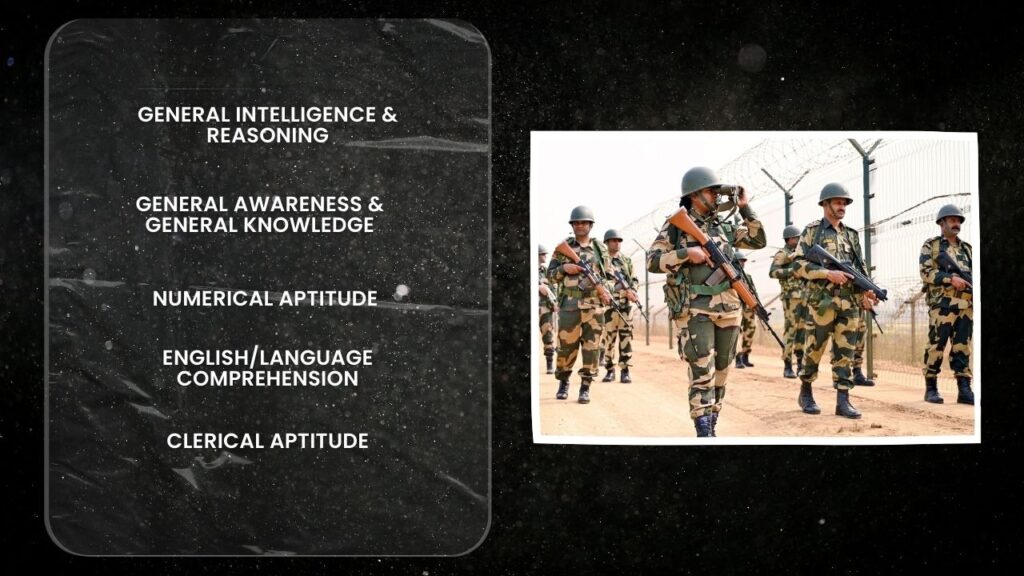
1. General Intelligence & Reasoning (25 Marks)

  • Analogy : To recognize relationships among words (e.g. Doctor, Hospital, Teacher).
  • Decoding Coding: The traditional sleuthing. 
  • Series Completion: In this, a certain pattern of numbers and alphabets is given. Find the missing link. 
  • Blood Relations: These are tangled family trees. If A is B’s brother’s mother’s sister…
  • Direction Sense: If you make a left turn, walk five kilometres, then take a right.
  • Venn Diagrams: representing Group Intersections. 

2. General Awareness & GK (25 Marks)

This part divides the normal aspirants and the obsessed aspirants.

  • Current Affairs : Open the newspaper every day (without fail). Concentrate on national news, sports, awards, and books.
  • Indian History: Freedom movement is a favourite topic. Be familiar with the Gandhian era, the 1857 Revolt, and significant milestones.
  • Geography: Emphasize on Indian geography like rivers, mountains, states and their capitals. The geography of the world is often restricted to a few key aspects.
  • Indian Polity: The Constitution. Rights, Duties and Parliamentary Procedure.
  • General Science. Normal Physics + Chemistry + Biology ( till 10 grade). Do not skip this portion; high yield and simpler than engineering science. 

3. Numerical Aptitude (25 Marks)

You don’t have to be a mathematician but you do have to be quick with numbers.

  • Number Systems: LCM, HCF, Whole Numbers.
  • Simplification: BODMAS rule.
  • Percentages & Profit/Loss 
  • Ratio & Proportion: Add things in the right amount.
  • Time and Work : If A can paint a house in 5 days and B can paint it in 10… then what is the combined time?
  • Time, Speed, and Distance: Trains and Platforms. 

4. English/Language Comprehension (25 Marks)

As the role is ‘Ministerial’, your proficiency in using official language is assessed.

  • Grammar: Spot the errors in a sentence, find tenses of the to complete the sentences. 
  • Vocabulary: Find every given word synonyms, antonyms and idioms.
  • Comprehension: You are provided a passage to which you would have to pose questions. 
  • One Word Substitution: One word is said for something complicated. 

5. Clerical Aptitude 

This is specific to this job. It determines if you have the personality for working in an office.

  • Detail Orientation: Identifies mistakes in addresses, numbers.
  • Routines in a Basic Office: Knowledge of filing, indexing, and verifying data consistency. 

Read More 👉 IAS Preparation Roadmap: Step-by-Step UPSC Strategy That Actually Works

Phase 2: The Skill Test (Typing)

After you clear the written test, you have to appear for the Typing Test. It has stood the best practical test for 2026 cycle.

  • English Typing: 35 words per minute (wpm) is usual.
  • Hindi Typing: 30 words per minute is usual.

Please Don’t Ignore This: So many brilliant students do not make it here because they only concentrated on the written exam. If you can’t type, you can’t do the job. Get started with your practice on Typing Master or any other typing software. Build muscle memory. Speed comes with accuracy, so concentrate first on hitting the right keys and later on going fast. 

Phase 3: Physical Standards (PST/PET)

They have to meet the various physical criteria, such as for males and females a minimum height of approximately 167.5 cm and 157 cm respectively, subject to relaxations for certain categories. 

Male applicants are subject to chest measurements of 78 cm unexpanded and 83 cm expanded. There is also a physical efficiency test, generally a 1.6 km run which must be completed within a stipulated time (e.g.6.5 minutes for males). 

Strategy for the 2026 Cycle

BSF Head Constable Ministerial Syllabus

Since this is the 2026 paper, you have time after all. Most candidates are underprepared, starting too late, just 3 or 4 months prior to the exam. 

1.The Foundation Period (Months 1-3):

Not so fast in the mock tests. NCERTs (read class 6 to 10) for Science and History. Solidify your grammar base. Clear your concepts of reasoning.

2.The Practice Phase (Months 4-6):

Start solving previous year papers. Not for the score, but to see what the BSF questions look like “trending” Are they give me more on current affairs? Is the math getting harder? Adapt accordingly.

3.The Mock Test Phase (Last 3 months):

Simulate the exam environment. Sit at a table, put your phone away and finish a 100-question test in 2 hours. Analyze each mistake and prepare for the last one. 

Conclusion

Becoming a BSF HCM Syllabus 2026 is a long journey. There will be days when you get the feeling that you are not holding on to anything but don’t lose hope.

Keep Consistent to fulfil your dream. Even studying a bare minimum of 4 hours a day but doing so everyday without fail would be enough to beat 90% of the competition who study sporadically.

Keep the syllabus handy, follow the pattern and have the eyes on the prize. That uniform isn’t just fabric, it’s a responsibility. And it’s waiting for you. 

Collateral vs No Collateral Loan Amount Where Collateral Starts Making Financial Sense

Collateral vs No Collateral Loan

Ask most people whether a secured loan beats an unsecured one, and they’ll say yes without blinking — lower interest rate, obviously better. That’s the assumption. It’s also where the math quietly falls apart, because a lower rate on paper doesn’t always mean a lower cost in your pocket. Don’t get confused about Collateral vs No Collateral Loan, understand where it matters.

Whether collateral actually saves you money depends on how much you’re borrowing, and more specifically, on what kind of asset you’re pledging to get that lower rate.

This isn’t a “secured is always cheaper” point. It’s about the exact moment moves depending on the collateral where the interest-rate discount stops being eaten alive by fees, valuation costs, and paperwork.

What Changes When You Add Collateral to a Loan

A collateral loan amount decision comes down to three things shifting at once, not just the rate.

The interest rate drops, because the lender’s risk drops. If you default, they recover the loan by selling or auctioning the pledged asset. As of late 2026, unsecured personal loans in India typically run 11–18% per year for a reasonably qualified borrower, and unsecured business loans usually start closer to 16%. Gold loans from banks price between roughly 8.5% and 12%, and loans against property (LAP) generally fall between 8.5% and 14%, though NBFC gold loans for weaker profiles can climb well past 20%.

Fixed costs show up that don’t exist on an unsecured loan. Asset valuation, legal verification, mortgage registration, sometimes insurance on the pledged asset. These are flat charges — they don’t scale down for a small loan the way percentage-based interest does.

Your money moves slower, and your asset stops being liquid. A personal loan can land in your account same-day. A property-backed loan needs valuation, title checks, and registration, which can take one to three weeks. During that time, and for the life of the loan, that asset is off the table if you need to sell it, gift it, or use it as collateral again elsewhere.

That third point is the one people underweight, and it matters more as the loan amount grows, not less which is part of why there’s no single “collateral is worth it above this number” answer.

The Real Threshold Depends on Which Asset You’re Pledging

The breakeven point isn’t one number in Collateral vs No Collateral Loan. It’s a different number for every type of collateral, because the fixed costs attached to each one are wildly different.

Gold or fixed-deposit collateral has almost no fixed-cost floor. A gold loan can be sanctioned in under an hour, valuation is done on the spot, and processing fees run 0.25–1% of the loan amount — often just a few hundred rupees on a small ticket. Because there’s barely any fixed cost to clear, a gold loan can make financial sense on amounts as small as ₹50,000–₹1 lakh. The rate gap versus an unsecured loan (often 4–8 percentage points) starts saving you money almost immediately.

Property as collateral (LAP) is the opposite case. Valuation fees, legal verification, and mortgage registration or stamp duty typically add up to somewhere between ₹15,000 and ₹30,000, depending on the state and lender — and that’s before you factor in the two-to-three-week processing time. On a small loan, that fixed cost can wipe out most or all of the interest savings. LAP generally only starts making financial sense somewhere in the ₹5–8 lakh range, and it becomes clearly worthwhile above ₹10 lakh, where the fixed costs shrink to a rounding error against the total interest saved.

Vehicle or equipment-backed business loans sit in between — moderate valuation costs, faster processing than property, and a breakeven point that usually lands somewhere in the ₹2–4 lakh range.

A Quick Numbers Comparison 

Here’s a simplified comparison over a 3-year tenure, using a representative unsecured rate of 15–16% against a representative secured rate of 10% (gold loan) or 10% (LAP), before fixed costs:

Loan AmountInterest Paid Unsecured (~16%)Interest Paid Secured (~10%)Raw Interest SavedTypical LAP Fixed CostsNet Saving After Fixed Costs
₹1,00,000~₹25,000~₹16,000~₹9,000N/A (use gold loan, not LAP)Gold loan: still net positive
₹2,00,000~₹53,000~₹32,000~₹21,000~₹20,000Roughly breakeven
₹5,00,000~₹1,33,000~₹81,000~₹52,000~₹20,000~₹32,000 saved
₹15,00,000~₹3,98,000~₹2,42,000~₹1,56,000~₹25,000~₹1,31,000 saved

Note: these are illustrative figures based on representative rate bands, reducing-balance EMI math, and typical fee ranges reported by Indian lenders as of August 2026. 

The pattern holds regardless of the exact numbers: 

On a ₹1 lakh loan, a gold loan wins easily because there’s almost no fixed cost standing between you and the rate discount. On a ₹2 lakh loan taken as a property-backed loan specifically, the fixed costs and the interest savings roughly cancel out — which is exactly why lenders rarely push LAP that small in the first place. By ₹5 lakh and above, the fixed cost stops mattering and the rate gap does all the work.

When Collateral Still Doesn’t Make Sense, Even Above the Threshold

Crossing the breakeven number doesn’t automatically make collateral the right call. A few situations flip the decision back toward unsecured, even at a large loan amount and you started searching for  Collateral vs No Collateral Loan.

  • You need the money in days, not weeks. An unsecured personal loan can disburse within 24–48 hours. A property loan’s valuation and registration process can eat two to three weeks — a real cost if the need is urgent (medical, a time-bound business opportunity, an admission deadline).
  • The asset has a use you’d lose access to. Gold jewelry you might need to sell or gift, or a property you’re planning to sell within the loan tenure, becomes harder to move once it’s pledged. Foreclosure and part-release processes add time and fees of their own.
  • Your income is genuinely unstable. Secured loans still get called in on default — the lender auctions the asset. If repayment is uncertain, adding “losing the collateral” on top of “damaged credit score” is a worse outcome than an unsecured default alone, all else equal.
  • The rate gap has shrunk. RBI rate cuts through 2025 and 2026 have compressed the spread between top-tier unsecured personal loans (some starting near 10%) and secured options in certain cases. Always compare Collateral vs No Collateral Loan live quotes — a hypothetical rate gap on a post isn’t the rate you’ll actually be offered.

Which One Should You Pick Between Collateral vs No Collateral Loan?

Match the collateral type to the loan size, not the other way round:

  • Borrowing under ₹2 lakh and you own gold or have a fixed deposit sitting idle? Pledge it — the fixed-cost floor is low enough that it almost always wins over an unsecured loan.
  • Borrowing ₹2–5 lakh? Run the actual numbers from at least two lenders before deciding. This is the genuine grey zone where fees can cancel out the rate advantage.
  • Borrowing ₹5 lakh or more and you have a property or a high-value asset to pledge? Collateral almost always wins on cost, provided you can tolerate the slower disbursal and the asset being locked up for the tenure.
  • Need the money within a week, regardless of amount? Unsecured is usually the only realistic option, and the speed premium is worth paying for.

The rate on the sanction letter is only half the decision. The other half is whether your loan amount is big enough to make the fixed costs of pledging that asset disappear into the background — and that number changes depending on what you’re pledging, not just how much you’re borrowing.

Read More 👉 Your Credit Score Ignores 90% of Your Financial Life — What Your First Credit Card Changes 

Conclusion

Collateral doesn’t automatically make a loan cheaper if you understand at what point it financially makes sense then you won’t get confused ever. The loan amount, the asset you pledge, and the rate difference all have to work in your favour. 

Which kind of loan you are seeking is also a matter, Gold or FD-backed loans can make sense even at smaller amounts because their upfront costs are low, while other higher loans such as property-backed loans usually need a much larger ticket before the interest savings outweigh valuation, legal, and registration costs.

Collateral vs No Collateral Loan is not a big confusion, there is no universal ₹5 lakh or ₹10 lakh cutoff where collateral suddenly becomes worth it. So you must understand where your interest savings finally outweigh the real cost and inconvenience of pledging the asset. 

Medical vs Engineering: Which Career Will Make You More Successful in 2025

Medical vs Engineering

If you are an Indian student in Class 10, 11, or 12, chances are you’ve heard a version of this line at least a dozen times. The age-old battle between Medicine and Engineering is a part of our DNA. For generations, these two streams have been seen as the ultimate tickets to a successful, secure, and respectable life.

The world is rapidly changing in 2025 with a lot of new career options for students. But when it comes to choosing between two different careers, everyone gets confused: Which path is better? Medical or Engineering? 

It’s a big decision of your life, both careers need your full potential whether you are preparing for NEET or JEE. It affects your life and your parent’s life too. Choose your path which aligns with your interest and skills.

The First Hurdle: The Challenging Road of Education

Before you can even dream of a stethoscope or a high-tech lab, you have to cross the battlefield of entrance exams. This is the first and most critical difference.

NEET (for Medical): The Marathon of Memory

  • The Exam: This is a single entrance exam for admission in MBBS. In 2024, over 23 lakh students fought for just over 1 lakh MBBS seats. The competition is insane.
  • The Challenge: Tons of topics to cover in Physics, Chemistry, and especially Biology, inside and out. It’s less about complex problem-solving and more about incredible memory, accuracy, and speed.
  • The Journey: The path is long. The time period is 5.5 years for MBBS with an internship certificate. After becoming a doctor at beginner level. You must do a postgraduate degree (MD/MS) to become professional, which is another 3 years after clearing another tough entrance exam, NEET-PG.
  • The Cost: Government medical colleges are very affordable (a few lakhs for the entire course). But getting a seat is like winning a lottery. You must be ready to invest ₹50 lakh to over ₹1 crore for MBBS course and more for postgraduation.

JEE (for Engineering): The Sprint of Logic

  • The Exam: This is a two-step process. JEE Main is the first filter. If you clear it, you can get into NITs and other good colleges. Admission in IITs is tough, you need to clear JEE Advanced.
  • The Challenging Step: If you are interested and have deep understanding in Maths, chemistry and physics, preparing for JEE isn’t that hard for you. But you must prepare with right strategy to beat the competition and get a chance for better college option. Because without a valuable degree, you will not get a high package of jobs. 
  • The Journey: A B.Tech degree is 4 years long. After this, you are an engineer and can start working immediately. A postgraduate degree (M.Tech) is an option, not a necessity, unless you want to get into research or specialised teaching roles.
  • The Cost: The fee for IITs and NITs is around ₹8-12 lakhs for the entire course, which is much more affordable than private medical colleges. Private engineering colleges have a huge range, from a few lakhs to ₹20-25 lakhs.

The stress of Kota coaching factories, the pressure from family, the fear of “wasting a year” – it’s real for both aspirants. A medical journey requires your time and money to become a doctor. You have to make commitments for this career.

Read More 👉 Top Engineering Govt Jobs in India 2025 – High Salary

Career Scope & Opportunities in 2025?

Engineering: it offers a diverse range of opportunities on national and international level.

The word ‘engineer’ is broad. The opportunities in 2025 depend heavily on your branch.

  • Computer Science & IT: This is the king of the jungle right now. With AI, Machine Learning, Data Science, and Cybersecurity booming, a skilled software engineer from a good college can land a job even before their final exams. 
  • Electronics & Communication: This field also requires engineers for running a network, designing for semiconductors, and automation. ECE engineers can get a lot of opportunities with a good salary package.
  • Mechanical & Civil: These are ‘evergreen’ branches. If students have skills and ability to construct, manufacture, and renewable energy then they can pick this career for their career.
  • Abroad: IIT or NIT qualified engineers are well-respected globally. With the right skills you can work on large projects abroad such as the US, Europe, and Australia.

Medical: Job security, secure future, and Respect in society

With an increasing health crisis, everyone needs a doctor who can cure and treat them. After MBBS, Medical training is also mandatory for every student. India has a huge shortage of doctors, with a doctor-patient ratio far below WHO recommendations.

  • In India: A doctor will never be jobless. You can have plenty of options like your own clinic, work in government or private hospitals. After specialization (e.g., cardiologist, dermatologist, oncologist), you will be demanded everywhere. The respect you get from society is unparalleled.
  • Abroad: MBBS degree is a door to open many options abroad but to work in countries like the US or UK, you need to clear their licensing exams (USMLE for the US, PLAB for the UK). Indian doctors can apply for them after a few years of experience in India because it is tough and expensive but the financial rewards and quality of life can be extraordinary.

Salary & Financial Growth

This is where the paths differ significantly.

  • Engineering: if you have done engineering in computer science from a reputed college or IIT, you can get a good placement package from top companies. IITs can get a starting package of ₹20-30 LPA. For other branches and colleges, it might be in the ₹6-12 lakh range. Your professional growth depends on how fast you can update your skills.
  • Medical: The financial journey is a slow burn. During your internship and PG residency, you earn a stipend, not a salary (around ₹25,000 to ₹80,000 per month depending on the state and college). The real earning starts after you are nearly 30 years old. But once you are a specialist, your earning potential is immense and stable. A successful specialist in a city can earn lakhs per month, far surpassing most engineers.

The Verdict: Engineering gives you a 6-8 year head start in earning. Medicine promises higher and more stable lifetime earnings, but you have to wait for it.

Read More 👉 Top 10 Central Universities in India 2025 – NIRF Ranking with Full Details

Work-Life Balance & Job Satisfaction

Success isn’t just about your bank balance. It’s about being happy.

A Doctor’s Life:

Heavy responsibility of a patient, being available for emergencies. So, this is not just a regular desk job. You need deal with many new things:

  • The Bad: The hours are brutal. Health crises can happen anytime-anywhere but being a doctor it’s your responsibility to be available for your patients. There are no weekends or festivals when there’s an emergency. Be ready to deal with everyday life and death situations. The small mistake can cost a life, so being focused and emotionally stable is mandatory to handle.
  • The Good: The job satisfaction is on another level. The feeling of saving a life or healing someone is a reward that money can’t buy. The trust and respect you receive from your patients and community are profound.

An Engineer’s Life:

Being an engineer is about creating and solving problems.

  • The Bad: Especially in the IT sector, there’s pressure of deadlines, project delivery, and constantly learning new technologies to stay relevant. Burnout is a real risk. Your job security is often tied to the performance of your company and the economy.
  • The Good: You often have more predictable work hours (though this can vary wildly). You have your weekends off. The work sometimes gives you hard challenges, but a lot of benefits like you can start your own side business after years of experience. You get to build things that millions of people might use, which is a great feeling.

What Should YOU Choose?

Forget about your friend’s suggestions. Forget about what your relatives will say. Ask yourself these questions with an honest heart.

Choose Engineering if:

  • You are fascinated by how things work. You are able to solve complex problems within less time and have a logical and analytical mind.
  • You love to solve quizzes from Maths and Physics.
  • Quickly understands new technologies and skills throughout your life. You don’t have a problem with quick changes in your professional world.
  • You want a faster entry into the professional world and want to start earning relatively early.
  • You are a creator and a builder at heart, whether it’s software, machines, or bridges.

Choose Medical if:

  • You have a deep, genuine desire to help people directly. Your primary motivation is service.
  • You have incredible patience and are prepared for a decade-long educational journey before you are fully settled.
  • You have quickly memorized diagrams and names of the phenomenon. You must adapt a habit to study consistently for very long hours.
  • You love to care about others and have strength to handle the pressure of life and death situations calmly. 
  • You want lifelong respect and a long-term future for your career.

In the end, there is no “better” field. There is only a “better fit” for you. A happy and successful engineer will always do better in life than a frustrated and burnt-out doctor, and vice-versa.

Success in 2025 and beyond will not come from choosing the most popular or the highest-paying stream. It will come from choosing the path where your natural interests and skills lie. It will come from choosing a profession that you won’t just ‘do’ for a living, but one that you will be proud to live every single day. So, talk to your parents, talk to people from both fields, and most importantly, listen to your own heart. The right answer is right there.e-old battle between Medicine and Engineering is a part of our DNA. For generations, these two streams have been seen as the ultimate tickets to a successful, secure, and respectable life.

UPSSSC Lekhpal Online Form 2025: Apply Online for 7,994 Revenue Posts

UPSSSC Lekhpal Online

UPSSSC Lekhpal Online: If you are busy preparing for government exams in Uttar Pradesh, now is the time for good news. The wait for one of the most awaited recruitments is finally over! The Uttar Pradesh Subordinate Services Selection Commission (UPSSSC) has started the UPSSSC Lekhpal Online Recruitment 2025. 

With a whopping 7,994 vacancies, this is not just a job alert, it’s a golden chance for thousands of aspirants like you to get a high paying government job. The application link has been activated from yesterday i.e. December 29 2025, so let’s get straight to the point and have a look at what all you need to know to grab this opportunity. 

Key Dates & Details at a Glance

EventDate
Application Start Date29/December/2025
Last Date to Apply28/January/2026
Fee Payment Deadline28/January/2026
Correction Window Closes4/February/2026
Application Fee₹25 (For all categories)
Age Limit18–40 Years

Vacancy Breakdown For Lekhpal

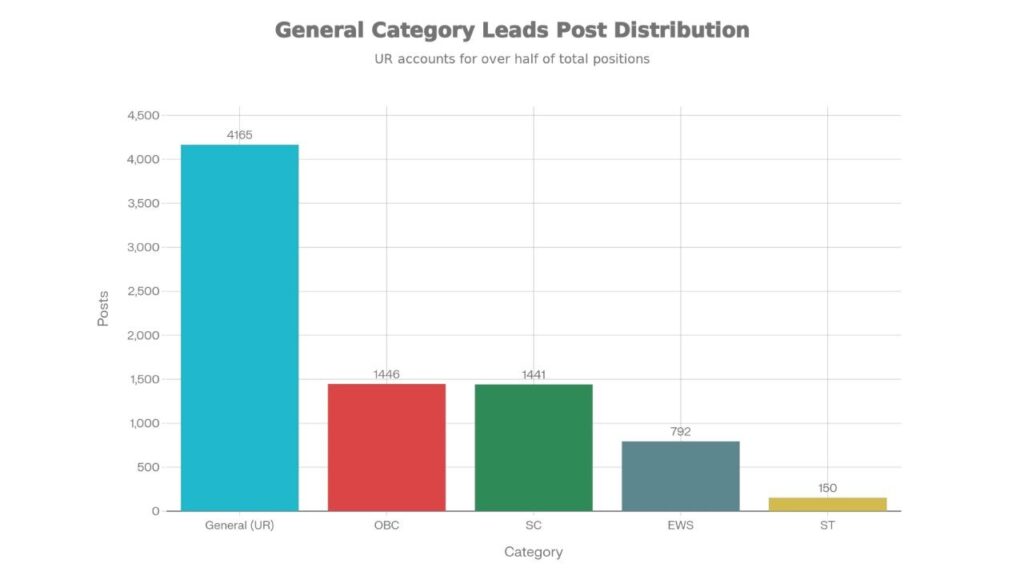
Knowing the rival is the first step. The commission has made available a clear breakdown of the 7,994 seats for various categories. Look out the chart whether you are from the General category or seeking a reservation? Here is the breakup of posts: 

Vacancy Breakdown For Lekhpal

Distribution for UPSSSC Lekhpal in a Category-wise

Firstly, the General (UR) Category is on the top with more than 4000 seats and then there is an almost equal split between OBC and SC candidates. This huge number of vacancies will make the cutoff competitive yet manageable with good preparation.  

Are You Eligible?

Before you hurry to the cyber cafe or switch on your laptop, let us confirm your eligibility. The rules are simple but hard:

Educational Qualification: The candidate should have completed 10+2 from any recognized board.

Top PET Requirement: And this is the most important part. You must hold a valid score card from UPSSSC PET 2025. The Mains exam will be short listed solely on your PET 2025 normalised score. 

Read More:- Best Courses for Business Analyst: Learn, Certify & Grow

How to Apply For UPSSSC Lekhpal Online

  1. Visit the official website of UPSSSC Lekhpal Online
  2. Click on the live notice link of Lekhpal recruitment.
  3. Sign in with your PET 2025 Registration Number. Most of your details will be auto-filled.
  4. Post your recent passport size D.O.B. & signature if not already posted.
  5. Make the application processing fee of ₹25.
  6. Apply and keep a print out of the form for future reference. 
Useful Links
Apply OnlineClick Here
Download NotificationClick Here
Official WebsiteClick Here

How To Prepare Current Affairs For Government Exams: A Complete Strategy

Current Affairs

Ask the former aspirants who cleared government exams about how they cracked the current affairs section, and they mostly advice to apply ‘read less and revise more’ strategy. While you are already dealing with tons of syllabus, don’t bother yourself with a question on How To Prepare Current Affairs for Government Exams because here you are going to understand what to cover, what to leave, and where you get to revise. 

Do not follow all at once such as daily newspapers, three YouTube channels, two monthly magazines, and a Telegram channel that posts forty notifications a day. By month three, you’re going to feel exhausted and still can’t recall what happened in January. Your memory is fine but processing information in the right way can be great.

This guide breaks down exactly which government exams test current affairs, what topics actually carry weight in each, and how to build a Current Affairs Preparation routine that survives contact with a real exam hall.

Which Government Exams Include Current Affairs?

Competitive Exam Current Affairs is not a field or a subject, it’s tested in every major government exam. The weightage and style of questions differ, but focus on updated events, schemes and development across India. These major exams have 

ExamSection NameApprox. Weightage
UPSC Civil Services (Prelims & Mains)General Studies (woven throughout)30-40% indirectly
SSC CGL / CHSL / MTSGeneral Awareness20-25 questions
IBPS PO / Clerk, SBI PO / ClerkGeneral Awareness (Banking & Static)40-50 questions (Mains)
RRB NTPC / Group D / ALPGeneral Awareness15-20 questions
State PCS (UPPCS, BPSC, etc.)General StudiesSignificant, scattered
UPSSSC (PET, Pharmacist, etc.)General Knowledge10-15 questions
Judiciary Exams (RO/ARO, court assistants)General KnowledgeModerate
NDA / CDSGeneral KnowledgeModerate
Teaching Exams (CTET, state TET)General Awareness (some states)Low-moderate

Notice the pattern: banking exams lean heavily on financial and economic current affairs, railway and SSC exams favor sports, awards, and government schemes, while UPSC and State PCS demand depth — they want you to connect a news event to its policy background, not just recall a date.

Read More 👉 SSC vs UPSC: The Ultimate Showdown for India’s Most Demanding Government Job Exams

Important Current Affairs Topics for Each Exam Type

1. UPSC Civil Services

  • Government schemes and policies (objectives, implementing ministry, budget allocation)
  • India’s relations with Foreign countries and organizations 
  • Updated Union Budget keypoints and Economic Survey
  • Environmental updates in India and national missions
  • Science and technology developments that affect government policies 
  • Global ranking and reports on hunger and development

2. SSC (CGL, CHSL, MTS)

  • Sports events, tournaments, and award winners
  • National and international days with themes
  • Important appointments (government and international bodies)
  • Books and authors released recently
  • New missile or mission under defence latest information
  • Connecting current events with static GK to expand your knowledge.

3. Banking Exams (IBPS, SBI)

  • RBI policy updates like repo rate changes 
  • New initiatives like digital banking in Banking that are in the news 
  • Latest financial schemes updates by the Government 
  • Large and new businesses updates in the news and how it impact on economic 
  • Basic rules of banking and new schemes on financial investments 

4. Railways (RRB NTPC, Group D, ALP)

  • Railway specific news including launch of new train, recent events and expansions 
  • Sports like cricket, football and olympics and their winners
  • Noble prizes, national films award and Padma
  • Government scheme names and launch details

5. State PCS and UPSSSC Exams

  • Budget news and new State government schemes updates
  • Current event and officers at state-level department
  • National news about the schemes that impact central departments
  • Cultural and heritage-related news tied to the state

Pro tip: State level exams are highly focused on state-specific news. Preparing current affairs which involve the state’s national policy that are going to affect the specific state is non-negotiable.

Read More 👉 Meet the Best Current Affairs Teacher for SSC CGL Who Can Boost Your Score

How to Prepare Current Affairs for Government Exams

This step-by-step Current Affairs Study Plan will help you understand how to cover Competitive Exam Current Affairs without loading too much on your head.

Step 1: Pick One Primary Source, Not Five

Getting information from too many sources that just repeat the same current affairs in different formats can confuse you. Stop making this mistake and choose only one verified source like a daily newspaper of Indian Express for UPSC/PCS aspirants; any standard Hindi daily like Dainik Jagran works fine for SSC/Railway-level prep and one monthly compilation magazine. That’s it. Stop adding more.

Step 2: Make Notes the Same Day, Not “Later”

Stick those relevant news cuttings from the daily newspaper in notebook or register so you don’t have to write it over, just highlight points to keep it remembered. When you open it daily for just 30 minutes, your mind captures one-line entries easily. So write them under categories: Schemes, Appointments, Awards, Sports, International, Economy. 

Step 3: Keep Revising for Competitive Exam Current Affairs

Do not just stick or write them in a notebook and wait to open them before the exam. You must give 15-30 minutes daily or one hour every Saturday to revise the entire week’s notes. So you get familiar with the events and schemes that will make you remember eventually.

Step 4: Use Monthly and Yearly Compilations Strategically

Don’t wait to read magazines 30 days before the exam. Instead, use them to fill gaps — if you’ve been making weekly notes consistently, the monthly compilation becomes a quick cross-check rather than a fresh reading exercise. Prepare your Competitive Exam Current Affairs with consistency.

Step 5: Practice with Quizzes, Not Just Reading

Reading creates familiarity; quizzes create recall. Attempt daily or weekly current affairs quizzes from a reliable source related to your specific exam. This forces active retrieval, which is what you’ll need under exam pressure, not passive recognition.

Step 6: Link News to Static GK

High-scoring aspirants don’t treat current affairs and static GK as separate boxes. If a new dam project is in the news, they revise the river system around it. If a country’s Prime Minister is in the news for visiting India, they quickly revise that country’s capital, currency, and basic facts. This linking technique multiplies the value of every current affairs item you read. That’s how they did Government Exam Preparation.

A Realistic Daily Time Allocation

  • Newspaper reading and note-making: 30-40 minutes
  • Quiz practice: 15-20 minutes
  • Weekly revision (once a week): 60 minutes

That’s roughly 45-60 minutes a day. If you’re spending more than that on current affairs alone while neglecting your core subjects, you’re over-investing in a section that, for most exams, carries less weightage than reasoning, quantitative aptitude, or your optional subjects.

Read More 👉 IIT vs NIT: Which Is Better for Placements, Curriculum & Career Growth?

Conclusion 

If you are panicking while thinking about how to prepare Current Affairs for a government exam then do not worry because this guide will help you understand where to focus and where to leave. Government Exam Preparation isn’t about who reads the most; it’s about who retains and recalls the most under exam conditions. 

Choose one source of News for Current Affairs Preparation and make notes. It is a way to keep your mind remembering without pressuring it too much. Revise it once a week and connect news to static facts. Keep doing this until you enter the exam hall with a current affairs section that feels less like a guessing game and more like familiar territory. 

Scroll to Top