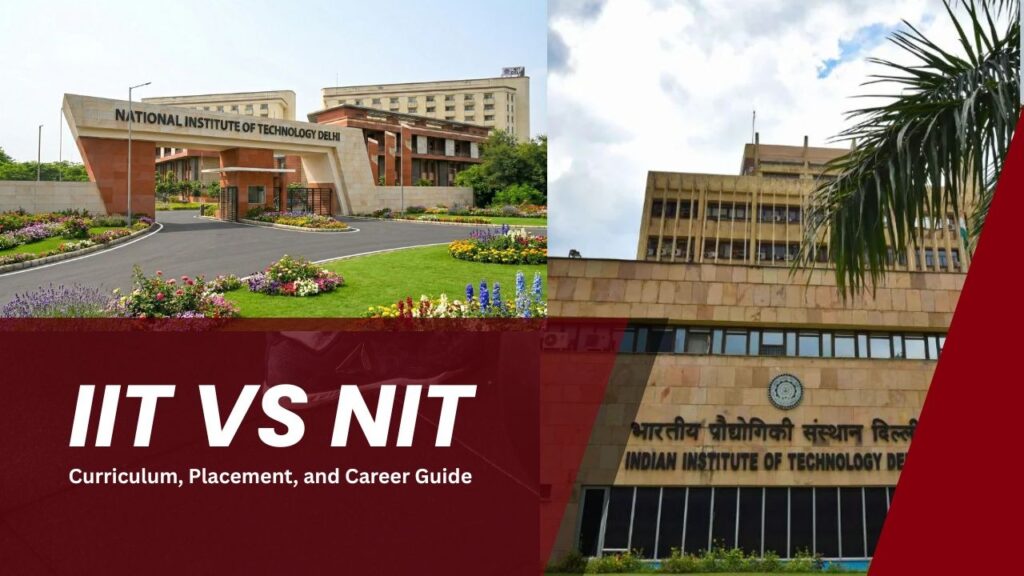
IIT vs NIT: Which Is Better for Placements, Curriculum & Career Growth?

IIT vs NIT

Let’s start with the thing nobody says out loud — your branch matters more than your college tag. A Computer Science student from NIT Trichy will almost always out-earn a Mechanical Engineering student from IIT Roorkee in the first five years. If you’re comparing IIT vs NIT without first locking down your branch and domain, you’re solving the wrong problem.

The IIT vs NIT debate is real and the differences are meaningful. Here’s what actually separates them.

Understand The Value of IIT and NIT

IITs carry a premium that opens doors before you even speak. Walk into a Goldman Sachs or Google recruiter’s room with an IIT stamp and you clear the resume filter automatically. NITs don’t have that reflex recognition globally, though the top five — Trichy, Warangal, Surathkal, Calicut, and Allahabad are well-respected domestically.

But here’s what this advantage actually means in practice: it gets you the interview. After that, you’re on your own. IIT students who coast on the brand tag get filtered out just as fast as anyone else. The brand buys you roughly one extra shot — use it well or waste it.

For postgraduate studies abroad, IIT carries more weight than NIT with foreign universities, especially in the US and Europe. If a master’s or PhD is your goal, this gap genuinely matters.

Curriculum is Almost Same For Both

Both systems run four-year B.Tech programs under roughly similar structures — core engineering subjects in years one and two, specialisation from year three, electives and projects in year four.

IIT vs NIT Comparison on Research Environment

The real curricular difference isn’t the syllabus on paper — it’s the research environment. IITs have substantially more funded research labs, active PhD programs, and faculty who are publishing in international journals. If you’re the kind of student who wants to do undergraduate research, intern in a faculty lab, or co-author a paper, IIT is genuinely the better environment. The infrastructure isn’t comparable.

NITs, particularly the older and larger ones, have improved their lab facilities significantly over the last decade. But the research culture at most NITs remains thin. The focus is largely on getting students job-ready — which is not a criticism, just a different orientation.

One underrated advantage at many NITs: smaller competition pools. At some IITs, particularly the newer ones established post-2008, the facilities are not significantly better than top NITs, but the peer competition and internal politics are fiercer. At a top NIT, you can more easily stand out, take leadership roles, build a visible profile, and walk into placements as a known quantity.

Read More 👉 What Is Distance Education? Benefits, Learning Programs, and Career Opportunities

IIT and NIT Admission Process

JEE Main and JEE Advanced are not the same exam. This distinction trips up more students than any other part of the process.

JEE Main is the entry point for NITs. It’s conducted by NTA — National Testing Agency — typically twice a year, in January and April. You appear, you get a percentile score, and that percentile determines your rank. The top 2.5 lakh candidates from JEE Main qualify to sit JEE Advanced. NIT admissions happen through JoSAA counselling using your JEE Main rank.

JEE Advanced is the second, harder exam that gates IIT admission. Clearing JEE Main doesn’t mean you’re close to an IIT seat — it means you’re eligible to try. In 2024, roughly 1.8 lakh students appeared for JEE Advanced. Around 48,000 qualified. Total IIT seats across all 23 IITs are approximately 17,000. The math is brutal.

For NITs, total available seats across 31 institutions are around 23,000 — nearly 40% more seats than IITs, spread across more institutions and more states.

1. The cutoff reality nobody frames honestly: Getting into IIT isn’t one bar — it’s dozens of bars stacked by branch, category, and institute. A General category student needs roughly AIR under 100 for CS at IIT Bombay or Delhi. AIR under 2,000 gets you CS at a newer IIT. AIR under 5,000 might land you Mechanical or Civil at a mid-tier IIT. Meanwhile, NIT Trichy CS closes around JEE Main AIR 500–800 for the General category genuinely competitive, but on a different scale of difficulty.

2. State quota is NIT’s hidden advantage. 50% of NIT seats are reserved for students from the home state. If you’re from Tamil Nadu, your NIT Trichy odds are structurally better than an out-of-state competitor with a higher rank. IITs have no state quota, every seat is All India. This sounds fairer. It also means every seat is more contested.

3. The year-drop calculation. Roughly 35–40% of IIT aspirants drop a year after Class 12 to improve their JEE rank. At Kota coaching centers, repeat batches are larger than fresh batches in most institutes. The question nobody asks before dropping: what’s your realistic rank improvement ceiling, and is the branch you’d access after dropping actually better than what you can access now? Most students who drop are chasing a brand, not a branch. That’s the wrong reason.

4. JOSAA Counselling is where seats are actually allocated. After both exams, IIT and NIT admissions run through a single joint counselling platform — JOSAA. You fill preferences in order, locks run in rounds, and seats fill from the top. There are typically six rounds, with seat upgrades possible in later rounds if a better preference opens up. Freezing too early or not understanding the upgrade system costs students better seats every year.

It’s around 10–15% of initially allotted seats go vacant or are surrendered before final lock-in, which means students who stay active through all rounds often access seats that weren’t available in round one. Most students abandon the process after round two. Don’t be that student.

Institute(s)Typical CS AIR range (General)
IIT Bombay / IIT Delhi1–100
IIT Madras / IIT Kanpur / IIT Kharagpur100–400
Remaining older IITs400–1,500
NIT Trichy / NIT Warangal500–1,200
NIT Surathkal / NIT Calicut1,200–3,500
Newer IITs1,500–5,000

IIT and NIT Difference in Placements

IIT placement averages are inflated. Median packages matter more than the maximum, and those Rs. 1.5 crore headlines you see are almost always international offers that convert at absurd rates rarely representative of what most graduates earn. The honest median domestic CTC at most IITs in CS ranges from Rs. 18–30 LPA for the class of 2024. That’s excellent. But it’s not a different universe.

Top NITs in CS — Trichy, Warangal, Surathkal are seeing domestic medians between Rs. 12–22 LPA. The gap exists. But it’s not a lifetime gap.

IIT vs NIT salary packages? core vs software. If you’re in a non-CS branch, IIT placement networks have more depth in core engineering — PSUs, defence contractors, manufacturing than most NITs. But if you’re going into IT, FAANG, or fintech, the brand premium on the offer letter is smaller than students expect.

One thing NITs do well: mass recruitment. Companies like TCS, Infosys, Wipro, and Cognizant recruit heavily from NITs. If you’re okay with a service-sector start, NIT gets you employed efficiently. IIT students often hold out for better offers which work when it works, but adds uncertainty.

Read More 👉 Online or Offline Coaching Which is Better For You? 

Higher Studies and Alternative Exits

Which is better IIT vs NIT? The answer is not that simple. IIT to IIM or IIT to top MS programs abroad is a well-worn path with strong alumni networks actively supporting it. The IIT alumni ecosystem — particularly for IIT Bombay, Delhi, Madras, and Kharagpur functions as a career accelerator that NIT alumni networks simply don’t match at scale yet.

GATE scores change this calculation slightly. NIT graduates who crack GATE with high scores can access IIT M.Tech seats, effectively re-entering the IIT ecosystem. This is a legitimate strategy that many NIT students use and it works.

For entrepreneurship, the IIT brand helps with early investor trust. It shouldn’t matter, but it does if an IIT founder gets a longer initial conversation. The IIT incubators also have more funding, better mentorship networks, and stronger Venture Capital connections.

Which is Better in IIT vs NIT?

Stop asking “IIT vs NIT” and start asking these:

Which branch at which college? An IIT seat in a branch you dislike will hurt you more than a NIT seat in a branch you’re good at.

What is your exit? Software job, core engineering, MS abroad, MBA, research, startup — each has a different answer.

Which specific NIT? NIT Trichy is not the same institution as NIT Agartala. Treating all NITs as one category is the most common mistake in this comparison.

What are your GATE/CAT plans? If higher studies are likely, the IIT tag matters more. If you’re going straight into industry in India, the top NITs compete seriously.

Conclusion

IIT wins on research environment, global brand, alumni network depth, and higher-studies outcomes. NIT wins on accessible entry, focused placement infrastructure for domestic jobs, and the underrated advantage of being a bigger fish in a smaller pond. 

Neither is a wrong choice. The wrong choice is picking based on brand alone and ignoring branch, location, faculty quality, and what you actually want to do after graduation. Both IIT vs NIT deliver the same curriculum with different environments and futures.


Leave a Comment

Your email address will not be published. Required fields are marked *

CBSE vs State Board: Choose the Right Board For Primary Education

Comparison of Different Boards

Educational boards have different advantages and disadvantages for students in India. Schools are the first stage for students to build their knowledge and shape their minds for a career. A student’s entire future depends on it. If you are a parent or educator then you must understand that when it comes to the classic debate of CBSE vs State Board, there is no one-size-fits-all answer.

There are factors including a student’s learning style, future goal, or central/state opportunities which can help you to decide the right one. So, let’s walk through this guide which explains the core differences between CBSE and State Board to help you make the right decision.

What is The CBSE Board?

CBSE offers a standard curriculum for students, schools authorized by CBSE board offer the same syllabus whether it is in Mumbai or Lucknow. This is best for students who change their cities frequently, so their studies won’t be disturbed. It is managed under the Union Government and heavily focused on Science and Mathematics. Schools offer both medium English and Hindi.

What is a State Board?

In India, every state has its own educational board for schools. The curriculum is designed to have one state’s language along with English as the primary language. For example, Hindi/Sanskrit in UP board and Marathi in Maharashtra board. It is focused heavily on the state’s geography, history, culture with leaning more towards science and mathematics. 

Best board for students who are aiming for state-level government exams or jobs. The lessons are also easy and point-to-point that will help students to easily understand their topic within less time.

Core Differences in CBSE vs State Board

To understand which board is better, we need to compare them across several critical parameters.

1. Curriculum and Syllabus

CBSE: The syllabus has been designed considering NCERT curriculum which is more inclined towards integrated theory and practical aspects. Students who have high level of analytical thinking can easily handle the CBSE syllabus as it is not based on rote learning. 

State Board: They punch a lighter syllabus but are heavily skewed towards a local language, history and geography. That curriculum would not be gone into with the same depth in CBSE.

2. Difficulty Level and Grading

CBSE: The exam structure is tough and built to test students’ reasoning skills. Scoring basically depends on continuous and multiple exams in a year which reduces the pressure of a single final exam. overall difficulty level is high in CBSE board for students. 

State Board: Traditionally, this has come down to relatively simple calculations and memory-based tests. The end of year board examination is the most important one. In general, students consider that it is simpler to get high marks in the State Board exams as questions are more direct. 

3. Alignment with Competitive Exams

If student wanted to make their career in government sector then choose accordingly. 

CBSE: If the goal is to crack national-level entrance exams like the JEE or NEET as these are the biggest exams for engineering and medical students, CBSE board students have advantage because their exam curriculum are same as students’ high school syllabus. 

If student is thinking about central government jobs like IRS or defence job, the analytical foundation built by CBSE gives them a distinct edge.

State Board: State boards are excellent if the target is state-level engineering and medical entrance exams (like UPSEE or MHT-CET). They are also highly beneficial for state civil services exams, as the localized curriculum provides a strong base in regional general knowledge.

4. Extracurriculars and Holistic Development

CBSE: There is an active promotion of academic and non-academic activities by the board. The majority of the CBSE schools possess strong infrastructure in sports, arts, and debate and consider them as part of the curriculum. 

State Board: It’s all studied-based. There are some extracurricular activities, but these are generally subordinate and become dependent on the management of the particular school and what they can provide. 

Read More:- Skill Development Courses For Indian Students

Which Board Should You Choose?

The decision ultimately boils down to what you envision for the student’s future.

Choose CBSE if:

  • You are moving all over India because of your parent’s job.
  • The student is targeting national-level exams (JEE, NEET) or central government jobs.
  • You need a syllabus that’s focused on concepts and their application, and not on memorising.
  • You want the best of both worlds, academically and extra-curricularly with the extracurricular side not taking a back seat. 
  • You are looking for a balanced approach with equal focus on extracurricular development.

Choose State Board if:

You live in one state permanently and have no intention of moving. 

The student intends to enter the civil service, but only in that particular state. 

You want the student to be well versed in regional languages and local customs.  

The student is involved heavily in passions outside of school (like competitive sports or music production) and needs a more forgiving academic schedule.

Conclusion

No board is naturally “best” or “worst.” They are just for different uses.

The CBSE board reigns supreme for national competitiveness and standardized pan-India education. It equips students for the tough national exams and is very analytical in its method of teaching. hly analytical approach to learning.

State Boards provide a localized, accessible, and culturally relevant education. They tend to be more flexible, granting students additional time to partake in outside activities or to prepare for opportunities at the state level. 

Evaluate students’ strengths, talk about their long-term objectives and what board is best suited for their individual path. Choose the right one over the best. 

Leave a Comment

Your email address will not be published. Required fields are marked *

SSC Exam Calendar 2026–27: Complete SSC Exam Schedule

SSC Exam

If you’re a hopeful civil servant or job seeker looking for government employment, consider the SSC Exam Calendar 2026–27 as your BFF. It’s your personal schedule that tells you when to study, when to apply, and when to take your exams. The Staff Selection Commission has been released by the Staff Selection Commission 8th January 2026 we’ll decipher every minute detail for you in the simplest way. 

The SSC Calendar acts as your guide-walking tool on your government job journey, It informs you about the dates for release of notifications, when you can submit the online applications, the last date to submit applications, and most importantly, the date on which you have to appear in exams. The government issues over 80,000 vacancies every year at different levels (10th pass, 12th pass, and graduation), so missing even one crucial date could mean the loss of a golden opportunity. 

SSC Exam Calendar 2026: Notifications Come Out?

Different SSC exams have different dates. It began in March 2026 exams like Combined Graduate Level (CGL), Junior Engineer (JE), selection post phase-XIV release their notifications. If you’re applying to these, watch for March 2026. 

In April, there will be notifications for other popular exams such as the Combined Higher Secondary (CHSL), Stenographer, and Junior Hindi Translators (JHT).

Aspirants who are looking for Multi-Tasking (Non-Technical) Staff and Havaldar posts should wait for June 2026. In the meantime, there will be a Notification for Sub-Inspector (SI) Delhi Policy/CF in May 2026. 

Complete SSC Exam Schedule

Exam NameNotification MonthApplication Deadline
JSA/LDC Grade Limited Departmental Exam, 202516/March/20267/April/2026
SSC CGL 2026March/2026April/2026
Junior Engineer—JEMarch/2026April/2026
Selection Post Phase-XIV 2026March/2026April/2026
SSC CHSLApril/2026May/2026
SSC Stenographer Grade C & D April/2026May/2026
SSC Combined Hindi Translators April/2026May/2026
SSC—MTS & Havaldar June/2026July/2026
SSC Central Police OrganisationMay/2026June/2026
SSC GD Constable September/2026October/2026

When Will the SSC Exams 2026 Actually Happen?

The CGL exam, which comes under the most desired post in the SSC, will be held from May to June 2026. For those seeking to begin an engineering career, the Junior Engineer test is also conducted in May to June 2026. Candidates looking at CHSL (Combined Higher Secondary) level may expect it around July – September 2026.

The recruitment for Constables in CAPFs will surely be at the end, Exam dates in January to March 2027, so that will be among the last exams in this series. 

Stenographer and Hindi Translator (For words and typing speed per minute refer point 8 of ADD2) are also scheduled on August to September 2026. The Multi-Tasking Staff and Havaldar posts, which students eagerly flock towards, will hold examinations between September to November 2026. And if you are eyeing the Sub-Inspector post in Delhi Police or CAPF, you should be ready for October to November 2026. 

Read More 👉 Railway RRB Technician Exam Date 2026: CBT Schedule & Latest Updates

Ongoing SSC Exams 2026

There are a few exams în progress or are about to commence. The Delhi Police Head Constable (Ministerial) exam was conducted between 7th to 12th January 2026 and Delhi Police AWO/TPO exam was held from 15th to 22nd January 2026. The eagerly awaited SSC CGL Tier-II exam was held on 18 and 19 January, 2026. Starting from 4th February 2026, the SSC MTS exam is now in progress and recruitment for the post of SSC GD Constable has also begun from 23rd February 2026. 

Delhi Police Head Constable07—12/January/2026
Delhi Police AWO/TPO15—22/January/2026
SSC CGL Tier-II18 and 19/January/2026
SSC MTS04 / February / 2026
SSC GD Constable23 / February / 2026

Application Process Date For SSC Exams 

Usually, there is about a one month period from the release date of the notification to the last date for submitting an application. So when the notification comes out, don’t procrastinate! Register immediately, these deadlines are firm and you won’t get extensions because you forgot. Mark those days on your calendar, set your phone alarms and be sure to send before time runs out. 

Conclusion

The SSC Exam Calendar 2026 – 2027 is not only a timetable, it is your strategic planning guide. As there are many examinations conducted in a year, you can get a number of chances to get a dream government job. Maintain your organization and concentration and keep in mind that Every successful SSC aspirant was a Calendar-junkie. Take it along with you everywhere and success will be waiting for you. The official schedule can be downloaded from the SSC website at ( ssc.gov.in ) for more information. 

Download Official SSC Exam Calendar 2026

Download Calendar Click Here
Official WebsiteClick Here

Leave a Comment

Your email address will not be published. Required fields are marked *

CBSE Group A, B & C Admit Card 2026 Download Link, Exam Date

CBSE Group A, B & C Admit Card

Central Board of Secondary Education (CBSE) is going to hold the Group A, B & C Tier-1 examination for various posts including Racing Officer, Assistant Secretary, Assistant Director, Accounts Officer, Junior Translation Officer, Junior Accountant, Junior Assistant, Assistant Professor and Superintendent. From 31 January 2026 To 01 February 2026. Candidates who will qualify the examination will be recruited for these posts as per the final result to be declared by CBSE. 

In December 2025, the application form was filled and candidates who are waiting for the exams can now check their admit card. If the link is still not open then check again after a few hours on the official website of cbse.nic.in

To download these, candidates will need the Application Number and Date of Birth. And no need to carry the exam hall ticket after downloading it for the exam. 

CBSE Group A, B & C Important Dates

EventDate
Notification Date02/December/2025
Application Start02/December/2025
Apply Online Last Date27/December/2025 (Extended)
Fee Payment Date27/December/2025
Correction Date29 & 30/December/2025
Exam City Date (Tier-1)17/January/2026
Admit Card Date (Tier-1)Before Exam
Exam Date (Tier-1)31/January/2026 to 01/February/2026
Result DateNotify Later

CBSE Group A, B & C Recruitment – Age Limit

CriteriaDetails
Minimum Age18 Years
Maximum Age27 / 30 / 35 Years (Post-wise)
NoteFor detailed age relaxation rules, read the official CBSE Notification 2025

Group A Posts – Vacancy & Eligibility

Post NameVacanciesStudy
Assistant Secretary08Undergraduate Required
Assistant Professor & AD (Academics)12PG Degree (55% marks) or equivalent from a recognised university (category-wise relaxation applicable)
Assistant Professor & AD (Training)08PG Degree or equivalent from a recognised university
Assistant Professor & AD (Skill Education)07PG Degree or equivalent from a recognised university
Accounts Officer02Graduate/postgraduate in Economics, Commerce, Accounts, Finance, Business Studies or Cost Accounting or any other professional qualification like MBA (Finance), CA, ICWA. 

Group B Posts – Vacancy & Eligibility

Post NameVacanciesStudy
Superintendent27Bachelor’s degree in any discipline having basic knowledge of computer and typing speed 35 WPM in English or 30 WPM in Hindi. 
Junior Translation Officer09PG Degree in Hindi or English or equivalent

Group C Posts – Vacancy & Eligibility

Post NameVacanciesStudy
Junior Accountant16Intermediate Marksheet; Necessary Subjects including Accountancy / Commerce / Economics / Business Studies / Finance with good typing speed
Junior Assistant35Intermediate Marksheet; speed of typing should be 35 WPM in English or 30 in WPM in Hindi. 
CategoryGroup A PostsGroup B & C Posts
Gen / OBC / EWS₹1750/-₹1050/-
SC / ST / ESM / PH / All Female₹250/-₹250/-
Total Posts124

Read More 👉 RBI Bank Office Attendant Recruitment 2026: Notification, Apply Online & Details

CBSE Group A, B & C Admit Card 2026 Download 

How To Download Your CBSE Group A, B & C Admit Card 2026?

1. Visit the official CBSE website or tap on the direct link given below.

2. Search and click on the link for CBSE Group A, B & C Admit Card/Hall Ticket 2026 Download.

3. Fill in your Application Number and Date of Birth in the given column.

4. Press “Submit”.

5. Your admit card will be displayed on the screen. Save it or take a print out for future reference.

6. Bring with you a hard copy of your admit card and a valid photo ID when you appear for the examination and submit the same at the examination centre. 

Apply nowClick Here
Admit CardLink Activate Soon
Official WebsiteClick Here

Leave a Comment

Your email address will not be published. Required fields are marked *

BSNL Recruitment 2026: Apply Online for 120 SET Vacancies, Eligibility & Full Details

BSNL Recruitment 2026

Bharat Sanchar Nigam Limited (BSNL) has been releasing multiple vacancies for various posts under its BSNL Recruitment 2026 notification and it is a very good opportunity for the young and energetic candidates to apply for this largest Telecom PSU of the country. The news has created a wave of excitement among the job seekers across the nation, and for those who were waiting to take their first step into the industry, they can’t get a better opportunity.

BSNL, the Indian state-owned telecom company has released a notification for Senior Executive Trainee (SET) Recruitment 2026. There are a total of 120 prestigious vacancies to be filled by professionals. The last date to submit an application for this job is 15 April 2026.

Dates For BSNL Recruitment 2026

EventDate/Details
Notification release29/January/2026
Application start05/February/2026
Last date to apply15/April/ 2026 (extended)
Application correctionAround April 8–23, 2026 
Exam dateTo be notified later

Breaking Down the Vacancies

Let’s get down to the numbers, because that’s really what matters when you’re plotting your career move. Out of 120 posts, 95 posts are reserved for Telecom Stream and 25 posts for the Finance Stream. The category wise distribution goes like this: 51 general, 31 OBC, 18 SC, 9 ST and 11 for EWS candidates.

StreamVacancies
Telecom95 
Finance25
Total120 

What makes this BSNL Recruitment 2026 all the more interesting is that BSNL has unequivocally given preference to technical knowhow – nearly 80% of the posts are in the telecom operations domain, underscoring the firm’s commitment to ramp up its core infrastructure and services. 

Eligibility Scale

For Telecom Stream A full-time B.E/B.Tech with minimum 60% marks in the following related disciplines is required: Electronics and Telecommunication, Electronics, Computer Science, Information Technology, Electrical, Instrumentation. The essential point being “full-time”; a distance learning degree or part-time degree is not acceptable. 

The Finance Stream, too, is very specific: you must be an ICSI member, in other words, a qualified Chartered Accountant (CA) or Cost and Management Accountant (CMA). This is no compromise either.

You should be between 21 and 30 years of age as on March 7, 2026. Apart from this, if you belong to reserved categories, you are allowed some relaxation: 3 years for OBC candidates, 5 years for SC/ST candidates, and 10 years for Persons with Benchmark Disabilities (PwBD). The exact duration depends on their category. 

How Much You Can Earn?

Selected candidates will receive according to the IDA E-3 pay scale with the pay ranging from ₹24,900 to ₹50,500 per month. Add into the mix House Rent Allowance (HRA), Dearness Allowance (DA), Travel Allowance (TA), and a variety of other perks for which PSUs are renowned and it is a very tempting salary package when you add the job security and work-life balance of the job. 

The Selection Process

BSNL is not giving these posts on a platter. The process is stringent and intended to select the best. This is how it is done:

  • Initially, you will appear in a Computer Based Test (CBT) containing 200 multiple choice questions for 3 hours. 
  • It is a two part test: a general aptitude test containing 40 questions and a technical or finance knowledge test having 160 questions, this depends on your stream. 
  • Candidates who are guessing blindly can face the deduction of 0.25 marks if their guess will go wrong so it may not be the best strategy. 
  • You must achieve Minimum 45% marks in each section and 50% marks overall if you belong to the General Category. Candidates from other categories need 35% in each section and 45% overall is enough to pass the exam. 
  • If you clear the written exam, you will be called for document verification and medical examination. 
  • Clear all these hurdles, and you’re in but with a condition. There is also a boundation that you must serve 2 year probation and 5 year service period.

Step-by-Step Guide to Apply

  1. You can find the link of application process on BSNL Official Website. 
  2. Register with your valid email ID and mobile number.
  3. Enter all your details (Personal and Education) correctly, even a single error can cost you the chance.
  4. Upload your photo, signature, you require certificates
  5. General/OBC/EWS candidates should pay a fee of ₹2,500 and SC/ST/PwBD candidates are exempted from half the application fee i.e. ₹1,250. 2,500 online.
  6. Submit and download or print your Print off your records, and any evidence of submission for your application to keep safe. 

Read More:- SSC vs UPSC: The Ultimate Showdown for India’s Most Demanding Government Job Exams

Conclusion

BSNL Recruitment 2026 is a golden chance for the candidates who want to make a good career in the infrastructure of India. With 120 vacancies, the National Company Law Appellate Tribunal (NCLAT) is inviting applications from freshly graduated engineering and CA/CMA professionals who are looking forward to a career-building or establishing job in the public sector. The application deadline has been extended to 15 April 2026, plenty of time to get ready.

Ensuring that you have all the paperwork and documents in order Getting your technical skills ready up to scratch Getting yourself comfortable with the CBT (Computer- Based Test) format Remember, preparation is key if you want to ace the exams. 

For those who are looking to start their career in the Indian Telecom industry, especially BSNL,then it is recommended to visit this official site. Get the Latest Notification for knowing about BSNL Recruitment 2026 Procedure of Application and eligibility criteria. Making that initial move might lead to a bright future in the industry.

Leave a Comment

Your email address will not be published. Required fields are marked *

HPSC Recruitment For PGT Post Graduate Teacher (PGT) Computer Science 2026

HPSC Recruitment

The HPSC Recruitment for 2026 Post Graduate teacher (PGT) Computer science Vacancy is out. There are a total of 1,672 posts and the process of application is going on. Those interested in this job can apply on-line from 16/February/2026 to 09/March/2026. Here is a golden opportunity  for all the aspirants who want to become a teacher in Haryana. 

Candidates should meet the eligibility criteria as per the HPSC to apply for the Teaching Posts. There is full information regarding eligibility, application fees, exam pattern and selection procedure in the notification. Applicants are advised to go through this notification carefully of HPSC Recruitment to ensure that they meet the eligibility criteria. 

Application Fees of HPSC Recruitment

CategoryFee
General/EWS/OBC₹1,000
SC/BC/PwD/Ex-Serviceman₹250
Females₹250
PH (Divyang)No fee

Schedule For Haryana HPSC PGT Teacher

EventDate
Notification Release5/February/2026
Online Application Start16/February/2026
Application Deadline9/March/2026 
Fee payment deadline9/March/2026

Education Requirement

QualificationDetails
M.Sc. Computer Science2-year regular course 
MCA3-year regular course
BE/B.Tech in Computer Science/ITFrom recognized university, minimum 55% aggregate 

Age Limit

CategoryAge Range
Minimum18 years
Maximum42 years (relaxations apply) 

Application Process

  1. View the Official Notification Or Apply Online: Interested candidates can apply online through the HPSC website.
  2. Now, go to the “Recruitment” section, check and click on the advertisement for PGT Computer Science.
  3. Select the option for Online Registration. Make sure you provide the correct number and DOB for registration in this step.
  4. Then, after registering for an account, you can complete your application form with the necessary details. It includes the details of educational qualification, ID, etc.
  5. Now, make the payment of the application fee as specified in the notification. You need to ensure that you do this step otherwise your application will not proceed further.
  6. After filling the form and making the payment of the fee, you may attach the required documents and submit the application. 

NOTE: Do keep a printout of your application form and payment slip for your reference. 

Read More:- BSc Dialysis Technology: Course Details, Eligibility, Salary & Career Scope

Selection Process and Exam Pattern 

The PGT selection procedure of HPSC Recruitment is meant to be a just and fair assessment through a simple two-tier exam system where your basic knowledge as well as expertise in the subject is tested.

1. Screening Test:

This is the initial level of screening. It combines your general knowledge with rudimentary knowledge of your subject to get rid of the non-serious and non-able candidates.

2. Subject Knowledge Test:

This is the main exam phase. It examines more deeply into your subject and examines what extent your conceptual clarity, understanding and hold of the subject is.

The selected candidates may be called for interview which will be concentrated for personality, communication/interactive skill and teaching aptitude after these written tests. 

Total Questions100 
Total Marks100 
Marking Scheme+1 mark per correct answer (0.25 negative marking in screening test) 

Syllabus for the HPSC PGT Exam

The HPSC PGT syllabus is very well crafted, as it is designed to impart teaching basics along with in-depth subject knowledge, guiding candidates to prepare in a comprehensive and methodical manner. It’s not just a test of what you know—it’s also a test of how well you know teaching.

General Topics (Applicable to all Subject)

These components are designed to focus on developing effective teaching practices:

Educational Psychology: Provides knowledge of how students learn, think, and grow, as well as some significant theories of learning and development.

Pedagogy: Practical teaching techniques, teaching in the classroom as well as learning to learn.

TLM (Teaching-Learning Materials): Related to production, use and management of TLM for efficient and effective classroom learning. 

Subject Specific Knowledge 

Each PGT subject has its own defined detailed syllabus by HPSC which is depth orientated and specialised.

For instance: For example, in Computer Science — Data structures, searching and sorting, algorithm analysis, graph theory getting solid computational and logical foundations.

English: A focus on reading comprehension, critical thinking and analysis of texts is effectively promoted by the syllabus. 

Conclusion

The application for HPSC Recruitment for PGT Computer Science 2026 is expected to be filled with aspiring candidates who wish to establish their career in the teaching field through this Haryana Public Service Commission Teaching jobs. With 1,672 vacancies dealing with a transparent selection process & a well-structured exam pattern, this recruitment serves as the best platform to enter into Haryana education. 

If you qualify for the eligibility and have the enthusiasm to teach, now is your time to take the plunge. Smart Preparation, Strategic Syllabus, brief Application Procedure & Get all Official Notifications. HPSC Recruitment 2026 can be the stepping stone for a bright and safe career in the Haryana’s Education System with hard work and integrity. 

GovUpdatewala is your trusted source for real-time updates on government exams and jobs in India. We provide verified info on SSC, UPSC, Banking, Railways, Defense, and Teaching exams. From syllabus and patterns to important dates and career tips — we support aspirants at every step.

Leave a Comment

Your email address will not be published. Required fields are marked *

Scroll to Top